





The 7 Steps to Analyze Product Reviews From UK Retailers Like Argos and Very

Feedback Analysis
November 5, 2026

To find what customers love and hate about your product across retailers, follow six steps: gather reviews from every retailer listing, read praise as carefully as complaints, categorize every review at the feature level, compare themes by retailer and country, look for use cases you never planned for, and share the result as a one-page brief for marketing, product and retail teams.
The short answer: star ratings tell you how people feel. Feature-level themes, split by retailer and country, tell you why. The why is what your messaging, retail copy and roadmap actually need.
If you sell physical products through retail, your most honest customer signals do not live on your website. They live on Best Buy, Walmart, Argos, MediaMarkt and JB Hi-Fi product pages, written by people who just paid for your product and want the next shopper to know the truth.
And that truth is scattered. One SKU can have a dozen listings across retailers and countries, each with its own story.
So most brand teams end up with a quarterly screenshot deck. A few quotes, an average rating, a vague sense that "people like it." That is a highlight reel, not Customer Intelligence.
The shift: stop treating retailer reviews as a rating to monitor. Treat them as the largest unprompted focus group your brand will ever get, running every day, in every market you sell in.
One product, every listing, every country, in one place.
Love themes are your next headline, product page bullet and retail copy.
"Love the sound, hate the app" is two signals, not one mixed review.
Different shoppers, different expectations, different themes.
Customers tell you new audiences and new campaigns, unprompted.
One page that marketing, product and retail teams can each act on.
Start with a list of every listing for the product: each retailer, each country, each colorway or bundle that has its own page.
Copy-pasting reviews works for one launch. It breaks by the third. Building your own scrapers means maintaining them through site changes and rate limits, and checking each retailer's terms of use. Review those terms and prefer approved or managed routes.
Then put retailer reviews next to everything else customers tell you: support tickets, surveys, returns notes, app reviews. This is how the strongest consumer brands work, as covered in how DTC brands analyze reviews, tickets, and surveys together.
Most review analysis is built for defect hunting. That is half the story.
Praise themes are marketing gold. If hundreds of reviewers say the battery "lasts all weekend," that phrase belongs on your retail product page, in your ads and in your sales training for store staff. Customers have already written your copy.
Track love themes with the same rigor as hate themes: volume, trend and the exact quotes behind them.
A four-star review that says "love the sound, hate the app" is not a mildly positive review. It is a strong positive on audio quality and a strong negative on app setup. Average them and both signals disappear.
Tag every review against product areas and features, and let one review carry multiple themes with their own sentiment. This is the step that turns open-text feedback into measurable insights. Here is what that looks like for an illustrative wireless speaker.
| Feature (illustrative) | What customers love | What customers hate | Who acts on it |
|---|---|---|---|
| Sound quality | "Bass is huge for the size" | Distortion at max volume | Marketing: lead with it |
| Companion app | EQ presets once set up | Pairing fails, setup takes too long | Product: fix onboarding |
| Battery | "Lasts all weekend" | Slow to recharge | Marketing and product |
| Design | Looks premium on a shelf | Fabric marks easily | Product and packaging |
| In the box | Carry strap included | No charging brick | Retail: set expectations in listing copy |
The same product gets a different review story depending on where it is sold. Shoppers at an electronics specialist may write about specs and setup. Shoppers at a mass retailer may write about value and gifting.
Break every love and hate theme down by retailer and by country. When a complaint spikes on one retailer only, check the listing first: the copy, the images, the bundle. Sometimes the fix is a product page edit, not a product change.
Customers will tell you how they really use your product. Picture a speaker designed for parties that keeps showing up in reviews as a white-noise machine for a baby's room. That is a new audience, a new campaign and maybe a new feature request, all in one theme.
Look for clusters of reviews describing a setting, person or job your launch brief never mentioned.
Insight stuck in a dashboard moves nothing. Package it as one page:
Customer Intelligence only works when it sits upstream of every team.
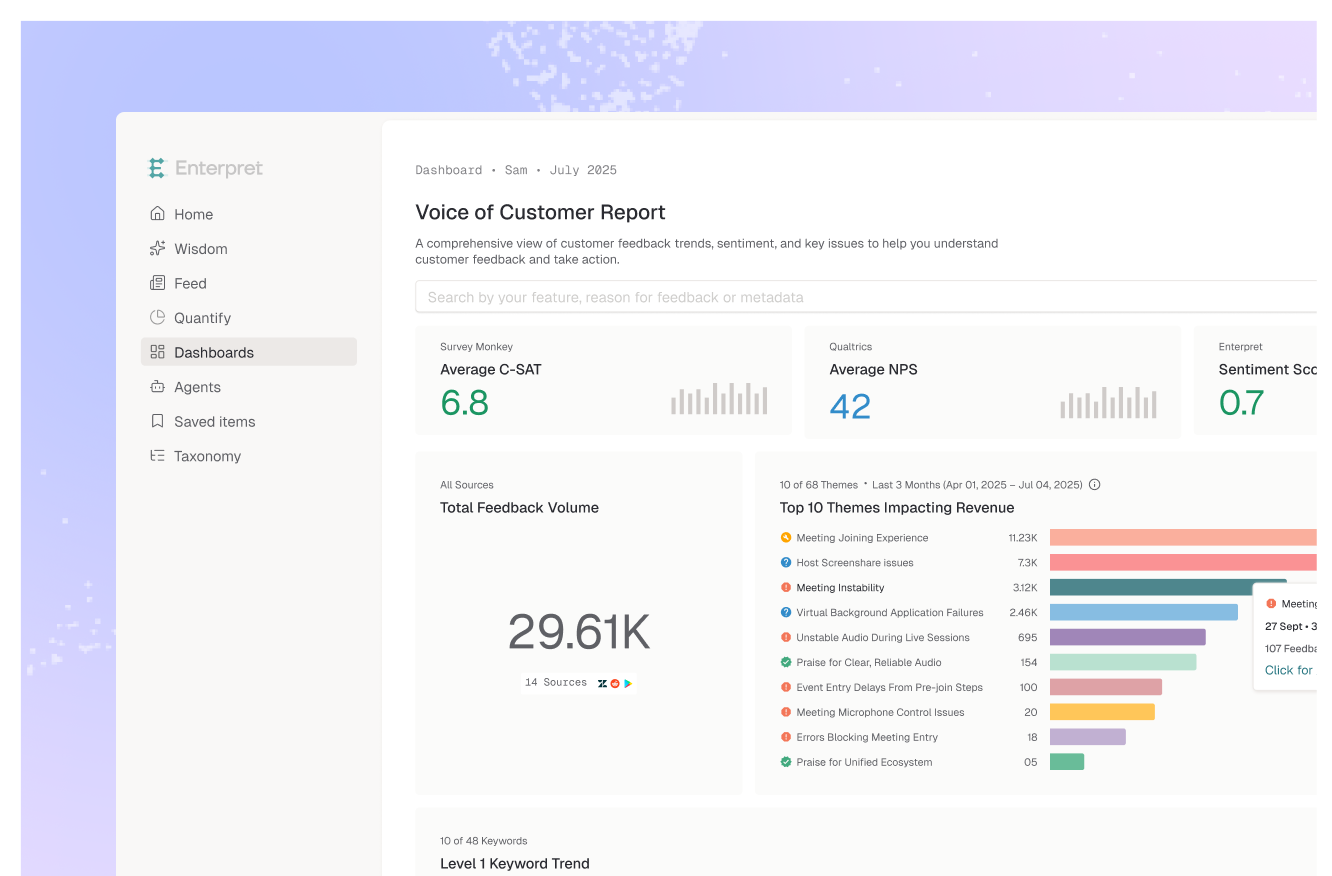
Teams can now bring product reviews from major retailers in the US, Canada, UK, Europe and Australia into Enterpret. Paste product links or product IDs and Enterpret pulls every new review on that product. Supported retailers include Best Buy (US and Canada), Walmart (US), Argos, Very (including Littlewoods), Orange, MediaMarkt (including Saturn and MediaWorld), JB Hi-Fi and the Meta Store.
From there, retailer reviews sit alongside support tickets from Zendesk or Salesforce, surveys, returns notes and app reviews from the Apple App Store and Google Play. Everything is organized by one Adaptive Taxonomy of product areas, features and sub-features that updates as products and SKUs change. That is exactly what makes step 3 work at scale.
You can break any theme down by retailer, product and country. Ask Wisdom a question like "what do UK customers love most about the new speaker?" and get the answer with the exact reviews behind it. Set AI agents and alerts to flag a new hate theme spiking after a launch. Deliver the brief to Slack, Jira, Linear or Notion, or pull it into Claude, Claude Code or Cursor through the MCP server. If you are new to this category, start with what a customer insights platform is.
Picture a smart home brand launching a video doorbell in the US, UK and Australia. Average ratings look healthy everywhere, so nobody worries.
Feature-level themes tell a different story. Video quality is the top love theme in every market, so marketing moves "crisp night video" into the first line of every retail listing. Installation is the top hate theme, but mostly on one retailer, where the listing leaves out that a chime adapter is sold separately. Retail fixes the copy that week. And a cluster of reviews from small business owners using the doorbell for shop entrances becomes a new campaign test.
Same reviews. Three teams. Three actions.
The brands that win the next decade of retail will not be the ones with the highest average rating. They will be the ones that hear every customer, in every market, and act first.
Retailer reviews are moving from a reputation metric to a core strategy input. If you want to see where your team sits on that curve, look at the customer feedback maturity model.
Tag every review by feature and track positive themes with the same rigor as negative ones: volume, trend and the exact quotes behind them. The most repeated praise phrases are ready-made messaging for ads, product pages and retail listings.
A star rating blends many opinions into one number. A four-star review can hold strong praise for one feature and a serious complaint about another. Feature-level categorization keeps both signals so the right team can act on each.
Each retailer and market attracts different shoppers with different expectations, so the same product earns different themes. A complaint that appears on only one retailer often points to that listing's copy, images or bundle rather than the product itself.
Yes. In Enterpret, teams paste product links or product IDs and Enterpret pulls every new review on that product from supported retailers such as Best Buy, Walmart, Argos, Very, MediaMarkt and JB Hi-Fi. Those reviews then sit alongside support tickets, surveys and app reviews on one taxonomy.
Top love themes with customer phrases to reuse, top hate themes by feature with volume and trend, differences by retailer and country, surprise use cases, and a handful of real quotes. Keep it to one page so marketing, product and retail teams each find their action fast.
If your team sells through retail and wants every review, in every market, turned into one clear picture of what customers love and hate, see how Enterpret works.
Lorem ipsum dolor sit amet, consectetur adipiscing elit. Suspendisse varius enim in eros elementum tristique. Duis cursus, mi quis viverra ornare, eros dolor interdum nulla, ut commodo diam libero vitae erat. Aenean faucibus nibh et justo cursus id rutrum lorem imperdiet. Nunc ut sem vitae risus tristique posuere.


