



Context Engineering for Customer Feedback: 6 Rules for Giving AI Agents the Voice of the Customer

Feedback Analysis
November 12, 2026

To make sure every top customer issue gets an owner and a decision, map each branch of your feedback taxonomy to one owning team, define what counts as a "top issue" with a threshold, put each one in front of its owner on a fixed cadence with the evidence attached, require one of four decisions (fix, schedule, decline or monitor) recorded with a date and a reason, link that decision to the work item and the affected customers, and review anything stale every month. Most teams skip the first step. If your categories do not split along team lines, every cross-cutting issue becomes everyone's and therefore no one's.
Three patterns show up again and again. Issues span teams: an onboarding complaint touches product, support docs and billing. Dashboards show volume but not who is accountable for each row. And "we saw it" passes for a decision, so a theme can sit at the top of the report for a quarter without anyone choosing to fix it or not.
The first pattern is usually a taxonomy problem. Enterpret's taxonomy evaluation paper measured how often records land in more than one top-level product area. Production taxonomies built with structural checks leaked about 20% (19.8% and 19.3%). AI-generated taxonomies leaked 34.7% to 76.4%.
3 of every 4 records spanned more than one team's branch in the worst AI-generated taxonomy, even though it passed every generic quality check. Source: Enterpret Research, "From Plausible Hierarchies to Useful Taxonomies" (arXiv, 2026)
If three quarters of your feedback belongs to more than one team, ownership arguments are guaranteed. Fix the structure first.
Assign one owning team, and one named person, to each top-level product area and to the second level where teams split further. Themes that cross areas get a primary owner and named contributors. Write the map down and publish it. For the program-level question of who owns voice of customer overall, see the six models for owning a VoC program.
Use a rule, not a feeling. A practical one: the top 10 themes by distinct accounts affected in the last 30 days, plus any theme whose weekly volume doubles against its 8-week average, plus anything tied to an account above your strategic revenue threshold. Count accounts once per theme so one noisy customer does not crowd out ten quiet ones. Then check each candidate with the five tests for whether a feedback theme is actionable.
Send each owner their list on a fixed cadence, weekly for most teams, with the evidence in one place: record and account counts, the trend, revenue affected, three representative quotes and links to the source records. An owner who has to go find the evidence will defer the decision.
"Acknowledged" is not a decision. Ask for one of four, each with required fields:
| Decision | Means | Required fields |
|---|---|---|
| Fix now | Work starts this cycle | Owner, work item link, target date |
| Schedule | Committed to a later release | Release or quarter, work item link |
| Decline | Not doing it, on purpose | Reason, what customers will be told |
| Monitor | Not enough evidence yet | Trigger to revisit (volume, accounts or date) |
Set a time limit, such as a decision within 10 working days of an issue reaching the list. Missing that limit is itself a signal worth reviewing.
Each fix or scheduled item should point to a ticket in Jira or Linear, and the ticket should point back to the theme and the affected accounts. That two-way link lets customer-facing teams see status without asking, and lets you tell the right customers when something ships. Engineers act faster on tickets that carry the context; here is what they need in the ticket.
Once a month, look at issues with no decision past the time limit, "monitor" items whose trigger has fired and "fixed" themes whose volume did not fall. A fix that did not move the theme is a reopened issue, not a closed one.
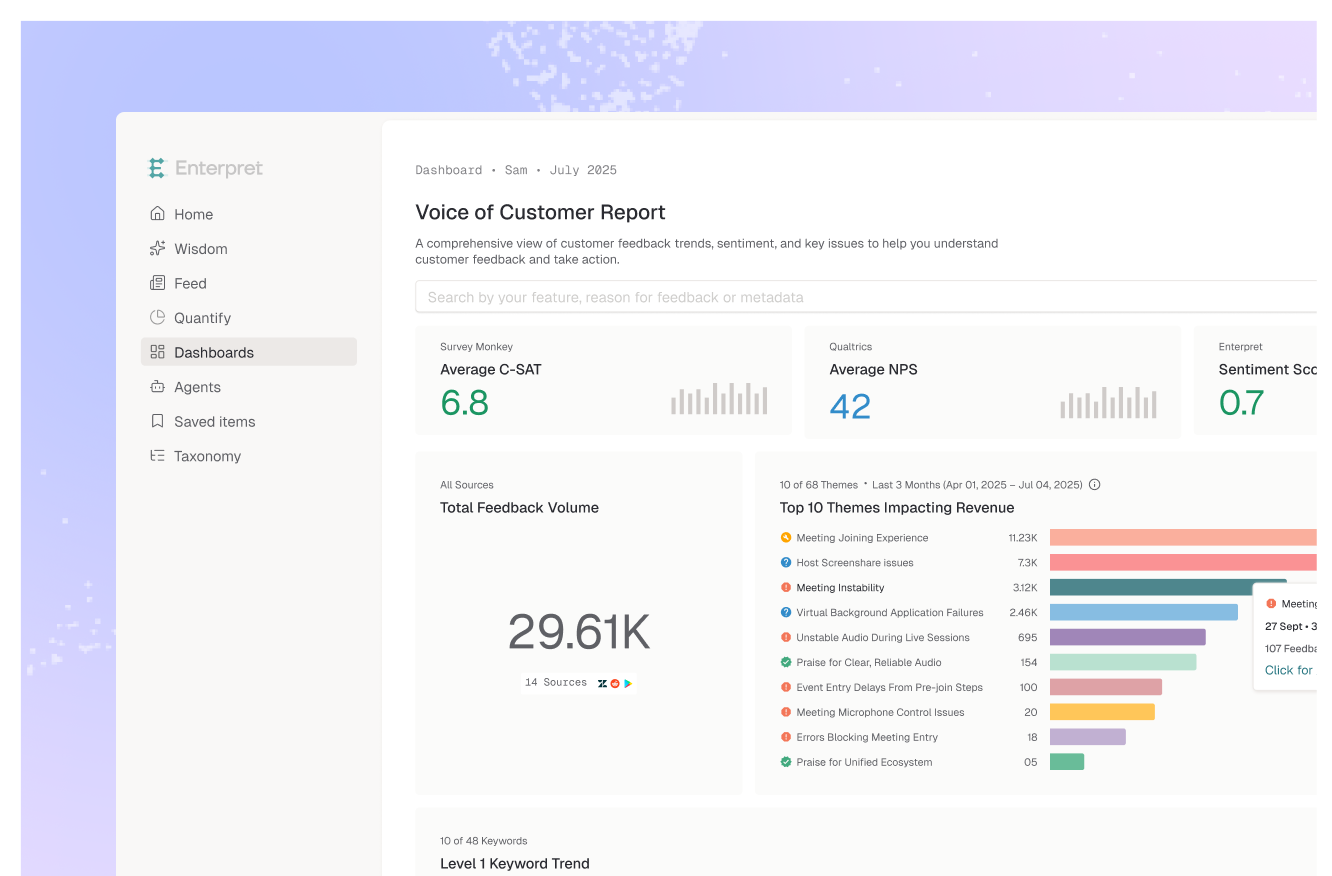
Enterpret supports each step. Adaptive Taxonomy's L1 to L3 Keywords map to your org structure, so insights route to the team that owns each branch. Quantify counts feedback by theme and account, and the Customer Context Graph links each record to accounts, revenue and opportunities. The Quality Monitor Agent flags spikes, and the Escalation Agent flags high-risk feedback from strategic accounts. The Jira integration links feedback to issues and syncs resolution status both ways, and Linear issues can be created with the feedback attached. In Enterpret's research on customer context graphs, that kind of graph is what lets an agent investigate "not only what customers say, but why, who is affected, what action followed, who owns it, and whether it was resolved." To compare tools for the tracking side specifically, see platforms for tracking action taken on feedback.
Picture a product org where "SSO setup fails for new workspaces" sat in the top five themes for three months. Support had flagged it, the identity team thought it was an onboarding bug, and the onboarding team thought it was identity's. Once the taxonomy mapped SSO under the identity team's branch and the weekly review required a decision, identity chose "fix now" within a week, linked a Jira ticket and named the twelve affected accounts. Volume dropped after the release, and customer success told each account. What worked: one owner per branch and a required decision. What did not: a shared dashboard everyone looked at and nobody owned.
As agents start drafting tickets and triage notes from feedback, the bottleneck moves from noticing issues to deciding about them. Teams that have owners, thresholds and a decision log will be able to let agents do the routing. Teams that do not will just get more alerts.
Give it one primary owner based on where the fix most likely lives, and name contributing teams. The primary owner makes the decision and coordinates; contributors are consulted. Shared ownership without a primary usually means no decision.
One of four outcomes with required fields: fix now, schedule for a named release, decline with a reason, or monitor with a trigger to revisit. "Acknowledged" or "on the radar" is not a decision.
Weekly for routing and new decisions, and monthly for stale items, fired monitor triggers and fixes that did not reduce volume. Faster cycles suit teams that ship weekly.
Watch the theme's volume and the number of affected accounts for several weeks after release. If neither falls, treat the issue as reopened and send it back to the owner with the new evidence.
If you want ownership and decisions to run on live customer data, see how Enterpret works.
Research cited
Lorem ipsum dolor sit amet, consectetur adipiscing elit. Suspendisse varius enim in eros elementum tristique. Duis cursus, mi quis viverra ornare, eros dolor interdum nulla, ut commodo diam libero vitae erat. Aenean faucibus nibh et justo cursus id rutrum lorem imperdiet. Nunc ut sem vitae risus tristique posuere.