





The 7 Steps to Analyze Product Reviews From UK Retailers Like Argos and Very

Feedback Analysis
November 5, 2026

To monitor new negative reviews on Best Buy and Walmart, do six things: track every product listing on Best Buy US, Best Buy Canada and Walmart US so new reviews flow into one place; define "negative" by star rating plus theme, not stars alone; alert on new themes and spikes instead of every 1-star; route each theme to the team that owns it; respond through the retailer's own tools where they exist; and review the whole picture weekly. The rest of this guide explains how to set up each step.
Most consumer brands already have a version of this. Someone checks the Best Buy page on Monday. Someone in quality gets a forwarded screenshot of a scathing Walmart review. That is not monitoring. That is reacting to whatever happened to surface.
The category mistake is treating the star as the alert. Stars tell you how a customer felt. They do not tell you what broke, who owns it, or whether it is new.
Picture two reviews on the same smart speaker. A 1-star: "Box arrived crushed." A 3-star: "Sounds great, but it drops Wi-Fi every night since last week." A star-based alert fires on the first and ignores the second. The first is one bad shipment. The second might be a firmware regression across thousands of units.
The reframe: stop asking "how many bad reviews did we get?" and start asking "what new problem are customers describing, where, and who owns it?" Retailer reviews are the app store reviews of physical products. Monitor them the same way: by theme, by spike, by owner.
You cannot alert on reviews you never collect. List every product page you sell through: Best Buy US, Best Buy Canada and Walmart US, plus each color, bundle and refreshed SKU that has its own page. A missing listing is a blind spot that looks like silence.
Keep an inventory of product, retailer, country and URL, and update it with every SKU launch. Some reviews on a retailer page may be syndicated from elsewhere: Best Buy's Seller Hub guide on gathering reviews describes review syndication through Bazaarvoice, so tag each review's origin before you count.
A useful definition has two parts: a rating threshold (say, 1 to 3 stars) and a theme that describes the problem, such as "battery drains overnight" or "missing mounting screws." A 4-star review that mentions overheating belongs in the queue. A 1-star about the weather does not.
Themes need to be specific enough to act on and stable enough to count. That is the point of turning open-text feedback into measurable insights. "Product quality" is a bucket. "Charging port loose after a month" is a signal.
A per-review alert trains people to mute the channel. Alert instead when a theme appears for the first time, when an existing theme jumps above its normal weekly volume, or when one retailer or country diverges from the rest.
Spike alerts only work if the counts underneath them hold still. In Enterpret's study of run-to-run instability across eight frontier models, raw models re-analyzing the same feedback reported counts that moved 7.5 to 9.8% on matched themes between runs. With a persistent taxonomy, a theme's count was identical every time. If your baseline shifts each time you ask, a 10% spike threshold is noise.
0 Volume disagreements for a theme across all 117 valid run pairs when the agent was grounded in a persistent taxonomy. Raw frontier models' counts moved 7.5 to 9.8% on the same themes. Source: Enterpret Research, "Same Feedback, Different Answer" (arXiv, 2026)
Here is an illustrative starting set of alert rules. Tune the thresholds to your own review volume.
| Rule (illustrative) | Trigger | Why it matters | Route to |
|---|---|---|---|
| New defect theme | A product defect theme appears in 3 or more reviews in 7 days with no prior history | Earliest sign of a manufacturing or firmware issue | Quality and engineering |
| Theme spike | An existing theme doubles its trailing 4-week weekly average | Something changed: a batch, an update, a supplier | Theme owner |
| Post-launch watch | Any negative theme on a SKU in its first 30 days on shelf | Launch issues are cheapest to fix early | Product manager for the SKU |
| Retailer divergence | One retailer's share of a theme is far above its share of total reviews | Points to fulfillment, packaging or listing content at that retailer | Retail ops and fulfillment |
| Country divergence | A theme concentrates in Best Buy Canada but not US listings | Regional SKU, power, language or manual differences | Regional product and CX |
| Safety language | Any review mentioning burning, smoke, shock or injury | One review is enough to escalate | Quality, legal and CX leads |
Every theme needs exactly one owner: product for feature gaps, quality and engineering for defects, fulfillment for damaged or late shipments, retail ops for listing and pricing issues, CX for setup confusion. Send alerts where those teams already work, such as a Slack channel, a Jira or Linear ticket, or a Notion page.
Routing breaks when themes do not split cleanly along team lines. Enterpret's taxonomy evaluation paper found that AI-generated taxonomies let 34.7% to 76.4% of records leak across more than one top-level product area, compared with about 20% for production references. A theme that belongs to everyone belongs to no one.
Public replies go through the channel each retailer provides, under its rules. The bigger response is the fix itself, and telling customers it happened.
If you sell on Walmart Marketplace, Walmart's guide to responding to reviews explains that you can reply publicly from the Ratings and Reviews page in Seller Center. Responses cannot be edited or deleted after submission, and syndicated reviews cannot receive responses. For Best Buy, confirm with your Best Buy partner or vendor contacts which response options apply to your account. Either way, the reply is the smallest part of closing the loop at scale.
Alerts catch the urgent. A 30-minute weekly review catches the slow drift: which themes are new, which are growing, which fixes actually reduced complaints, and whether one retailer or country is pulling the average down.
It is also where rules get tuned: if one fired five times and nobody acted, retire it. This rhythm is what separates reactive teams from the later stages of the customer feedback maturity model.
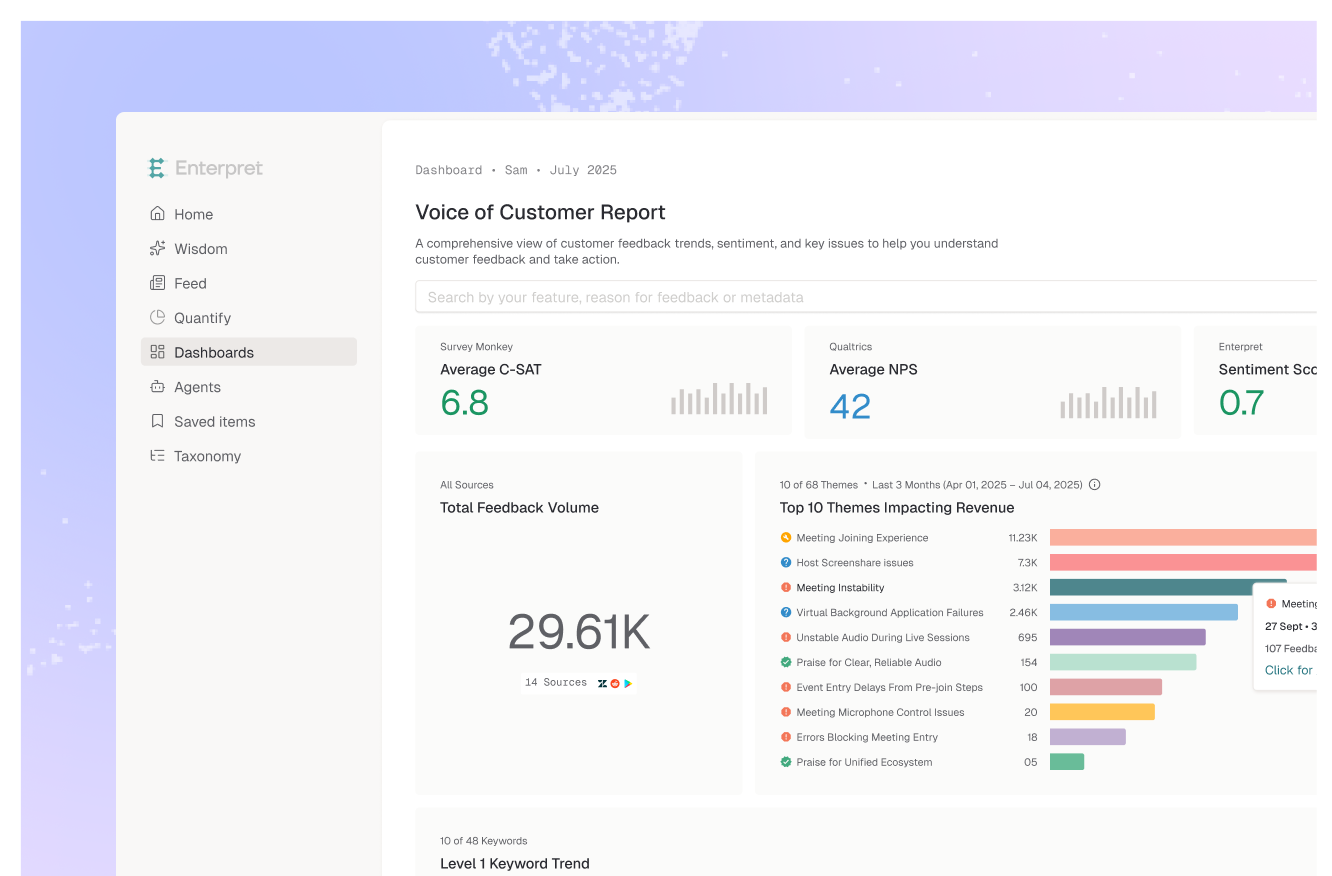
Teams can now bring product reviews from major retailers into Enterpret, including Best Buy (US and Canada) and Walmart (US). Paste product links or product IDs, and Enterpret pulls every new review on that product. Those reviews then sit next to the rest of your feedback, which is how DTC brands analyze product reviews, support tickets and post-purchase surveys together: Zendesk tickets, surveys, Apple App Store and Google Play reviews, and more.
Picture a smart home brand that ships a video doorbell refresh. In week two, a new theme appears: "night vision grainy after update," in four Walmart US and two Best Buy US reviews, mostly 3 stars. A star filter misses it. The new-theme rule opens a Jira ticket for the firmware team with the six reviews attached, and Wisdom finds the same complaint in two support tickets. The patch ships, and the weekly review confirms the theme flattening. Hypothetical, but it is all six steps working together.
Retailer reviews used to be a reputation metric. They are becoming a product telemetry stream, one that customers write for you. The brands that treat them that way will find defects in weeks instead of quarters. That gap compounds with every launch.
Track every Best Buy US, Best Buy Canada and Walmart US listing in one place, classify reviews by theme, and alert on new themes and spikes rather than every low rating. Platforms like Enterpret pull new reviews from product links and send theme-based alerts to Slack, Jira, Linear or Notion.
Usually not. Per-review alerts create noise, and stars mix defects with delivery problems. Alert on new themes, spikes and safety language, and review the rest weekly.
For a one-off look, yes. For monitoring, consistency matters: in Enterpret's research, raw frontier models' counts for the same themes moved 7.5 to 9.8% between runs on identical data, while a taxonomy-grounded agent had zero volume disagreement across 117 valid run pairs. Spike alerts need counts that hold still.
Walmart Marketplace sellers can respond publicly to eligible reviews from the Ratings and Reviews page in Seller Center. Responses cannot be edited or deleted once submitted, and syndicated reviews cannot receive responses.
A DIY scraper means maintaining code, handling site changes and rate limits, and checking each retailer's terms of use. Review those terms first and prefer approved or managed routes.
If you want negative retailer reviews routed to the right owner alongside the rest of your customer feedback, see how Enterpret works.
Research cited
Lorem ipsum dolor sit amet, consectetur adipiscing elit. Suspendisse varius enim in eros elementum tristique. Duis cursus, mi quis viverra ornare, eros dolor interdum nulla, ut commodo diam libero vitae erat. Aenean faucibus nibh et justo cursus id rutrum lorem imperdiet. Nunc ut sem vitae risus tristique posuere.


