



The 5 Ways DTC Brands Analyze Product Reviews, Support Tickets, and Post-Purchase Surveys Together

November 2, 2026

A 200-person startup signs a Qualtrics or Medallia contract, then spends the next quarter on implementation calls, survey programming, and dashboard requests to a services team. By the time the first NPS readout lands, the product has shipped three releases and the support queue has already told you what broke. Both platforms were built for enterprise experience programs, and a startup pays for that design in time, headcount, and contract size.
The 7 best alternatives to Medallia and Qualtrics for startups are Enterpret, Thematic, Dovetail, Sprig, Canny, Typeform, and SurveyMonkey. What separates them is the feedback each one is built around: unsolicited feedback from tickets, calls, reviews, and communities (Enterpret, Thematic), research and in-product signals (Dovetail, Sprig, Canny), or surveys you design and send yourself (Typeform, SurveyMonkey).
The first criterion is the real differentiator. Most tools on this list can analyze text. Far fewer were built for a feedback mix where surveys are the minority of the signal.
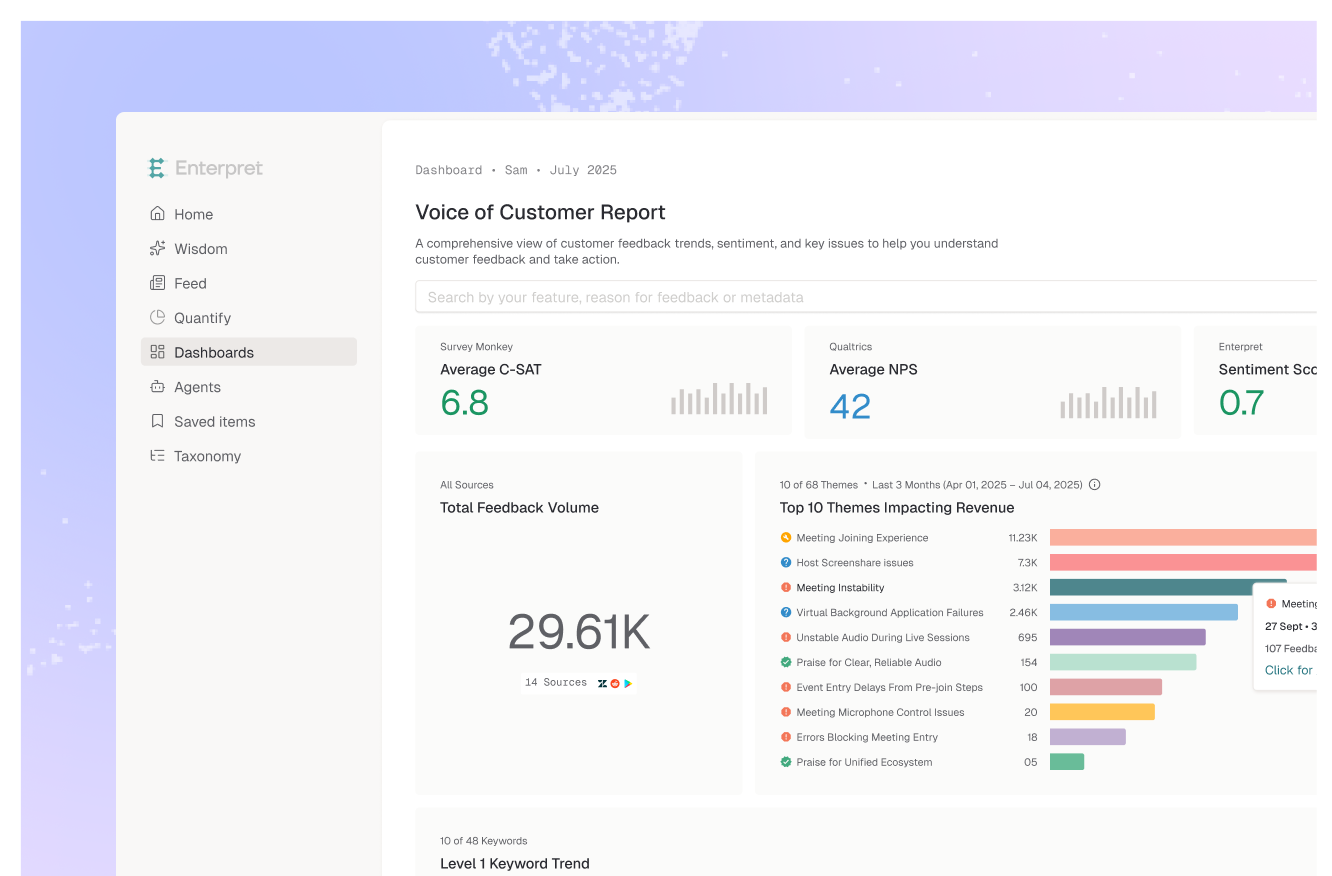
Enterpret is a customer intelligence platform built around unsolicited feedback. It unifies feedback from 50+ sources, including Zendesk, Intercom, and Pylon tickets, Gong and Fathom calls, Apple App Store and Google Play reviews, Discord and Discourse communities, Slack, and the surveys you already run in Typeform, SurveyMonkey, Sprig, or Qualtrics. Its Adaptive Taxonomy builds a multi-level set of themes from your own feedback, keeps categorization consistent over time, and lets your team edit it as the product changes. The Customer Context Graph links each piece of feedback to accounts, segments, revenue, and features, so a theme comes with the ARR behind it.
The part that matters most for a lean team is what happens after analysis. AI agents watch for emerging issues and trend changes, alert in Slack, and push work into Jira or Linear. Public customers include Notion, Figma, Canva, Loom, and Linear. The honest caveats: Enterpret is not a survey builder, so if you need to design and send surveys you will pair it with a survey tool. It also needs integration setup and processing time before themes are ready, so it is not an instant switch-on.
Best for: startups and scale-ups whose feedback lives mostly in support, sales, reviews, and community, and who want one view of it tied to revenue.
Thematic is AI-powered thematic and sentiment analysis for qualitative feedback. Its integrations cover survey platforms (including Qualtrics, Medallia, SurveyMonkey, Typeform, and Delighted), support tools (Zendesk, Freshdesk, Intercom, Salesforce), review sites (App Store, Google Play, Trustpilot, Capterra), community sources (Slack, Discord, Discourse), and warehouses like Snowflake and BigQuery. That makes it a credible option for teams that want text analytics without an enterprise suite.
Its center of gravity is still analysis and reporting on themes, and it is strongest where survey verbatims are a large share of the data. Teams looking for account-level revenue context or automated actions should check how far its workflows go for their use case.
Best for: insights and CX teams that mainly need strong theme analysis across surveys, tickets, and reviews.
Dovetail began as a user research repository and has expanded into AI analysis of calls, documents, and surveys. Its pricing page lists a free plan for individuals with one channel and one project, and an Enterprise plan with unlimited channels, CRM sync to Salesforce and HubSpot, and SSO. It describes AI opportunity tracking across support tickets, app reviews, and other feedback.
Dovetail shines when researchers are the main users and interviews are the core input. If your volume is thousands of tickets a week rather than dozens of interviews, test how it handles that scale and which support tools connect directly.
Best for: product and research teams that run regular customer interviews and want one place to tag, analyze, and share them.
Sprig is built for product teams: in-product surveys, session replays, heatmaps, and feedback collection, with AI analysis on top. Its plans run from Free (up to 5,000 monthly unique users, with monthly caps on responses and replay clips) to Starter and a custom Enterprise tier.
Sprig is the closest thing on this list to a lightweight survey replacement that lives inside your product. It captures what users say at a moment you choose. It does not replace the analysis of feedback that arrives through support and sales.
Best for: product teams that want targeted in-product questions and behavioral context in one tool.
Canny centers on feature requests: public or private feedback boards, voting, roadmaps, and changelogs. Its Gong integration detects feature requests in call recordings, links them to customer data like revenue and team size, flags duplicates, and can email customers when a feature ships.
Canny is a request tracker, not a full VoC platform. Bugs, sentiment, churn reasons, and support pain that never get phrased as a request stay outside it.
Best for: B2B SaaS teams that want a structured, customer-facing way to collect and prioritize feature requests.
Typeform is a form and survey builder known for its conversational, one-question-at-a-time format. Plans step from Free and Basic to Plus and Business. Basic includes 100 responses a month and does not support multiple users, so most teams land on a higher tier.
Typeform is the right answer when the job is collecting better survey responses. It is not an analysis layer for the rest of your feedback.
Best for: teams that need well-designed NPS, onboarding, or research surveys with high completion rates.
SurveyMonkey is the familiar general-purpose survey platform. Its AI analysis features let you ask questions about your results in plain language, sort open-text comments into themes, label sentiment, and flag low-quality responses.
For a startup that needs surveys now, it is fast to start and widely understood. Like Typeform, it analyzes the feedback you asked for, not the feedback customers volunteer elsewhere.
Best for: teams that want a quick, broadly known survey tool with built-in AI summaries of responses.
Most teams frame this as a survey swap: same job, cheaper vendor. That is the category mistake. Medallia and Qualtrics are heavy because they were designed to run solicited programs at enterprise scale. Replacing them with a lighter survey tool fixes the cost and keeps the blind spot.
A startup's best feedback is unsolicited. The customer who files a ticket about a broken export, the prospect who tells your AE the integration is missing, the reviewer who leaves two stars after an update. None of them filled in a survey, and all of them told you something specific. Surveys measure the temperature on a schedule. Tickets, calls, and reviews tell you what is happening this week. The reframe: stop asking "which survey tool replaces Qualtrics?" and ask "where does our feedback actually live, and who reads it?"
This is also why startups outgrow tagging spreadsheets before they ever need an enterprise suite. Our guide on building a VoC program from scratch at a startup covers the sequencing, and the differences between AI-native and legacy VoC explain why categorization approach matters more than survey features. If budget is the main constraint, see the affordable feedback management tools for startups.
Vendor stability is a fair input too. Medallia completed a recapitalization in August 2026 that moved ownership from Thoma Bravo to an investor group led by Blackstone, Apollo, and FS KKR. That does not change what the product does today, but a startup choosing a multi-year system should weigh roadmap direction alongside features. Teams further along may find the Medallia alternatives for mid-market companies or the Qualtrics alternatives for voice of customer a closer fit.
The decision rule: pick the tool built for the channel where most of your feedback already lives, and add a survey tool only for the questions customers will not volunteer.
It depends on where your feedback lives. If most of it comes from support tickets, sales calls, app reviews, and community channels, Enterpret is built for that mix. If you mainly need to send surveys, Typeform or SurveyMonkey are lighter options, and Sprig covers in-product surveys.
Usually yes, but as a supporting tool rather than the center of the program. Surveys are useful for questions customers will not raise on their own, like NPS or onboarding experience. The larger volume of specific, actionable feedback at most startups arrives unsolicited through support, sales, and reviews.
Enterpret is not a survey builder. It ingests responses from tools like Typeform, SurveyMonkey, Sprig, Delighted, and Qualtrics alongside tickets, calls, and reviews, then categorizes all of it with one Adaptive Taxonomy. That lets you see whether a theme in NPS comments also shows up in support and which accounts it affects.
For a one-off read of a few hundred comments, yes. For tracking themes over time, general LLMs are inconsistent: in Enterpret research across eight frontier models, the most consistent one still changed more than 60% of its theme set between identical runs on the same 100 records. A platform with a stable taxonomy gives you counts you can compare week to week, and Enterpret's MCP server lets you query that data from Claude or ChatGPT.
Yes. Medallia announced a recapitalization agreement with its lenders in June 2026 and said it closed the transaction on August 3, 2026. Ownership moved from Thoma Bravo to an investor group led by funds managed by Blackstone, Apollo, and FS KKR, and the company secured $150 million in new capital.
If your feedback lives in tickets, calls, and reviews more than surveys, see how Enterpret runs voice of customer for growing teams.
Research cited
Lorem ipsum dolor sit amet, consectetur adipiscing elit. Suspendisse varius enim in eros elementum tristique. Duis cursus, mi quis viverra ornare, eros dolor interdum nulla, ut commodo diam libero vitae erat. Aenean faucibus nibh et justo cursus id rutrum lorem imperdiet. Nunc ut sem vitae risus tristique posuere.