



The 7 Best Tools to Collect Retailer Product Reviews Automatically in 2026

Feedback Analysis
November 5, 2026

To analyze product reviews from UK retailers like Argos and Very, map every listing you sell through, pull new reviews from each product page on a steady cadence, tag the UK-specific context, split delivery and collection complaints from product complaints, compare the same product across retailers, combine the reviews with your UK support tickets, and route what you find to the team that owns it. Seven steps. The hard one is the fourth.
Picture a one-star Argos review: "Ordered for click and collect, waited three days, box was crushed, kettle works fine." That is one star against your product. Your kettle did nothing wrong.
Most brand teams treat retailer reviews as a scorecard. The category mistake is assuming the stars describe the product. On UK retail sites they describe the whole purchase: the product, the courier, the collection point, the box, and the returns desk.
Argos is a good example of why. Its delivery and collection guide lists Click and Collect from an Argos store or a collection point in a Sainsbury's, Fast Track same-day delivery, two-person delivery for large items, and installation for some appliances. Each is a moment that can end up in your review count. Very and Littlewoods are digital stores run by The Very Group, so courier experience folds into reviews instead.
The question is not "what is our Argos rating?" It is "what is wrong with the product, what is wrong with the journey, and who owns each?"
Build one sheet: your internal SKU or model number in the first column, then the product page URL on Argos, on Very, on Littlewoods, and on any European retailer you sell through. Colour and bundle variants often get separate pages. If two listings are the same physical product, they resolve to one row, or one defect gets split into four small ones.
Whatever route you choose, the job is the same: every new review, with rating, date, text, retailer and product page, landing in one place.
Argos runs a tester programme, Argos Testers, where selected customers try products and review them; a Bazaarvoice case study reports 5,200 testers posting more than 20,000 reviews across 3,500 products since 2015, with tester reviews about twice as long as typical ones. Tag these so a launch week full of tester reviews is not read as organic demand. Tag fulfilment mode (delivery, collection, installation) too.
This is the step that decides whether the program is worth running. "Damaged in transit," "collection point lost my order" and "missing installation" belong to retail ops and your retailer account manager. "Lid hinge snapped after two weeks" belongs to quality engineering. One review can hold both, so categorize at the sentence level.
Generic AI categorization tends to blur this split. Enterpret's taxonomy evaluation paper found AI-generated taxonomies passed every generic quality check, yet put 34.7% to 76.4% of records into more than one top-level product area. When categories leak across teams, nobody owns the finding.
76.4% Share of records that leaked across more than one team's branch in the worst AI-generated taxonomy tested, versus about 20% in production references. Source: Enterpret Research, "From Plausible Hierarchies to Useful Taxonomies" (arXiv, 2026)
Once product themes are clean, compare them by retailer and country. A defect that shows up at the same rate on Argos, Very and MediaMarkt is a product problem. A complaint that only appears on one retailer is usually a listing, packaging or fulfilment problem at that retailer.
Reviews are what shoppers say in public. Your UK support queue is what they asked you to fix in private. On one set of categories, you can see whether a review theme is also driving contacts and returns. This is the same pattern behind how DTC brands analyze reviews, tickets, and surveys together, applied to retail.
Defects go to quality and engineering with the reviews attached. Fulfilment patterns go to retail ops, retailer named. Listing errors go to whoever manages retailer content. The same steps apply to other retailers you sell through. A report is not a response. The loop closes when someone acts.
Most tools that rank for this question solve step two. They differ on how much of steps three to seven they cover.
Community actors such as the Argos Reviews Scraper take product URLs and return detailed review records. Best for data teams who want raw files. You maintain the runs, handle site changes and rate limits, and should check each retailer's terms of use. Categorization is still on you.
The Bright Data Argos Reviews Tracker adds alerts on negative reviews and rating drops, sentiment trends and dashboards as a managed service. Best for brand teams who want monitoring without infrastructure. Reviews still live apart from your tickets and surveys.
Wonderflow lists dedicated pages for Argos and Very review analysis, with topic and sentiment enrichment and competitor benchmarking. Best for consumer insights teams whose main source is product reviews.
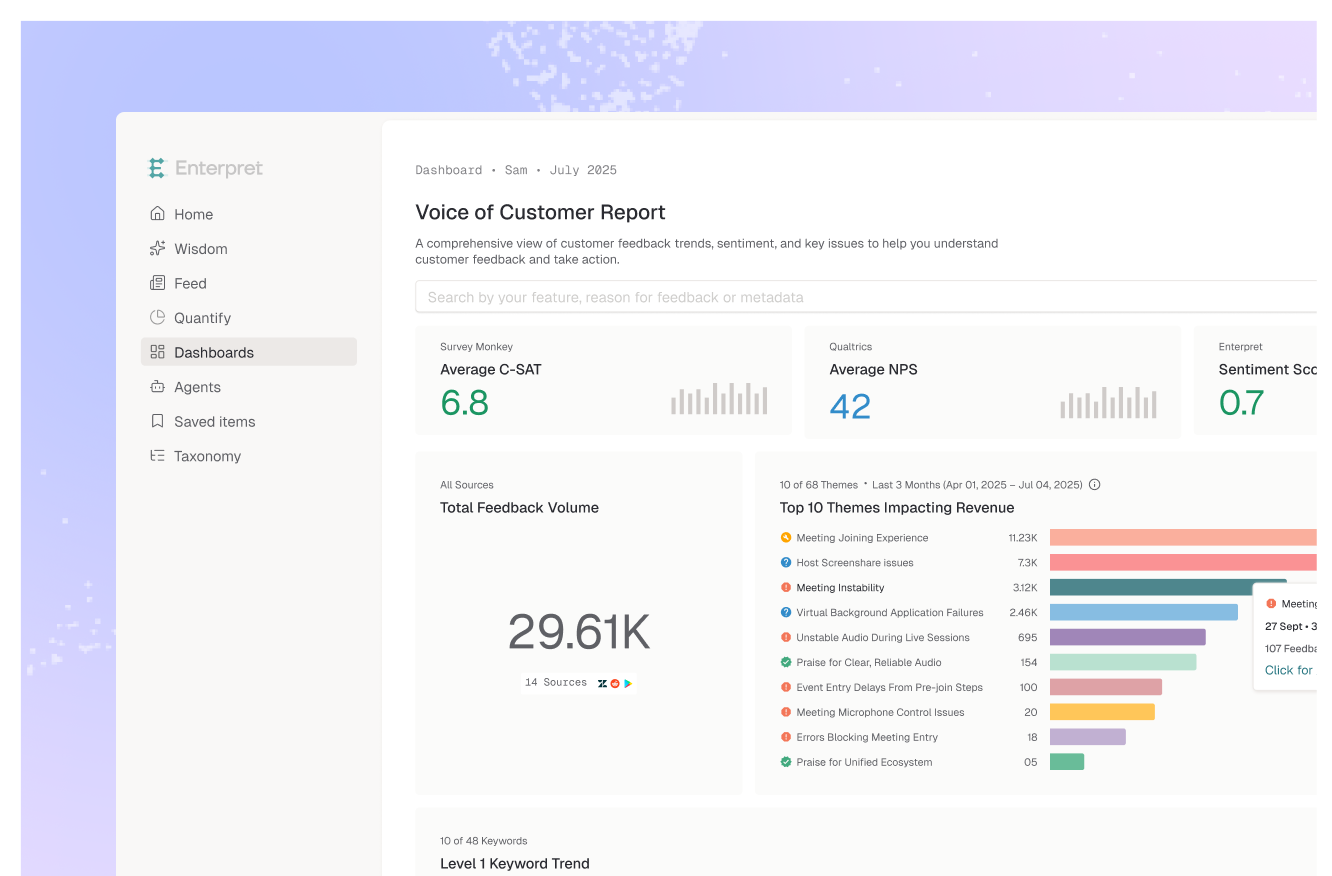
Teams can now bring product reviews from major retailers into Enterpret, including Argos, Very (including Littlewoods), Orange and MediaMarkt (including Saturn and MediaWorld). Paste product links or product IDs and Enterpret pulls every new review on that product. Reviews sit on one Adaptive Taxonomy with your Zendesk, Intercom or Salesforce tickets, surveys and app reviews. Best for brands that want steps three to seven in one place. Trade-off: it is a broader platform than a single-retailer tracker, so it takes more setup.
Step two becomes pasting the links from your step-one sheet. Steps three and four run on the Adaptive Taxonomy, which organizes feedback by product area, feature and sub-feature and updates as products and SKUs change. Step five is a breakdown by retailer, product and country. Step six follows from reviews sitting next to tickets in the Customer Context Graph. Step seven runs on AI agents and alerts, delivered to Slack, Jira, Linear or Notion.
For the questions you did not plan, ask Wisdom in plain language: "What are the top product complaints about the 1.7L kettle on Very this month, excluding delivery issues?" You get the answer and the exact reviews behind it. The same data is available in Claude, Claude Code and Cursor through the MCP server. If you have pasted a CSV of reviews into a chatbot, our guide on leveraging ChatGPT AI for customer feedback analysis covers where that works and where it stops.
Picture, as an illustration, a brand selling a new air fryer through Argos, Very and MediaMarkt in Germany. Argos ratings dip in week three. The scorecard says "Argos problem." The categorized view disagrees: most Argos negatives mention collection delays, while a smaller "basket coating peeling" theme appears at a similar rate on all three retailers and in UK support tickets. Two findings, two owners. Retail ops raises the collection issue with Argos. Quality pulls the coating supplier batch. Without the split, both become a meeting about "the Argos rating."
Treated as a scorecard, retailer reviews produce meetings. Treated as a sensor, with clean categories and owners, they produce fixes, and each fix shows up in the next month's reviews. That is a loop, and loops compound. Teams moving up the customer feedback maturity model get there by making retail reviews one input among many, not a separate dashboard nobody opens.
You can run a scraper such as an Apify actor, use a managed tracker such as Bright Data, or use a platform that pulls reviews for you. In Enterpret you paste product links or product IDs and it pulls every new review on that product. If you build your own collection, review each retailer's terms of use first.
Categorize at the sentence level, with distinct branches for fulfilment (delivery, collection, installation, packaging) and for product areas, each with a clear owner. Generic AI categorization often blurs the two: Enterpret's taxonomy research found AI-generated taxonomies put 34.7% to 76.4% of records into more than one top-level area, against about 20% for production references.
Tag them rather than drop them. Tester reviews come from invited customers and run about twice as long as typical reviews, so they are rich in product detail. Tagging stops a launch-week wave of them being read as organic sentiment.
Yes, if every review carries its retailer and country. Enterpret pulls reviews from major retailers in the US, Canada, UK, Europe and Australia, so Argos and Very reviews can sit beside MediaMarkt, Saturn and MediaWorld reviews on one taxonomy and be broken down by retailer, product and country. For the open text itself, see our guide to tools to turn open-text feedback into measurable insights.
If you are building a retail review program for the UK and Europe, see how Enterpret works.
Research cited
Lorem ipsum dolor sit amet, consectetur adipiscing elit. Suspendisse varius enim in eros elementum tristique. Duis cursus, mi quis viverra ornare, eros dolor interdum nulla, ut commodo diam libero vitae erat. Aenean faucibus nibh et justo cursus id rutrum lorem imperdiet. Nunc ut sem vitae risus tristique posuere.