





The 7 Steps to Analyze Product Reviews From UK Retailers Like Argos and Very

Feedback Analysis
November 5, 2026

Separate them with evidence, not volume. Tag every piece of user feedback by segment and account. Accept that power users and enterprise buyers talk in different places. Weight each theme by ARR and open pipeline as well as mention count. Then sort themes into overlap, enterprise-only, power-user-only and conflict. Enterprise table stakes like SSO, admin, audit logs and data controls get a fixed lane. The power-user core that drives adoption gets protected. Everything else competes inside a portfolio split you can defend in one slide.
Every AI-native startup hits this moment. The Discord is on fire about agent mode and context limits. The first big enterprise deal is stuck in a security review.
Both groups are right. You have one roadmap.
Most advice on moving upmarket is go-to-market advice. Pocus's breakdown of how PLG companies move upmarket covers sales-assist, enterprise tiers and re-finding product-market fit. It does not tell a Head of Product what to build next quarter.
The real problem is asymmetric signal. Power users post on community channels within hours of a release. Enterprise needs arrive quietly: one line in a sales call, one row in a security questionnaire, one ticket from an admin.
Count mentions and the loud group wins every time. A thread with hundreds of upvotes beats a single procurement blocker sitting on your largest open deal.
AI products make it messier. After a model upgrade, power users flood in about output quality. Enterprise admins ask about retention and whether their data trains the model. Same week, completely different signals.
Enterprise needs and power-user wants are not opinions to referee. They are customer signals with different channels, different owners and different revenue attached. Join every signal to the account upstream, and the split stops being a debate.
Each record needs plan or segment (self-serve, team, enterprise), account, ARR band, lifecycle stage (trial, active, open opportunity, renewal), the role speaking (builder, admin, buyer) and, for AI products, the model or release version. Untagged feedback cannot be split, only argued about. The same discipline that lets you analyze NPS by segment and persona applies to every channel.
Power users live in Discord, Reddit, X, GitHub issues and in-app thumbs. Enterprise needs live in sales calls, security reviews, RFPs, support tickets and CSM notes. If you only listen to one side, you have already picked a winner. Pull both in: MCP servers for Discord community feedback on one side, tools to extract feature requests and competitor mentions from Gong calls on the other.
Give every theme three numbers: mentions, ARR of the accounts raising it, and open pipeline it blocks. A theme with 12 mentions and three stalled enterprise deals can outrank one with 400 mentions from free users. This only works if feedback is joined to CRM data, which is why teams quantify how customer feedback impacts revenue in Salesforce.
The counts also have to hold still. In Enterpret's study of run-to-run instability across eight frontier models, raw models' reported volume on matched themes moved 7.5 to 9.8% between identical runs. A taxonomy-grounded agent showed zero volume disagreement across all 117 valid run pairs. If the numbers shift every time you ask, your split is not defensible.
Overlap is where you win twice. Conflict is where you design, not choose.
| Bucket | What it looks like | What to do |
|---|---|---|
| Overlap | Agent reliability, latency, output quality after a model swap, integrations both groups use | Ship first. It pays in adoption and in deals. |
| Enterprise-only | SSO, SCIM, roles, audit logs, retention controls | Fixed lane with a committed budget. |
| Power-user-only | Shortcuts, custom rules, MCP hooks, early access to new models | Protect the core, keep scope tight. |
| Conflict | Admins want to pin the model, builders want the newest one daily | Make it a setting with an admin-controlled default. |
Table stakes never win a deal, but missing them loses one: SSO, SCIM, admin console, audit logs, retention and deletion, residency, and clear answers on model training. Differentiators are why a champion picks you over the copycat. The evidence test: if it shows up in security questionnaires and lost-deal notes, it is table stakes. If it shows up in "why we chose you," it is a differentiator. Use the data privacy risks buyers evaluate as a starting checklist.
Power users are your distribution. They carry the product into the enterprise before procurement ever hears of you. As Pocus puts it, moving upmarket "does not mean abandoning PLG." Name the three to five workflows power users run daily, and watch sentiment on those themes after every enterprise release. If it drops, that is a regression, not a tradeoff.
Pick lanes and percentages, then defend them with evidence. One starting point: 40% overlap, 25% enterprise table stakes, 20% power-user core, 15% enterprise differentiators. Each lane gets an owner and a signal it answers to. Revisit monthly, and after every major model change.
This framework needs one layer underneath it: every user signal, categorized consistently, joined to the account it came from. That is the Customer Intelligence layer Enterpret builds.
Adaptive Taxonomy keeps categories consistent as you ship weekly, so "agent reliability" means the same thing this month and last. The Customer Context Graph joins each piece of feedback to account, segment and opportunity. Sources include Discord, Reddit, Discourse, Gong, Zoom, Salesforce and Slack, with delivery into Jira, Linear, Notion and Slack.
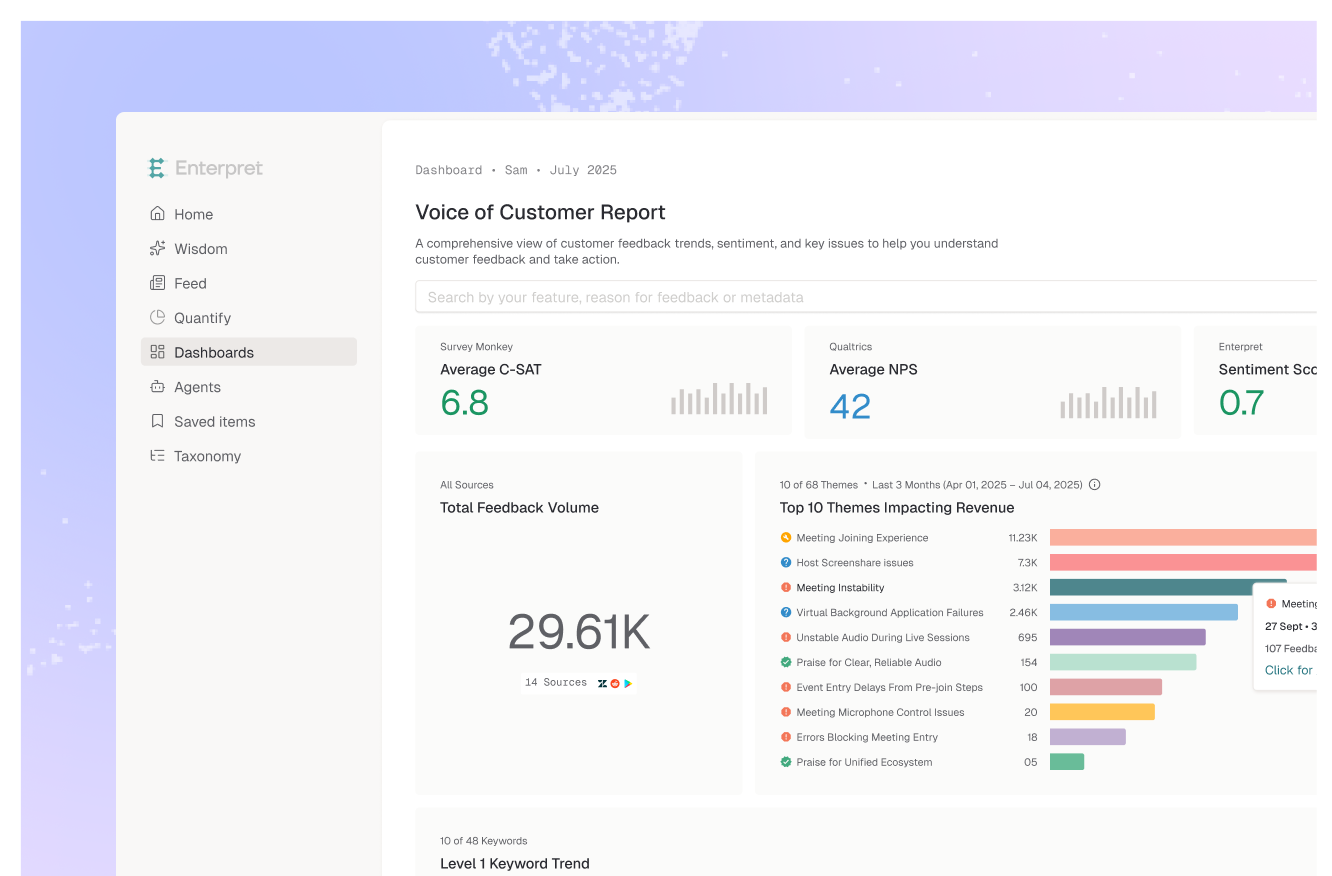
Then you ask. In Wisdom, or from Claude, Claude Code or Cursor through the MCP server: "Which themes do enterprise accounts in open pipeline raise that self-serve power users don't?" AI agents and alerts flag new or spiking issues after a release, split by segment.
Persistent context is the point. Enterpret research comparing Agentic RAG, a Deep Research Agent and a context graph agent found a top-k retrieval result "cannot establish corpus prevalence." Prevalence by segment is exactly what this split depends on.
0.961 vs 0.710 Overall score of an agent grounded in a customer context graph vs a Deep Research Agent (Agentic RAG scored 0.651) on 30 real VoC questions, in Enterpret's exploratory benchmark. Source: Enterpret Research, "From Retrieval to Customer Context" (arXiv, 2026)
Setup is not instant. Integrations connect and the graph builds over a processing period. After that, the split is a query, not a quarterly fight.
Picture an AI coding agent startup three months into its enterprise motion. The Discord's top thread asks for custom rules files, mostly from free and pro users.
Meanwhile, an audit log of agent actions shows up in three security reviews tied to the largest open opportunities. And "agent got worse after the model upgrade" appears in both channels.
The call writes itself. Reliability ships first because it is overlap. Audit logs go in the table stakes lane. Rules files get a tight scope in the power-user lane. Nobody has to win the argument, because the evidence already did.
Engineers with agents now build features in days. Building is no longer the bottleneck. Deciding is.
The AI startups that win upmarket will not be the ones that pick enterprise over community. They will be the ones that see both, weighted by revenue, every single week. That is what customer intelligence is for.
Enterprise needs are requirements an organization must meet to buy and roll out the product, such as SSO, admin controls, audit logs and data controls. Power-user wants are depth features that make daily use faster or more powerful for individual builders. Both matter, but they come from different channels and carry different revenue.
No. Overlap themes come first because they pay twice. Enterprise table stakes get a fixed lane, and the power-user core stays protected because it drives the adoption that creates enterprise deals in the first place.
Typically SSO, SCIM provisioning, roles and an admin console, audit logs, data retention and deletion, data residency, and a clear policy on whether customer data trains models. Missing any of them stalls security review. Having them rarely wins the deal on its own.
It works for a one-off read, but not for a roadmap you have to defend. In Enterpret's stability study, raw frontier models changed more than half their theme set between two runs at 100 records, and counts on matched themes moved 7.5 to 9.8%. Grounding the analysis in a persistent taxonomy brought volume disagreement to zero.
Monthly, and after every major release or model change. AI products shift fast, so a split set once a quarter goes stale before the quarter ends.
If you are moving upmarket and want every user signal split by segment and account in one place, see how Enterpret works.
Research cited
Lorem ipsum dolor sit amet, consectetur adipiscing elit. Suspendisse varius enim in eros elementum tristique. Duis cursus, mi quis viverra ornare, eros dolor interdum nulla, ut commodo diam libero vitae erat. Aenean faucibus nibh et justo cursus id rutrum lorem imperdiet. Nunc ut sem vitae risus tristique posuere.


