

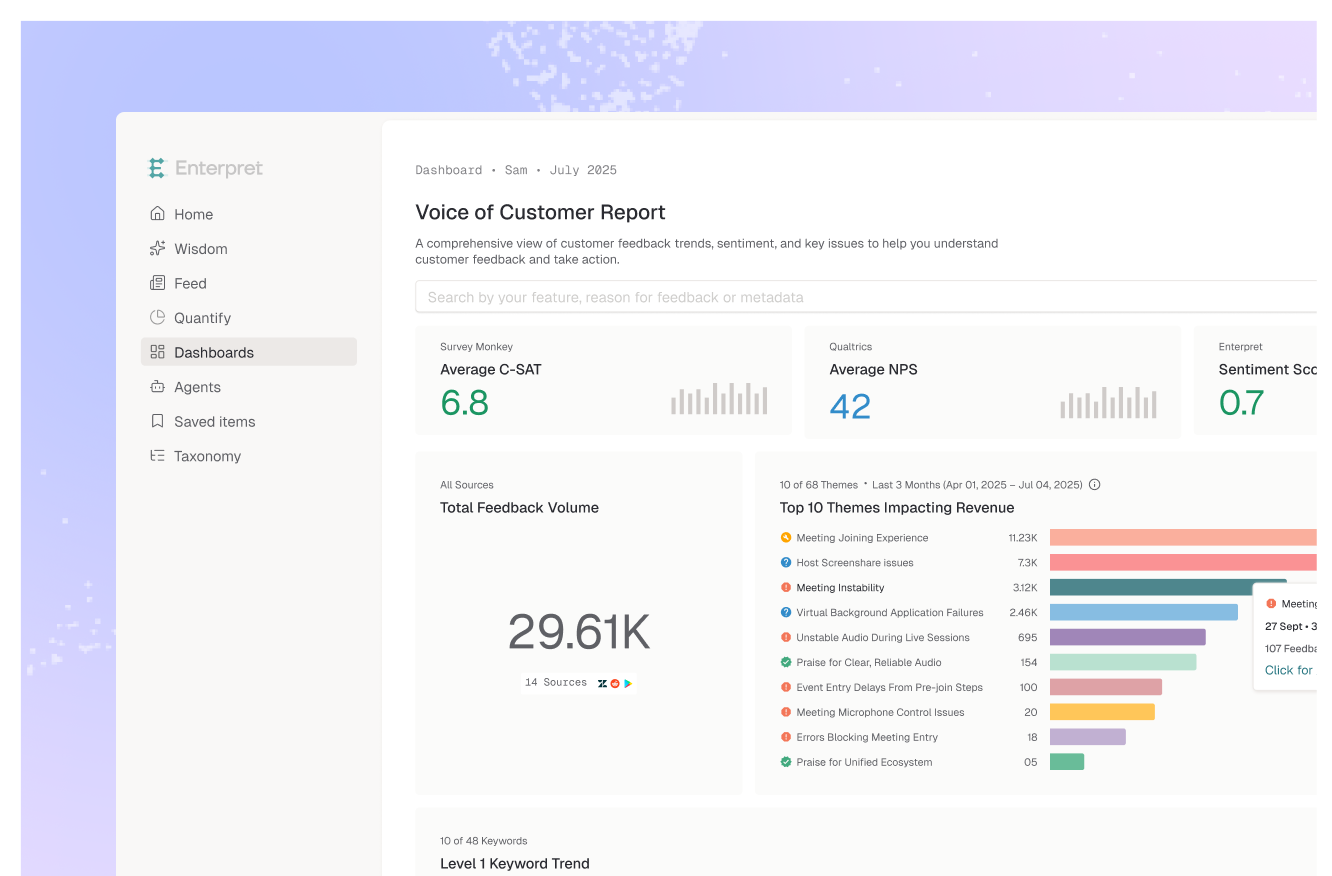




The 7 Steps to Analyze Product Reviews From UK Retailers Like Argos and Very

Feedback Analysis
November 5, 2026

To turn user feedback into eval sets, build from failure themes, not from individual thumbs-downs. The seven steps: find failure themes across every channel, size them by volume, segment and revenue, pull representative examples with their original context, write expected behavior and grading criteria, keep the categories stable, refresh the set as new themes appear, and confirm the theme declines in user feedback after the fix ships. Your eval platform runs the tests. The feedback layer decides which tests deserve to exist.
Most teams get the categories wrong. In Enterpret's study of run-to-run instability across eight frontier models, a raw model asked twice for the top themes in the same feedback changed more than half its theme set at 100 records and nearly three quarters at 5,000 (theme churn 0.552 rising to 0.726). Eval categories built that way cannot map to anything that holds still.
The tracing side is well covered. Langfuse's guide to turning user feedback into evaluation datasets shows how to capture ratings as scores on traces, filter for negative ones, add them to a dataset, use expert corrections as expected outputs, and gate CI on experiment runs. If your main signal is a thumbs rating on a trace, start there.
The gap is everything that never touches a trace. At an AI-native startup, the most specific failure reports live in community channels, Reddit, GitHub issues, app reviews, tickets and, once enterprise deals start, sales calls. A thumbs-down says a response was bad, rarely why, and Langfuse's guide itself notes that some negative ratings are about latency or tone rather than correctness. That gives you bad responses, not a ranked list of the failure modes costing you users.
Asking a general model to cluster a CSV works once (see our guide to leveraging ChatGPT AI for customer feedback analysis). It breaks when you need the same categories next month to compare pass rates across a model swap.
Traces tell you what the model did. User feedback tells you what users needed and what the failure cost you. Build the eval set from the second.
Pull ratings, chat logs, tickets, community threads, reviews and call notes into one place, then group by failure mode: "agent edits the wrong file in a monorepo," "invents an API that does not exist," "refuses a valid request." Only model behavior goes in the eval set; UX gaps and missing features go to the roadmap.
If you are stitching sources by hand, start with a system for managing multi-source customer feedback.
Rank themes by volume, trend since the last release, segment (free users vs enterprise trials), and attached accounts and revenue. Top themes get blocking CI tests; the long tail gets scheduled runs, in line with Langfuse's advice to keep the gated set small.
Counts only help if they repeat. In the same study, taxonomy-grounded runs showed zero volume disagreement across all 117 valid run pairs, while raw models' counts moved 7.5 to 9.8% on matched themes, enough to reorder a priority list.
For each prioritized theme, pick examples that cover its variations, not the five loudest. Keep the original input, prior turns, model and prompt version, account tier, and the user's own complaint in their words. Link the trace when one exists, and strip personal data.
Write the rubric once per theme, then apply it to every example in it. "Only references functions that exist in the provided repo" is gradable. "Better code" is not. Decide what each criterion needs: a deterministic check, an LLM judge, or human review.
| Field on each eval item | Example | Why it matters |
|---|---|---|
| Theme ID | agent.context.wrong-file-monorepo | Lets you report pass rate per user-facing theme |
| Input and prior turns | Original request plus conversation | Reproduces the real failure, not a cleaned-up version |
| User verbatim | "It rewrote utils in the wrong package again" | Anchors the rubric in what the user actually needed |
| Expected behavior | Edits only files under the referenced package | Defines pass and fail |
| Segment and account weight | Enterprise trial, 3 accounts | Decides blocking test vs monitor |
Tag every eval item with a theme ID from a persistent taxonomy, not a label a model invented this week. After a model swap, compare pass rates per theme to see which user problems got better or worse.
86 to 88% Reduction in theme churn when an AI agent is grounded in a persistent taxonomy instead of re-clustering raw feedback on every run (0.104 vs 0.765 for a raw model, same model and data). Source: Enterpret Research, "Same Feedback, Different Answer" (arXiv, 2026)
Caveat: the study measured stability, not accuracy. A stable taxonomy can still be wrong, so review theme definitions in step 4.
After every release and every model change, check for new or spiking themes and add a slice for each one that is model behavior. Move resolved themes to a regression suite, and version the dataset (Langfuse versions every change) so old runs stay comparable.
Spotting new themes fast is its own capability; see customer voice tools for identifying trending product issues.
A higher pass rate is half the proof. The other half is the theme's volume dropping in user feedback after the fix ships, normalized for usage, inside the segment that reported it. If the eval passes and complaints continue, the rubric measures the wrong thing. Rewrite it.
This is the same discipline as closing the customer feedback loop at scale, applied to model quality.
Datasets, experiments and runs belong in your eval platform: Langfuse, Braintrust, LangSmith or Arize Phoenix. The output of steps 3, 4 and 6 lives there. Unifying feedback across channels, keeping categories stable and attaching revenue (steps 1, 2 and 7) happen upstream. For a side-by-side of both layers, see the 6 best tools to turn customer feedback into an AI eval set.
Enterpret is the user-feedback side, not an eval runner. It brings feedback into one place, including Discord and Reddit (see MCP servers for Discord community feedback), with four capabilities mapped to the steps:
Setup is not instant: integrations need connecting and the taxonomy needs processing time before themes can anchor an eval set.
Picture a team shipping an AI coding agent that upgrades its default model on a Tuesday. By Friday, "edits the wrong file in monorepos" is rising in Discord and tickets, including three enterprise trial accounts. The PM pulls examples with prior turns, writes one rubric (edits stay inside the referenced package), and adds the slice to the gated dataset. The new model fails cases the old one passed. A context fix turns the gate green, and over two weeks the theme falls inside the enterprise segment. What worked: the gate now catches the regression. What did not: nobody wrote that test until users reported it, the case for steps 1 and 6.
Evals are becoming a product artifact, not just a model team artifact. When every slice maps to a theme users report, pass rates become a shared language across model, product and sales teams. The eval set should mirror user feedback, refreshed every release, not sit as a benchmark written once.
You can start there; Langfuse makes it straightforward to turn negative scores on traces into dataset items. The limit is context: thumbs say a response was bad, not why, and the most specific failure reports arrive in tickets, community threads and calls. Use thumbs as one input, not the whole set.
Because the categories will not hold still. Enterpret's research found raw frontier models changed more than half of their top themes between two runs on the same 100 records, while a taxonomy-grounded agent cut theme churn by 86 to 88% with the model held constant.
After every release and every model change, since either can shift quality overnight. Add slices for new model-behavior themes, move resolved ones to a regression suite, and version the dataset.
Yes. Enterpret finds, sizes and tracks the failure themes in user feedback; an eval platform stores datasets, runs experiments and gates CI. Use both, with theme IDs as the join.
If you want the theme layer handled, see how Enterpret works. Then run the seven steps on one theme and tell us where the process breaks.
Research cited
Lorem ipsum dolor sit amet, consectetur adipiscing elit. Suspendisse varius enim in eros elementum tristique. Duis cursus, mi quis viverra ornare, eros dolor interdum nulla, ut commodo diam libero vitae erat. Aenean faucibus nibh et justo cursus id rutrum lorem imperdiet. Nunc ut sem vitae risus tristique posuere.


