



6 Ways Product Marketers Use Customer Feedback for Positioning and Messaging

Voice of Customer
November 20, 2026

Seven things: canonical entities and identity, metric definitions, policies and rules, product knowledge, decisions and their rationale, customer knowledge, and permissions and provenance. Most context layer guides cover the first five well because they come from documents and data catalogs. Customer knowledge is the one teams leave as "a folder of tickets," and it is the one agents get wrong most often, because it has to be counted, not looked up.
The shared list of customers, accounts, products, features and teams, with IDs that match across CRM, billing, product analytics and help desk. Without it, agents treat records about the same customer as unrelated.
What "active user," "churn" and "ARR" mean at your company, usually from a semantic layer. Agents should read definitions, not guess them from column names.
Pricing, refunds, SLAs, security and compliance rules that constrain what agents may say or do.
Specs, docs, release notes and known issues, so agents know what exists, what changed and what is broken.
Why things are the way they are: roadmap decisions, trade-offs, rejected options. This is often the most valuable and least captured context.
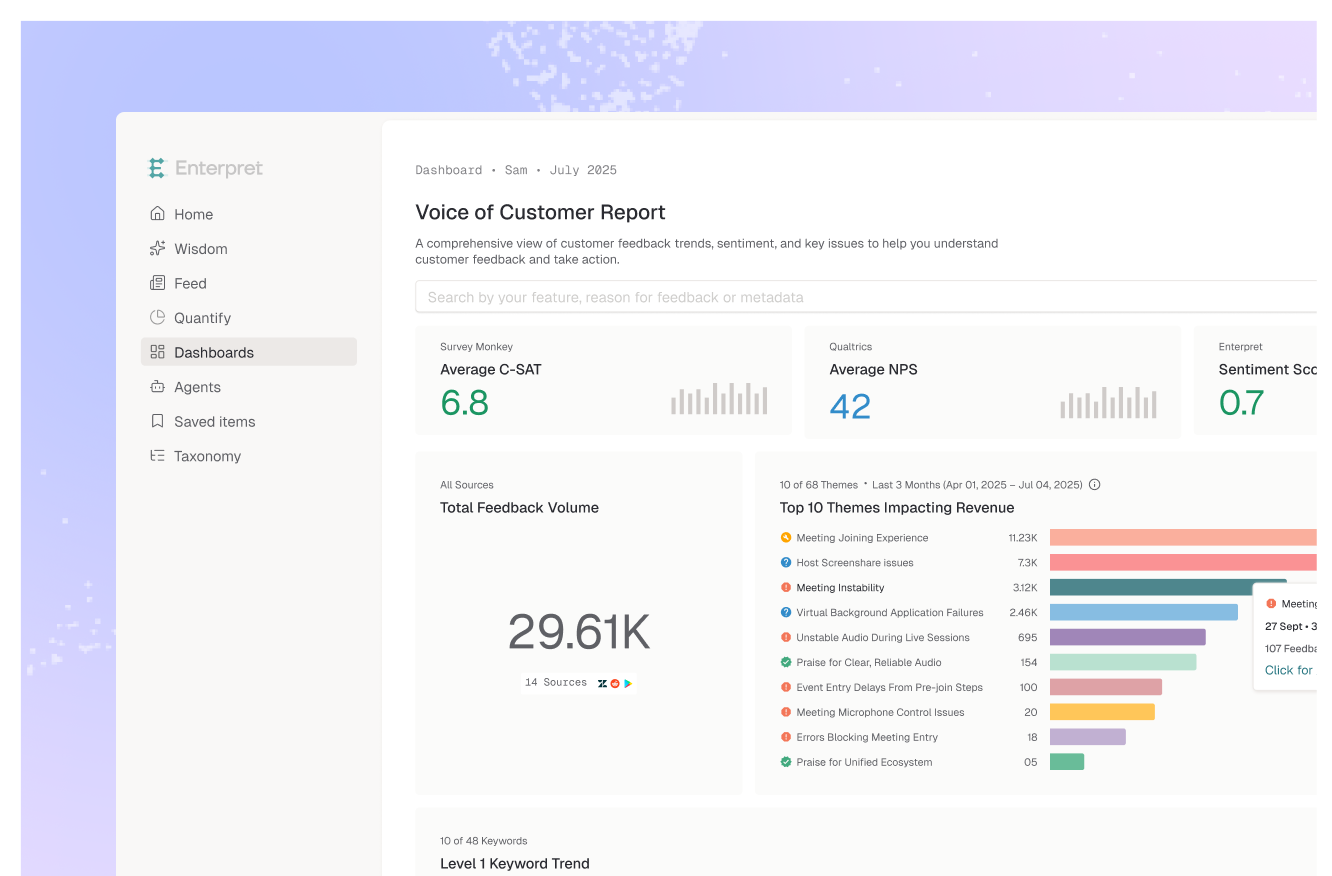
What customers say, need and are worth: feedback from tickets, calls, reviews and surveys, classified into stable themes and linked to accounts and revenue. This needs its own structure. A retrieval index can find a few similar complaints, but it cannot say how common they are. In Enterpret research comparing Agentic RAG, a Deep Research Agent and a context graph agent on 30 real voice-of-customer questions, the agent grounded in a persistent customer context graph scored 0.961 against 0.710 and 0.651, with its largest lead in analytical depth. See the 7 fields of a customer context block for what each unit should contain.
Who can see what, where each fact came from and how fresh it is, so agents respect access controls and can cite sources.
Expose every part through MCP servers or APIs so Claude, Cursor, Glean and internal agents read the same context. For the customer part, Enterpret's customer context graph and Wisdom MCP Server do this out of the box. For how the customer layer is built, see how to build a context layer for an AI-first company.
The infrastructure that gives AI agents structured, governed knowledge of how your company works: its entities, definitions, rules, products, decisions and customers.
No. A semantic layer defines metrics for BI tools. A context layer includes metric definitions but adds documents, policies, decisions, customer knowledge and permissions for agents.
Customer feedback is high-volume and unlabeled, and agent questions about it are about prevalence and trends. It must be classified and linked to accounts before agents can answer reliably.
Typically through MCP servers or APIs that return structured context with sources and permissions applied.
Lorem ipsum dolor sit amet, consectetur adipiscing elit. Suspendisse varius enim in eros elementum tristique. Duis cursus, mi quis viverra ornare, eros dolor interdum nulla, ut commodo diam libero vitae erat. Aenean faucibus nibh et justo cursus id rutrum lorem imperdiet. Nunc ut sem vitae risus tristique posuere.
The infrastructure that gives AI agents structured, governed knowledge of how your company works: its entities, definitions, rules, products, decisions and customers.
No. A semantic layer defines metrics for BI tools. A context layer includes metric definitions but adds documents, policies, decisions, customer knowledge and permissions for agents.
Why is customer knowledge separate from other context?
Typically through MCP servers or APIs that return structured context with sources and permissions applied.