





The 7 Steps to Analyze Product Reviews From UK Retailers Like Argos and Very

Feedback Analysis
November 5, 2026

Picture minute 22 of a product review. The room has finished reading your six pages in silence. The VP of Engineering looks up and asks one question: "How many customers is this, actually?" If the answer lives in your head, or in a spreadsheet you did not attach, the memo is over. The narrative did its job. The evidence did not.
The short answer: to write a 6-pager backed by customer evidence, start from the customer problem, gather evidence from every channel, size it by accounts and ARR instead of mentions, pick 2 to 3 quotes that represent the pattern, write the numbers inline in prose, move the detail to an appendix, pre-answer the hard questions in an FAQ, and draft with an AI assistant connected to real customer data so nothing is invented.
The format itself is well documented. Jeff Bezos has described how Amazon teams write six-page narrative memos instead of PowerPoint decks and read them silently at the start of each meeting. Accounts from former Amazon employees describe appendices packed with data that the narrative references rather than charts pasted into the body.
Search for help and you get templates and Claude skill files. Almost none explain the section a skeptical reader attacks first: the evidence. How to gather it, how much to include, how to present it in sentences when slides and bullet dumps are off the table, and how to make it survive a second question.
Most PMs treat customer evidence as a collection: a folder of quotes, a few Gong clips, a ticket screenshot. At Senior and Staff level, where you persuade peer teams without authority, that is not enough.
Evidence that persuades a room is a count with a denominator. How many accounts, which segments, how much ARR, how fast it is growing. Quotes then do one job: they make the count feel human. Not the other way around.
A quote proves a problem exists. A count proves it matters. A 6-pager needs both, in that order.
Write the problem statement before you touch the proposal, and write it in the customer's terms. "Admins at multi-team accounts cannot delegate access without granting full workspace control" beats "we should build granular roles." Start from the solution and every piece of evidence becomes confirmation.
One channel gives you one population: tickets skew toward admins hitting errors, sales calls toward prospects. Pull from Zendesk or Intercom, Gong and Zoom calls, Slack and community channels, G2 and app store reviews, and Salesforce or HubSpot notes, then manage multi-source customer feedback on one consistent set of themes. Cross-channel agreement is itself evidence.
Mention counts are inflated by a few loud accounts. One enterprise customer filing 40 tickets is one account. Report distinct accounts, the segments they sit in, and the ARR they represent, and compare it to a baseline period so the reader sees direction. This is the number that ends the "how many customers?" question. If your data does not join feedback to CRM records, fix that first: quantifying how customer feedback impacts revenue in Salesforce is the step most memos skip.
The angriest quote is the most memorable and the least representative. Pick quotes that sound like the median account in your count. Draw them from different segments or channels and attribute each by role and segment. A quote a reader can dismiss as an outlier weakens the number beside it.
The format exists to force complete thoughts, so the evidence section cannot be a bullet list of stats. Put the number in the sentence that makes the claim, follow it with the quote that illustrates it, and end with what it means. If a paragraph has no number, ask whether it is evidence or opinion.
The body carries the claim. The appendix carries the proof: the theme definitions you used, the date range, the channel breakdown, the account list by segment, and links to the source records. Reference it directly ("see Appendix B for the 37 accounts").
Write down the five questions the most skeptical reader will ask and answer them before they do. How many accounts? Is it growing or flat? Is it concentrated in one segment? What happens if we do nothing? What did customers who churned say about it?
Claude or Cursor can draft a strong narrative in minutes. Without access to your actual feedback data, they will also draft plausible evidence, and plausible is the problem. The fix is to connect the assistant to a source of record through an MCP server, so every number and quote it uses traces back to real records you can open.
Pasting a CSV into a chat window feels like evidence work. It is not. In Enterpret's study of run-to-run instability across eight frontier models, raw models asked the same question on the same data reported counts that moved 7.5 to 9.8% on matched themes between runs. A taxonomy-grounded agent showed zero volume disagreement across all 117 valid run pairs. That measures stability, not accuracy, but a number that changes when you ask twice will not survive a VP asking twice.
7.5 to 9.8% How much raw frontier models' reported counts moved on the same themes between runs, versus zero volume disagreement for a taxonomy-grounded agent. Source: Enterpret Research, "Same Feedback, Different Answer" (arXiv, 2026)
Retrieval alone does not fix it either. Enterpret research comparing Agentic RAG, a Deep Research Agent, and a context graph agent notes that "a top-k retrieval result cannot establish corpus prevalence," and that a fluent summary "can cite relevant records while attaching the wrong count." For a 6-pager, the wrong count is the whole failure.
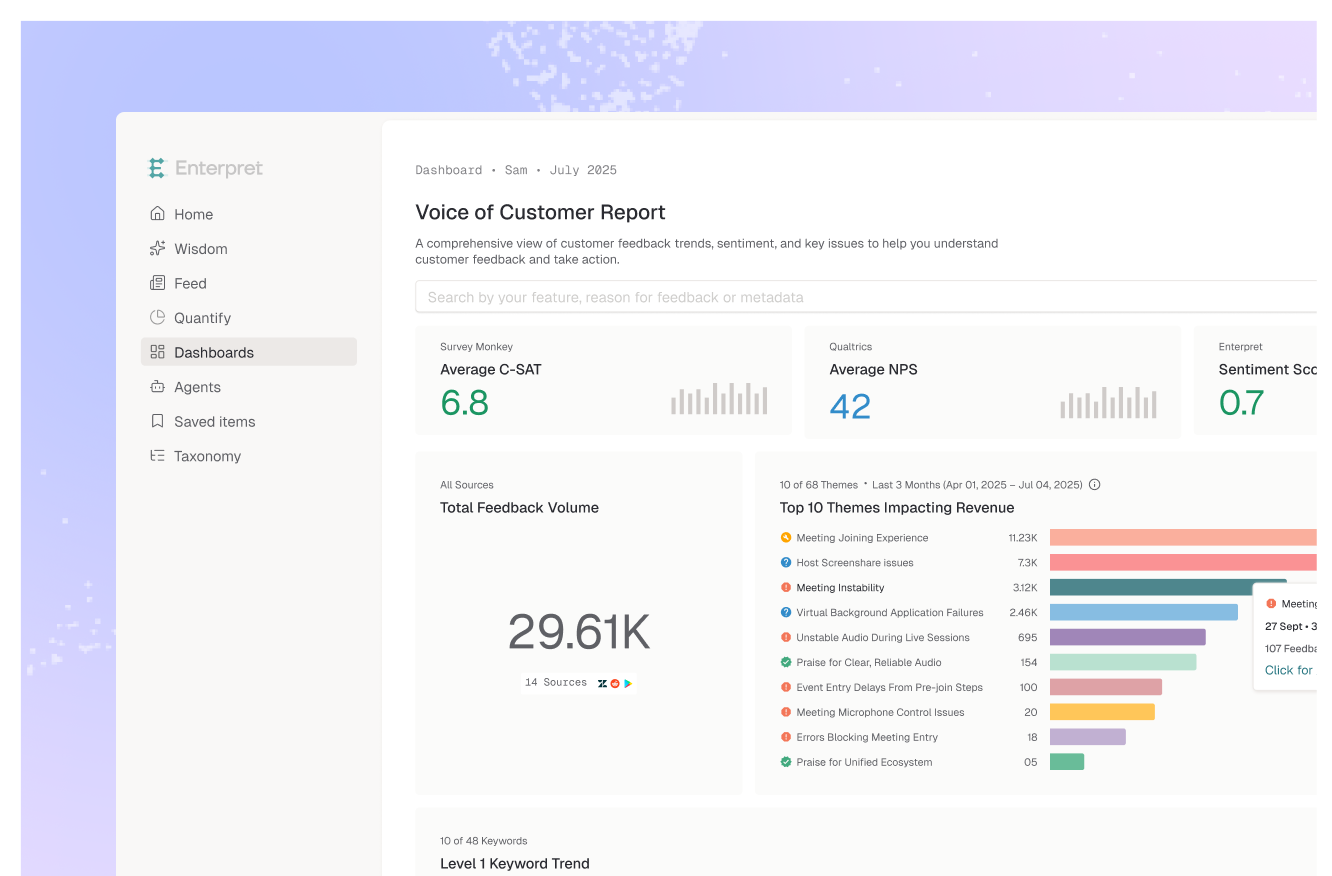
Enterpret is built for steps 2, 3, and 8. It unifies feedback from sources like Zendesk, Intercom, Gong, Slack, app stores, and Salesforce. Its Adaptive Taxonomy organizes themes on a consistent L1, L2, L3 product-area structure, so a problem that spans three teams shows up as one problem. The Customer Context Graph joins every theme to accounts, segments, and ARR, so step 3 is a query, not a week of spreadsheet work. Wisdom answers questions in natural language with the exact records behind each answer. The MCP server puts that same evidence inside Claude, Claude Code, Cursor, and Notion, which means you can access customer insights in Notion while you write. Connecting sources and building the graph takes integration and processing time, so set it up before your memo is due, not the night before.
Here is an illustrative before and after. The numbers are hypothetical.
Before: "Customers are frustrated with permissions. One admin told us, 'This is a nightmare and we are evaluating alternatives.'"
After: "Over the last two quarters, 37 enterprise accounts representing $5.8M in ARR raised the inability to delegate access without full admin rights, up from 21 accounts the prior two quarters. The issue appears in support tickets, sales calls, and QBR notes alike. As an IT admin at a 2,000-seat account put it, 'I end up making three people workspace owners because there's no middle option.' Appendix B lists every account and source record."
The second version answers "how many," "how much," "is it growing," and "where's the proof" before anyone asks. For more models of this shape, see these voice of customer report examples.
The first evidence-backed memo takes effort. The second is faster, because the themes, account joins, and appendix already exist. By the fifth, peers ask for your numbers before your proposals. Credibility compounds. So does its absence.
In the body, one paragraph per key finding: a sized count (accounts, segments, ARR, trend), one illustrative quote, and the implication. Account lists, theme definitions, and source records belong in the appendix.
Accounts. Mention counts are skewed by a few high-volume customers, while distinct accounts and their ARR show how widespread and valuable the problem is.
Pick 2 to 3 quotes that sound like the typical account in your count, not the angriest one. Attribute each by role and segment.
Use AI to draft prose, not to produce counts from pasted data. Enterpret's research found raw frontier models' counts on the same themes moved 7.5 to 9.8% between runs, while a taxonomy-grounded agent showed zero volume disagreement. Connect the assistant to a source of record through an MCP server so every number traces to real records.
At minimum: how many accounts are affected, how much ARR, whether it is growing, whether it is concentrated in one segment, and what happens if the team does nothing.
If you want every number in your next memo to trace back to real customer records, see how Enterpret works.
Research cited
Lorem ipsum dolor sit amet, consectetur adipiscing elit. Suspendisse varius enim in eros elementum tristique. Duis cursus, mi quis viverra ornare, eros dolor interdum nulla, ut commodo diam libero vitae erat. Aenean faucibus nibh et justo cursus id rutrum lorem imperdiet. Nunc ut sem vitae risus tristique posuere.


