



Technique
Feedback summarization
Condense large volumes of open text feedback into short summaries so teams can quickly understand what customers are talking about.
Best for: early orientation before deep analysis

The first time you paste a CSV of customer feedback into ChatGPT, it feels like a shortcut you have been waiting for.
You export a few thousand NPS comments or support tickets, drop them in, and within seconds you see a clear list of themes. Onboarding confusion. Missing features. Performance issues. You copy the output into a slide, refine a few sentences, and suddenly customer feedback looks structured enough to share.
That initial experience is powerful. It is also why so many teams begin experimenting with ChatGPT customer feedback analysis techniques before considering a dedicated system.
This article explains how teams are using ChatGPT for customer feedback analysis today, where those techniques genuinely help, and where they begin to introduce risk. It also clarifies how ChatGPT fits inside a real feedback system rather than acting as the system itself.
Product and CX teams aren’t turning to ChatGPT because they believe it’s a silver bullet; they’re turning to it because the alternatives feel heavy. Spreadsheets are familiar but depend on constant manual tagging and discipline. Traditional analytics tools handle numeric metrics well yet struggle with messy, unstructured text, while dedicated feedback platforms can feel like a large investment when teams are still trying to prove that customer feedback will meaningfully influence decisions.
ChatGPT, by contrast, is immediately available. There’s no setup, no procurement process, and no schema to design. Teams paste in feedback, ask questions in natural language, and get answers back. For teams under pressure to show momentum and to demonstrate that they’re using AI, leveraging ChatGPT for customer feedback analysis feels practical and efficient. In the early stages, it often is.
ChatGPT is most effective as a first pass over customer feedback as it helps teams orient themselves quickly and articulate what they are seeing.
Most teams use ChatGPT customer feedback analysis in a few consistent ways.
These techniques reduce cognitive load where instead of reading every comment, teams interact with a compressed version of customer sentiment. That compression is useful when the goal is exploration or communication.
In practice, most teams follow a familiar workflow. They export feedback from support tools, surveys, reviews, or call notes, split the data into batches to work around token limits, and prompt ChatGPT to summarize or cluster themes. Prompts are refined until the output looks reasonable, then manually reviewed, cleaned up, and copied into spreadsheets or slides. The following month, the process starts over.
At first, this approach feels efficient. Insights surface faster than before, and the output is polished enough to share. Over time, however, the limitations become harder to ignore. Each analysis begins from scratch, structure doesn’t persist, and comparing results across time becomes increasingly difficult.
When feedback starts to inform real decisions, this fragility becomes a problem.
These issues tend to surface as small moments of doubt rather than obvious errors, but over time they accumulate and erode confidence in the insights. A product manager asks whether onboarding issues are improving quarter over quarter. A leader wonders whether complaints are coming primarily from enterprise customers or smaller accounts. An executive asks to see real customer examples behind a theme.
At that point, ChatGPT output is often not enough. Even with custom GPTs layered on, ChatGPT remains stateless by design, meaning last quarter’s taxonomy, definitions, and decision context aren’t reliably preserved or enforced. The same feedback can surface different themes depending on how the prompt is written. Spreadsheets don’t fix this, they simply shift responsibility for consistency onto people, and as teams scale and products evolve, that manual enforcement breaks down.
The result is subtle but serious: insights become difficult to defend. When decisions are challenged, teams struggle to trace conclusions back to specific customers, segments, or verbatim feedback, and conversations drift from evidence toward interpretation.
This isn’t a prompting problem. It’s a structural one.
It’s tempting to believe that better prompts or stricter instructions are the solution, but while prompt quality matters, it doesn’t solve the underlying problem. ChatGPT is not built to maintain a living taxonomy or preserve relationships between themes, customers, and segments over time, making it unsuitable as a durable source of truth for decisions that must be revisited and defended months later. That level of reliability requires a system, not a one-off analysis.
Once customer feedback influences roadmap priorities, staffing decisions, or executive conversations, expectations change. Teams require a system that continuously ingests feedback from multiple sources, maintains consistent structure as products and markets evolve, preserves traceability from high-level themes to individual customer comments, and supports meaningful segmentation across customers and revenue. Just as importantly, it must allow teams to revisit past insights and understand how decisions were made. ChatGPT and spreadsheets were not designed for this role.
ChatGPT does not disappear in a more mature feedback setup; its role simply becomes clearer. Instead of being responsible for creating and maintaining structure, it functions as an interface for exploration on top of structured data. Teams can still ask natural-language questions and generate summaries, but the system beneath ensures those answers remain consistent, traceable, and grounded in shared definitions over time.
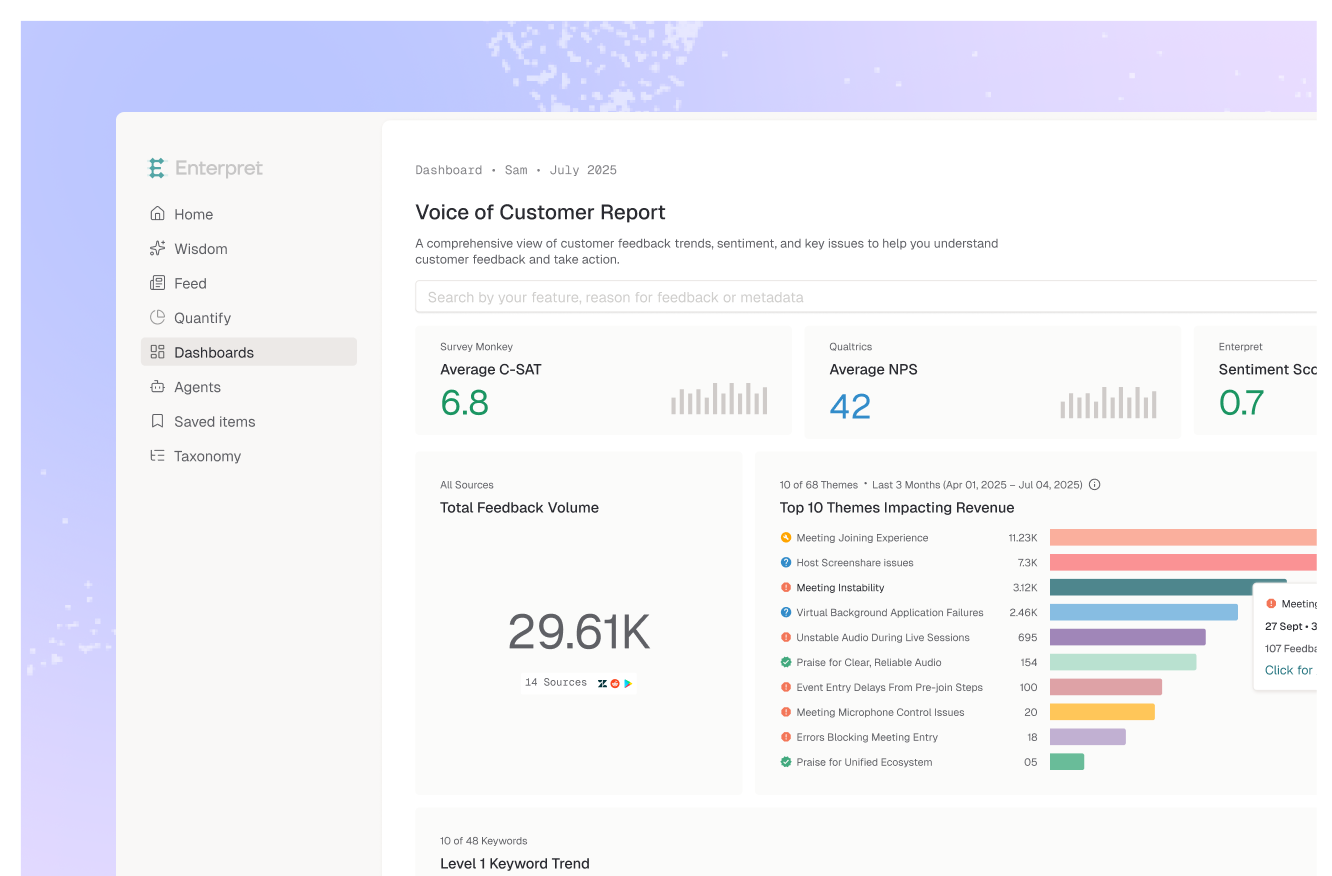
Enterpret provides that missing foundation. It continuously ingests customer feedback, automatically builds and maintains a living taxonomy, and preserves traceability from high-level insights to individual customer comments. With this infrastructure in place, teams can apply LLM-driven analysis without reprocessing data or worrying that insights will drift as the organization scales.
In this model, ChatGPT enhances exploration, and Enterpret ensures reliability.
The future of customer feedback analysis is not about choosing between AI and structure, but about combining the two. As feedback volumes grow and decisions face greater scrutiny, teams will move away from one-off analyses and toward systems that treat customer feedback as institutional knowledge rather than ad hoc input. Generative AI will continue to play an important role in this shift, but only when paired with durable structure that preserves context, consistency, and traceability over time.
Platforms like Enterpret are designed for this future. They allow teams to pair the flexibility of AI with the rigor required for decision-making, so insights don’t just sound reasonable in a meeting; they hold up when someone asks to see the evidence.
If you are currently using ChatGPT and spreadsheets for customer feedback analysis, it is worth pausing for a quick gut check.
Ask yourself a few questions.
• Can you compare themes quarter over quarter without redoing the analysis from scratch?
• Can you clearly show which customers, segments, or revenue bands sit behind each insight?
• When a roadmap decision is challenged, can you pull up the original customer feedback that supports it within minutes?
If not, the issue isn’t your prompts or effort; it’s the absence of a real system. ChatGPT is powerful for exploring feedback, and spreadsheets can capture snapshots of that thinking, but neither was designed to maintain structure, context, and evidence over time.
Enterpret fills that gap. It provides the feedback infrastructure that continuously organizes customer feedback, maintains a living taxonomy, and preserves traceability from high-level themes to individual comments, so insights remain consistent and defensible as teams and products evolve.
With Enterpret, teams can still use natural-language, LLM-driven analysis without redoing work each cycle or worrying that insights will drift.
See how Enterpret works at decision depth.
