



The Three Phases of Product Feedback: From Startup to Scale

Most teams don't realize they have outgrown their feedback tools until something breaks. Manual work piles up. Planning slows down. Leaders feel disconnected from what customers are actually saying.
So when is the right time to invest in real feedback intelligence? How do you know if your team has moved beyond what simple tools can support?
This guide walks through the three phases of feedback maturity, with a framework to help you identify where you are today and what tools are the best fit at your scale.
Phase I: Building with Intuition
When you're small - a few engineers shipping fast or a single PM managing a brand new product - expertise and intuition works great. You reading every piece of feedback (maybe a few hundred items), and you talk to early users. And it all fits in your head.
At this stage, quick AI summaries are enough. You paste a CSV into ChatGPT or Claude, ask for themes, and move on. You are looking for broad direction, not precision, and the volume is low enough for this approach to work.
Your tools: Spreadsheets, ChatGPT or Claude, Slack channels, Google Forms, Zoom transcripts.
Your process: Read everything, trust your judgment, ship fast.
Phase II: Growing Pains
As the team grows, complexity grows with it. You have more users. More surfaces. More features that create new questions. Your product pod expands to five people. You find yourself facing a new risk: repeatedly leaning on the same power users for insights.
Two problems appear.
- You risk burning out those customers with too many requests.
- Your insights become biased toward a small, highly engaged group.
At this point, your feedback volume has jumped to five thousand items a year. LLMs struggle to hold this much context, while you’re unable to read everything. Manual tagging becomes a recurring tax.
Most teams adopt a basic feedback tool at this point - something like Amplitude’s Feedback module or the analysis features in your survey tool. You run a quarterly analysis to reorient yourself, asking questions like “What changed this cycle” or “What themes should I validate before the next roadmap?”
Teams still rely heavily on intuition, and though you’re becoming more data-informed, the process to pair qualitative and quantative data is still manual. You pull it when you're doing planning cycles, not continuously.
Your tools: PostHog, simple feedback analysis tools, spreadsheet pivots.
Your process: Quarterly deep dives, manual tagging, slow synthesis.
Phase III: Scaling with a Real Feedback System
The tipping point comes when your product and organization become too complex for manual workflows. You now have multiple product areas, each with its own PM. You have many surfaces. You have many types of users. The pace of inbound feedback accelerates, and at this stage, your volume is well beyond 5,000+ each year.
Decision making also changes. You can no longer rely on local intuition or local research. You need a shared view of customer reality to prioritize at the portfolio level. You need clarity on what impacts revenue, retention, adoption, or loyalty. Without a system that provides that context, prioritization becomes guesswork.
This is where Phase I and Phase II tools fail. Manual tagging breaks. Quarterly reports come too late. LLMs cannot help if they run out of context window for your products, usage data, customer data.
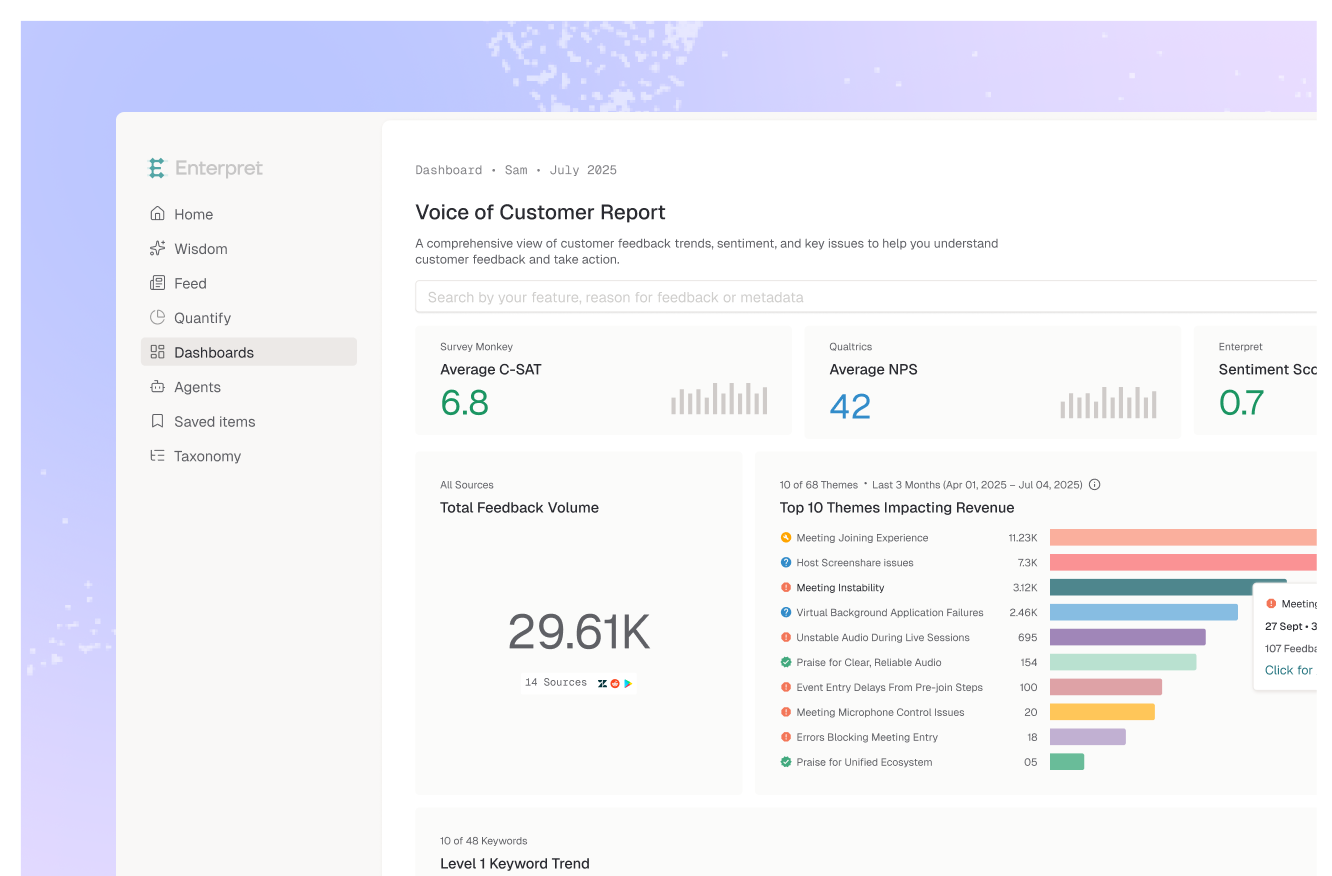
This is where a customer intelligence platform like Enterpret becomes foundational. It gives teams a unified, real-time view of customer feedback, grounded in business context to support global-level prioritization decisions.
At this stage, teams need:
- Weekly reporting and trend visibility
- Feedback linked to accounts, cohorts, revenue, and usage
- Categorization that is custom to the business
- Proactive alerts, instead of reactive reporting
Maturity Assessment: Where Are You Today
The Bottom Line
Phase I: Use whatever is fast and free. LLMs and spreadsheets work well.
Phase II: Use simple tools to generate quarterly views. Accept that insight comes in batches.
Phase III: Invest in Customer Intelligence. Your scale now demands a system that understands your business context and delivers intelligence that teams can act on.
The biggest mistake teams make is forcing Phase I or Phase II tools to operate at Phase III scale. You cannot manually tag fifty thousand pieces of feedback. You cannot use quarterly reports when your product changes every week. You cannot rely on LLMs alone without a contextual knowledge graph or adaptive taxonomy that reflects your unique products and customers.
If you are spending more time organizing feedback than using it to ship meaningful work, you have crossed the threshold. It is time to upgrade your system.
