





The Fundamentals Don't Change. The Training Does.

Every coach eventually gives some version of the same speech: the best performers aren't doing anything exotic; they're executing the fundamentals better and more consistently than everyone around them. We all nod along, because it's obviously true. And then most of us go right back to hunting for the secret move.
Basketball offers about as clean an example as exists. Tim Duncan won 5 championships with a game built on bank shots, footwork, positioning and defensive discipline, the parts of the sport that rarely make a highlight reel. Shaquille O'Neal, who gave him the nickname "The Big Fundamental," has described himself as mostly talent with some fundamentals, and Duncan as the reverse... and has admitted that Duncan finishing with one more ring than him still bothers him. The flashier player had more raw ability. The more fundamental player had more trophies.
The same pattern shows up in amateur motorsports, where drivers will happily spend thousands on stickier tires, stiffer suspension and more horsepower, or burn hours debating advanced techniques, while leaving whole seconds on the table through inconsistent braking points and poor vision. Upgrades are easier than discipline. They're also a lot more fun to talk about.
Every product team knows the fundamental
Business has its own version of this, and it isn't a secret. Product managers know they need to listen to customers. It's in every job description, every onboarding deck, every leadership offsite. Ask any PM whether customer feedback matters and you'll get an emphatic yes. Ask the follow-up questions, though, and the picture gets murkier. When did you last read 50 raw pieces of feedback in one sitting? What are the 5 most common complaints this quarter, in customers' own words? Which item on the current roadmap can you trace back to specific customer evidence, rather than an internal hunch? Most of us, with the best of intentions, don't have crisp answers. We know the fundamental; we don't practice it consistently. That's precisely the gap between Duncan and everyone else who knew the bank shot mattered.
Why growth erodes the habit
Of course, almost every company starts out customer-centric, because at the beginning there's no alternative. The founders are on every sales call. Support tickets land in a shared channel that everyone reads. The PM knows the top 20 customers by name and can tell you what each of them is frustrated about this week. Nobody needs a process for listening; listening is the default state of a small company.
Growth changes that quietly. For example, let's say (these numbers are invented, but not unrealistic) a company now handles 3,000 support tickets, 400 recorded sales and success calls and 1,500 survey responses a month, plus app reviews, community threads, messages from CSMs, and so on. A diligent PM who reads feedback for 30 minutes every single day might get through 5% of it, and probably the most recent or most dramatic 5% at that. The feedback didn't go away. It fragmented across a dozen tools owned by a dozen teams.
At the same time, a new set of questions moves in. How do we increase net retention? How do we hit the revenue target? Which segment should we prioritize next year? These are legitimate, important questions, and I'm not suggesting anyone stop asking them. The problem is where the answers come from. Dashboards can tell you that retention dropped; they can't tell you why. So the why gets filled in from the inside: the loudest executive, the most recent escalation, the customer whose CEO happens to know ours. The company remains customer-centric in principle and becomes inside-out in practice.
The obvious response is to mandate more listening. Require every PM to do 5 customer calls a month, or rotate everyone through support for a day each quarter. Those are good habits, and I'd keep them. But they don't solve the scale problem; 5 conversations out of 10,000 customers is an anecdote, not a signal. Think of a chef who tastes every plate in a 10-table restaurant, and then picture that same chef trying to taste every plate at a 400-cover banquet. The commitment to quality hasn't changed, but tasting can no longer be the whole quality system.
Same fundamentals, better apparatus
Steph Curry is worth looking at here. Since 2011, his trainer Brandon Payne has run him through ball-handling drills (one of the oldest fundamentals in the sport) while Curry wears strobe goggles that interrupt his vision, dribbling with one hand and catching tennis balls with the other. Critics scoffed that all a basketball player needs is a ball, a hoop and a court. They missed the point. Curry wasn't hunting for a trick to replace the fundamentals; he was training the same fundamentals at a level of intensity and precision that a ball and a hoop alone couldn't provide.
Racing works the same way. A novice can improve by feel. A serious driver eventually hits the limit of what feel can detect, so they add a data logger and video, not to change what they're practicing (braking, turn-in, throttle application, and so on) but to see their execution at a resolution of tenths and hundredths.
This is the distinction that separates a useful tool from another shiny upgrade. Some tools replace a fundamental: the stiffer suspension that masks a driver's sloppy inputs, or the dashboard that reduces customer experience to a single score nobody interrogates. Others help you practice a fundamental at a level you couldn't reach without them. A reasonable test is to ask whether the tool brings you closer to what customers actually said, or abstracts you further away from it.
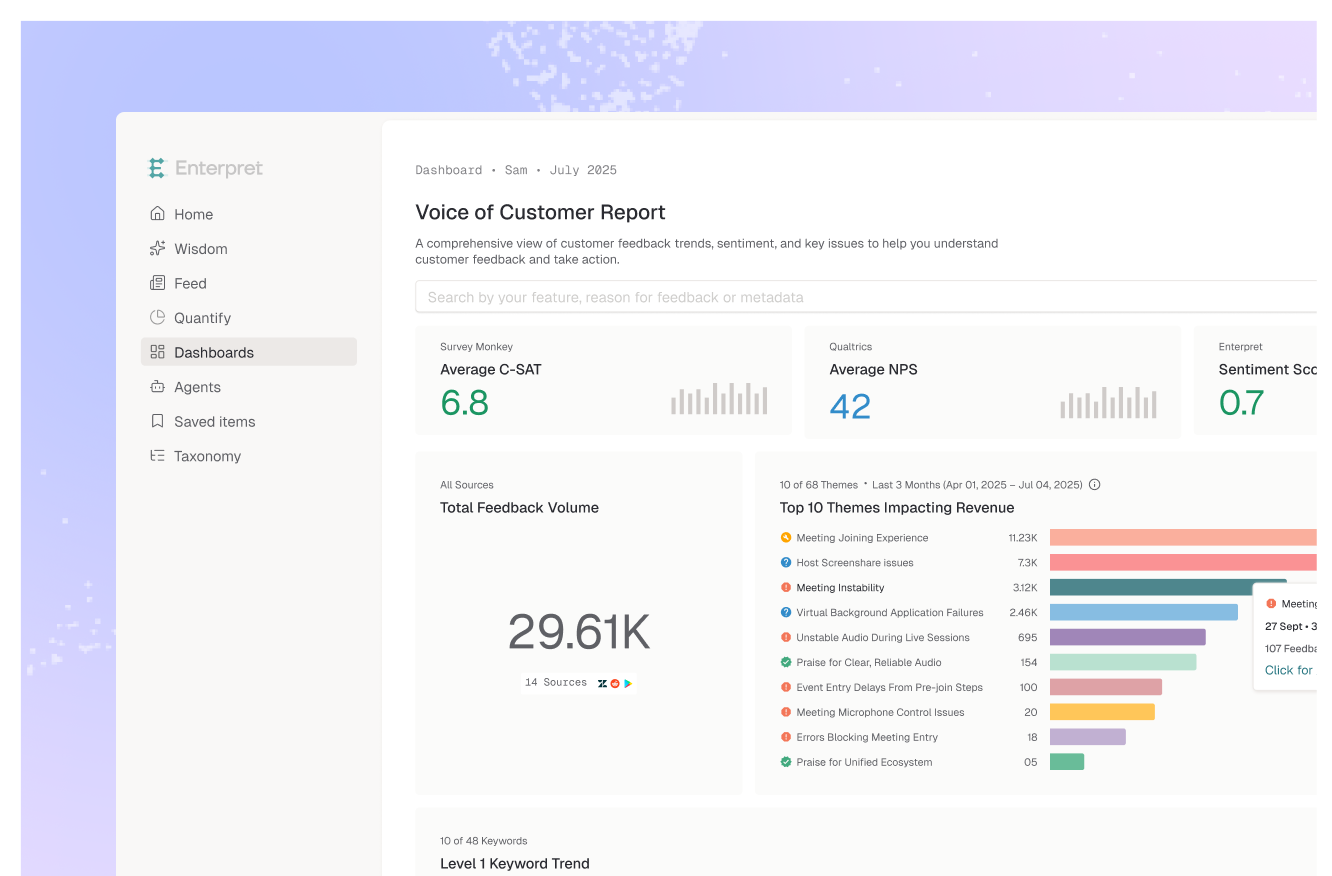
Modern customer intelligence platforms like Enterpret exist to pass that test. They pull feedback from support, calls, surveys, reviews and the rest into a single place, organize it into themes, and let a PM ask something like "why are mid-market customers churning?" and get an answer backed by customers' own words. The fundamental is identical to what a founder did on day one. The apparatus is built for 10,000 customers instead of 10.
Nobody outgrows the fundamentals. What changes as we level up is how we train them. A high school point guard can work on ball handling in the driveway; an MVP trains it with strobe goggles. A 10-person startup can listen by reading every ticket; a 1,000-person company needs a system that does the reading at scale. The teams that stay close to their customers as they grow aren't doing anything exotic...they've refused to let growth become the excuse to stop practicing.


