



Context Engineering for Customer Feedback: 6 Rules for Giving AI Agents the Voice of the Customer

Feedback Analysis
November 12, 2026

Enterpret and Canny solve different problems. Canny is a feature request and feedback portal: customers submit and vote on ideas, Autopilot captures requests from sales and support conversations, and teams share a roadmap and changelog. Enterpret is a customer intelligence platform: it classifies all feedback, not just requests, from 50+ channels into a product-specific taxonomy and connects it to accounts, revenue and owners. Choose Canny if a public portal and request tracking are the core need. Choose Enterpret if you need to understand every complaint, bug and request across channels and tie it to revenue. Some teams use both.
The two get compared because both now use AI to pull feedback out of conversations. The difference is what they do with it next.
| Dimension | Canny | Enterpret |
|---|---|---|
| Built for | Collecting and managing feature requests and ideas | Understanding all customer feedback and its business impact |
| Unit of analysis | Ideas, with insights attached | Every feedback record, classified into themes |
| Feedback types | Mainly requests and ideas | Requests, bugs, complaints, praise, churn reasons |
| Capture | Portal, plus Autopilot from Gong, Intercom, Zendesk, Slack and others | 50+ channels including tickets, calls, surveys, reviews and communities |
| Categorization | Groups you define, which Autopilot sorts into | Adaptive Taxonomy learned from your product and kept current |
| Revenue context | Requests tied to customer, account and revenue | Customer Context Graph linking feedback to accounts, revenue, tickets and owners |
| Customer-facing | Public portal, voting, roadmap, changelog | Internal; no public portal |
| Querying | Ideas list, filters and summaries | Wisdom natural-language analysis, dashboards, AI agents, MCP server |
Canny's model centers on ideas: things customers want built. Autopilot reads conversations and turns feedback into new ideas or into insights on existing ones. That is the right shape for "what should we build next."
Enterpret classifies everything customers say, including problems that are not requests: bugs, confusing workflows, outages, billing friction, reasons for churn. Many of the most expensive issues never arrive phrased as a feature request. If you want those in the same view as requests, that is the core difference.
In Canny, you set up groups with descriptions, and Autopilot uses those descriptions to sort incoming feedback. That works well when your product areas are stable and well defined.
Enterpret's Adaptive Taxonomy builds a product-specific hierarchy from your feedback and updates it as you ship, so new features and new problems get their own themes without someone creating them first. See tests to run on AI feedback categorization during a vendor demo to compare both on your data.
Both connect feedback to customers and revenue. Canny ties each request to the customer, account and revenue behind it, so you can see which ideas matter to valuable accounts. Enterpret's Customer Context Graph links every feedback record, not only requests, to users, accounts, revenue, tickets, opportunities and owners. The practical test: can you answer "which open deals mentioned this problem, and what is the ARR at risk from accounts complaining about it?" in one place. For more on this, see tools for linking feature requests in open deals to feedback themes.
Canny's Feedback Portal is a real strength: customers can submit ideas, vote, follow progress on a roadmap and read a changelog. Autopilot captures stay internal unless you publish them. Enterpret has no public portal; it is an internal system for product, CX and revenue teams. If closing the loop publicly with a voting board is central to how you work, Canny does something Enterpret does not.
Canny Autopilot captures from tools including Gong, Intercom, Slack, Zendesk, Help Scout, Freshdesk, Zoom and tl;dv, plus review sites such as G2, Capterra, Trustpilot, the App Store and Google Play, with more through Zapier. Enterpret ingests from 50+ channels, including support tickets, call recordings, surveys and NPS, app and review sites, community platforms and CRM data, and normalizes them into one model. If your feedback is mostly sales and support conversations, both cover the core; check the long tail you rely on with integration coverage checks.
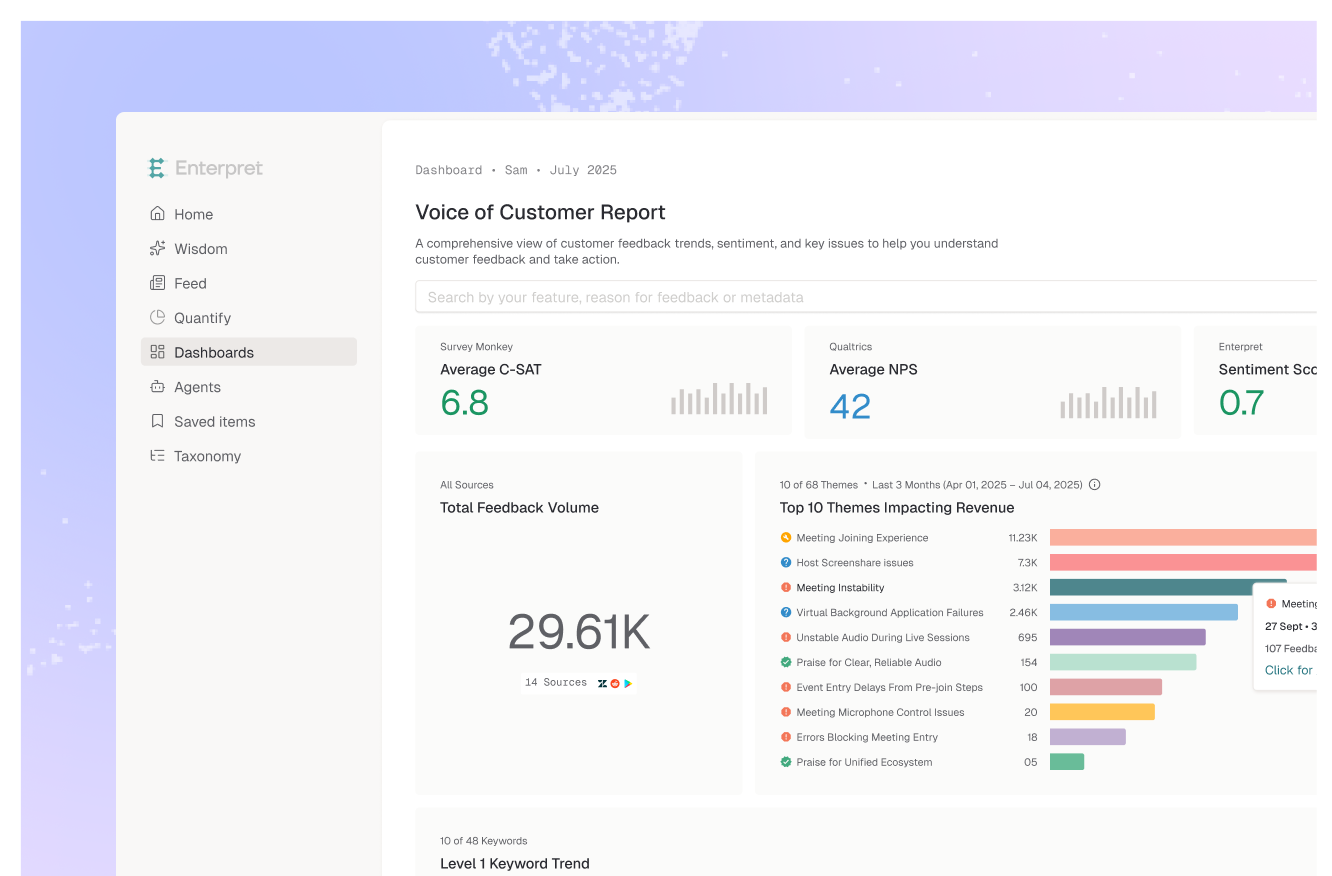
Canny surfaces themes, urgency for specific customers and summaries inside its Ideas view. Enterpret adds Wisdom for natural-language analysis across all feedback, AI agents and alerts that flag spikes to Slack, Linear or Jira, and an MCP server that lets Claude, Claude Code, Cursor, Codex, Glean or Notion query the data directly. That matters if engineers or AI agents, not only PMs, need customer context.
Choose Canny if: your main need is collecting, deduplicating and prioritizing feature requests; you want a public portal with voting, roadmap and changelog; and your product areas are stable enough to define as groups up front.
Choose Enterpret if: you need to understand all feedback, not only requests; your feedback spans many channels and teams; you need to tie themes to accounts, revenue and open deals; or you want AI agents and tools to query customer context.
Use both if: you want a public request portal and a full intelligence layer. Teams in this setup typically keep Canny for the customer-facing portal and use Enterpret for analysis across every channel.
For a broader field, see the six best Canny alternatives.
Picture a B2B team whose top-voted idea was "better CSV export." Product scheduled a rebuild. When the team classified all support tickets and call notes, not just ideas, the larger theme was "exports time out on large workspaces," a performance bug that enterprise admins reported in tickets and never posted as an idea. Fixing the timeout addressed most of the demand in a sprint; the rebuild moved down the roadmap. What worked: looking at all feedback, tied to account size. What did not: treating vote count as the only signal of demand.
Partly. Enterpret replaces Canny's internal request capture and prioritization with analysis of all feedback tied to revenue, but it does not offer a public portal with voting and a changelog. Teams that need the portal sometimes run both.
Yes. Canny Autopilot captures feedback from tools including Gong, Intercom, Zendesk, Slack, Help Scout, Freshdesk and Zoom, and turns it into ideas or insights on existing ideas.
It classifies all feedback types, not just requests, into a taxonomy learned from your product, links every record to accounts, revenue and owners, and makes that context available to AI agents through an MCP server.
Canny offers a public feedback portal where customers submit and vote on ideas, plus a public roadmap and changelog for closing the loop.
If you are weighing the two, see how Enterpret works on your own feedback, and bring your top-voted ideas to see what sits behind them.
Lorem ipsum dolor sit amet, consectetur adipiscing elit. Suspendisse varius enim in eros elementum tristique. Duis cursus, mi quis viverra ornare, eros dolor interdum nulla, ut commodo diam libero vitae erat. Aenean faucibus nibh et justo cursus id rutrum lorem imperdiet. Nunc ut sem vitae risus tristique posuere.