





The 7 Steps to Analyze Product Reviews From UK Retailers Like Argos and Very

Feedback Analysis
November 5, 2026

Should you scrape Best Buy and Walmart reviews? You can, but for most brand insights and product teams it is the wrong first move. Scraping means owning a pipeline that breaks when pages change, reading each retailer's terms of use, handling reviewer data carefully, and then still turning raw text into answers. The alternative is a feedback platform where you paste product links or product IDs and new reviews flow in, already analyzed. Here are the five things to know before you decide.
The review page is now the loudest focus group your product has. If you sell TVs, smart home devices or appliances through retailers, customers are telling you exactly what broke. Just on someone else's website.
For a brand that sells through retail, retailer reviews are often the largest stream of unprompted product feedback it has. Shoppers rarely visit your site to complain. They go back to where they bought.
That signal is scattered. One product can have separate review pages on Best Buy in the US, Best Buy in Canada and Walmart in the US, and quality, product and CX teams each want a different cut of it.
Search this topic and you get code tutorials from scraping vendors like Oxylabs, Scrapfly, SerpApi and Crawlbase. They are good at what they do: showing engineers how to extract fields from a page.
But an insights team is really asking "what are customers saying about our products, every week, across every retailer?" Extraction is step one of a much longer job.
The real decision: do you want to own a review collection pipeline, or do you want Customer Intelligence on retailer reviews? Those are different projects with different owners.
A scraper works on the day it ships. After that, it is engineering time, every quarter, indefinitely.
Before anyone writes a line of code, read each retailer's terms of use, for every country site you plan to cover. Walmart.com's Terms of Use (last updated September 9, 2026) include restrictions on using robots, spiders or other automated tools to retrieve or gather content from its sites, and on using site materials to train AI models.
Some retailers also run developer programs. Best Buy publishes API terms for its developer program that cover registration, rate limits and how long content may be cached. Walmart's developer portal includes Reviews APIs for Marketplace sellers, which are built around a program to grow review counts rather than exporting review text.
The practical move: check whether each retailer offers an official route that fits your use case, and bring legal in early. This is not legal advice.
Retailer reviews usually carry a reviewer name or nickname, and the text itself can include details about the person. Once that lands in your systems, your company's privacy obligations apply to it.
This is where most scraping projects stall. A CSV of 40,000 reviews (an illustrative number) is not an answer. Your VP of Product wants to know which feature drives one-star reviews on the new model, and whether it is worse in Canada.
Getting there takes consistent categories by product area and feature, breakdowns by retailer and country, and trends over time. That is the work of turning open-text feedback into measurable insights, and it is bigger than collection.
Pasting exports into an LLM helps with a quick read, but consistency suffers. In Enterpret's study of run-to-run instability across eight frontier models, raw models changed more than half of their top theme set between two runs at 100 records, rising to a churn of 0.726 at 5,000 records. If your top issues change every time you ask, you cannot track them.
86 to 88% Reduction in theme churn when an AI agent is grounded in a persistent taxonomy instead of re-clustering raw feedback on every run (same model, 1,000 records of enterprise support feedback). Source: Enterpret Research, "Same Feedback, Different Answer" (arXiv, 2026)
The study measured stability, not accuracy. But stable categories are the minimum bar for a trend line you can trust.
Instead of owning collection, you can bring retailer reviews into a feedback platform. With Enterpret, you paste product links or product IDs and Enterpret pulls every new review on that product. Supported retailers include Best Buy (US and Canada), Walmart (US), Argos, Very (including Littlewoods), Orange, MediaMarkt (including Saturn and MediaWorld), JB Hi-Fi and the Meta Store.
Your team's job becomes choosing which products to track, not keeping a pipeline alive.
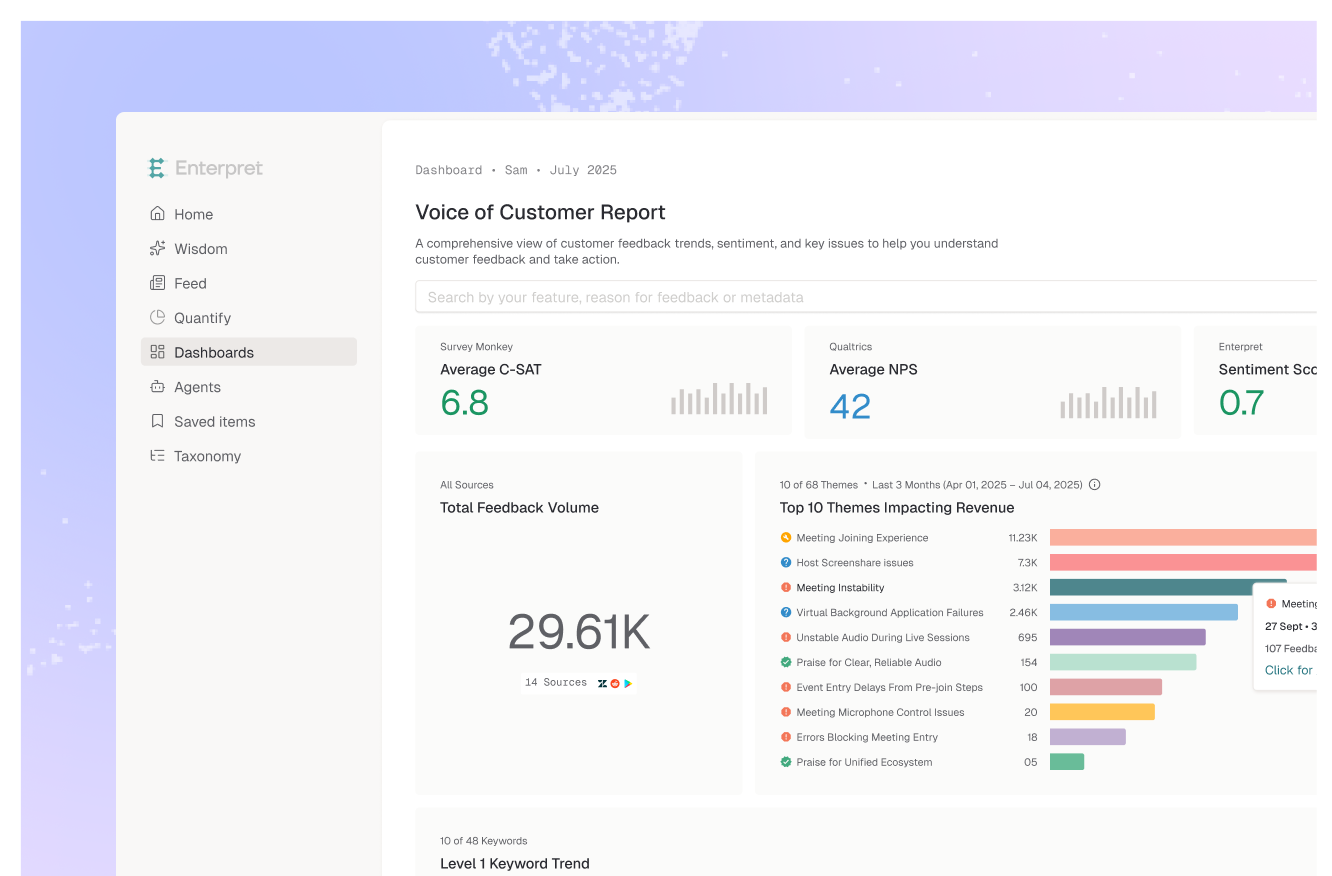
Retailer reviews sit alongside support tickets, surveys, returns notes and app reviews on one Adaptive Taxonomy (product area, feature, sub-feature) that updates as products and SKUs change. Break results down by retailer, product and country, ask Wisdom questions in natural language with the exact reviews behind each answer, and set AI agents and alerts. Trade-off: it is a platform decision, so it fits teams that want ongoing analysis rather than a one-off pull.
| Question | DIY scrapers | Scraping service or API | Feedback platform (Enterpret) |
|---|---|---|---|
| Who maintains collection? | Your engineers | The vendor handles extraction; you manage jobs and outputs | You choose products by link or ID |
| Terms and privacy review | Your team, per retailer and country | Your team, per retailer and country | Review with your legal and privacy teams as with any vendor |
| Analysis included? | No, you build it | No, you receive raw data | Yes: taxonomy, trends, natural language questions, alerts |
| Best for | Teams with spare data engineering capacity and a narrow, one-off need | Data teams that want raw review fields in their own warehouse | Insights, product and quality teams that want answers every week |
Picture a hypothetical smart home brand launching a video doorbell at Best Buy (US and Canada) and Walmart. In week two, an AI agent flags a new "Installation > Wiring" theme spiking in Canadian reviews and alerts Slack.
The product manager asks Wisdom which models are affected and reads the reviews behind the answer. Support tickets show the same issue, so a Linear ticket gets filed. Nobody touched a scraper.
It is the pattern DTC brands use when they analyze reviews, tickets and surveys together, extended to the retail shelf. Teams can also query the same data from Claude, Claude Code or Cursor through Enterpret's MCP server.
Collecting reviews is plumbing. Customer Intelligence is knowing, every week, what your customers on every shelf are telling you and who needs to act on it. The brands that win the next product cycle will be the ones that stop arguing about scrapers and start acting on the signal.
Retailer reviews are moving upstream. They used to be a marketing metric; now they are a product quality signal that belongs next to support tickets and returns data.
Mapping how your team gets there? Compare the five ways to set up a customer feedback analytics platform, or see how to leverage ChatGPT for customer feedback analysis if you are weighing an LLM-only approach.
It depends on each retailer's terms of use, the country site and your intended use, so read the terms for every site you cover and involve your legal team. Walmart.com's Terms of Use restrict automated tools that gather content, and Best Buy publishes separate terms for its developer program. This is not legal advice.
For a quick read, yes, but results are hard to track over time. Enterpret's research on eight frontier models found raw models changed more than half of their top themes between two runs at 100 records, while an agent grounded in a persistent taxonomy cut theme churn by 86 to 88% (arXiv:2610.08036). The study measured stability, not accuracy.
Use a feedback platform that supports retailer reviews. In Enterpret, you paste product links or product IDs and it pulls every new review on that product from major retailers in the US, Canada, UK, Europe and Australia, including Best Buy and Walmart. Reviews are then categorized on the same taxonomy as your support tickets and surveys.
Often, yes. Reviews usually show a reviewer name or nickname, and the text can include personal details. Store only what you need, follow your company's privacy policy and retention rules, and ask your privacy team for guidance.
If your team wants retailer reviews analyzed next to every other customer signal, see how Enterpret works.
Research cited
Lorem ipsum dolor sit amet, consectetur adipiscing elit. Suspendisse varius enim in eros elementum tristique. Duis cursus, mi quis viverra ornare, eros dolor interdum nulla, ut commodo diam libero vitae erat. Aenean faucibus nibh et justo cursus id rutrum lorem imperdiet. Nunc ut sem vitae risus tristique posuere.


