



The 5 Ways DTC Brands Analyze Product Reviews, Support Tickets, and Post-Purchase Surveys Together

November 2, 2026

Your CSM hears it on a Tuesday call: "We're taking a fresh look at our stack before renewal." It goes into a call summary, nobody tags it, and three months later the account is gone. The warning was in the transcript the whole time. It just never left the recording.
The 5 ways to detect churn signals from call transcripts are Enterpret, Gong trackers and account insights, a CS platform such as Gainsight or ChurnZero, manual QBR and call review, and a DIY LLM pipeline. What separates them is whether a signal is read for meaning, compared against accounts that renewed, and tied to the ARR and renewal date of the account that said it.
Not every complaint predicts churn. The signals worth tracking in CSM, support and sales calls are the ones that change the shape of the relationship:
For the broader list across tickets, surveys and reviews, see our guide to feedback signals that indicate churn risk.
Most tools handle the first criterion reasonably well now. The baseline and the revenue context are where approaches actually split.
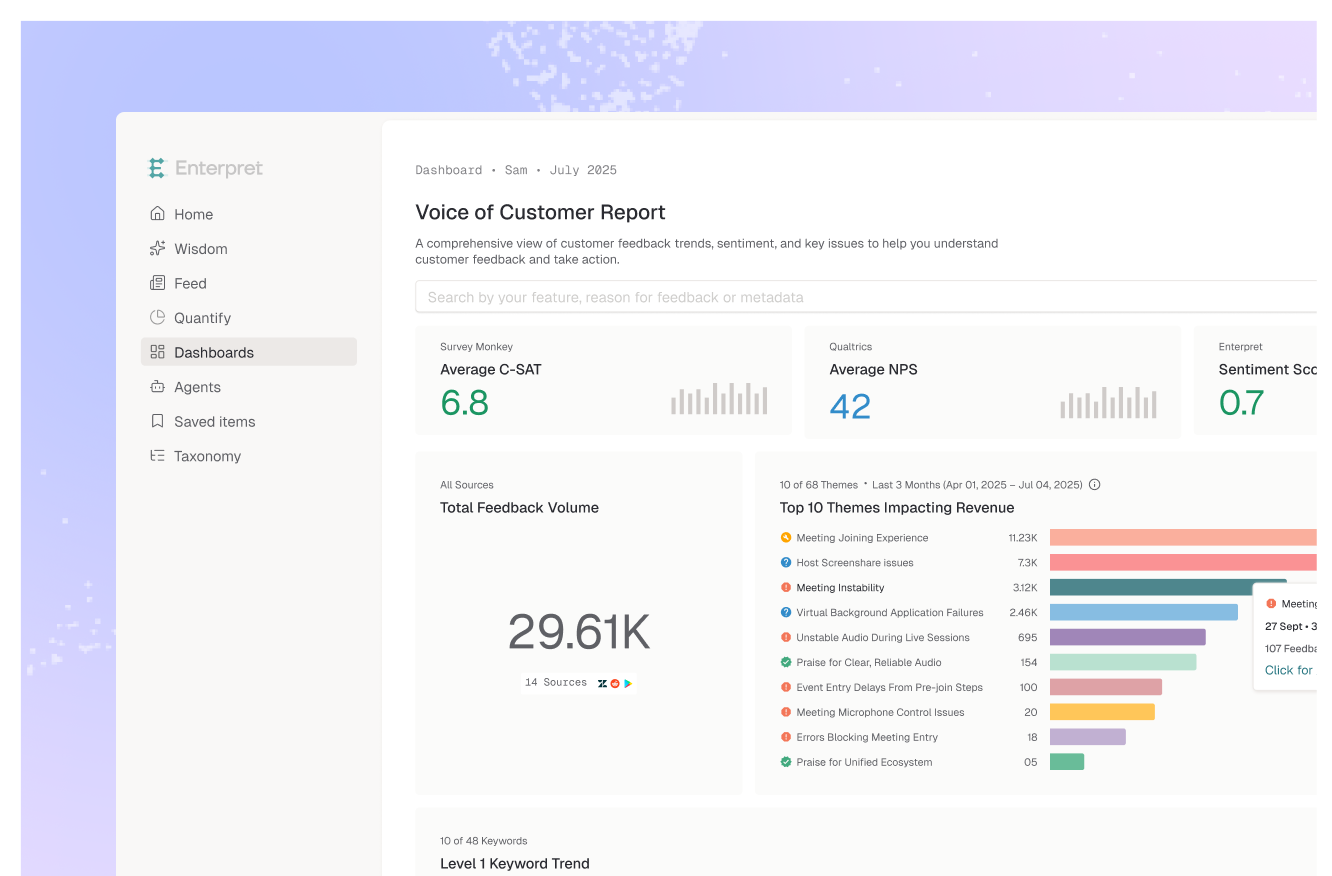
Enterpret ingests call transcripts from Gong, Chorus, Grain and Fathom alongside support tickets, surveys, reviews and CRM data from Salesforce or HubSpot. Adaptive Taxonomy learns the categories from your own feedback, so "workaround talk" or "renewal hesitation" becomes a consistent theme instead of a keyword list someone has to maintain. The Customer Context Graph links each signal to the account, its segment and its ARR, which is what lets you compare churned accounts to retained ones and see which themes actually separate them. AI Agents then watch for those patterns and alert the right team in Slack when they appear on an account. Enterpret has run this kind of analysis across roughly 20,000 accounts in its research on which feedback signals predict churn.
The tradeoff: Enterpret needs integrations connected and processing time before the baseline is useful, so it is not a same-day setup. It is the intelligence layer, not a CS task manager, so most teams pair it with the CS platform where renewals and playbooks already live.
Best for: B2B teams that want call signals compared against retained accounts, weighted by ARR, and combined with what tickets and surveys are saying.
Gong's keyword trackers flag exact words or phrases, which works for competitor and product names. Its AI trackers detect concepts and intent rather than exact words, either prebuilt by Gong or written as custom natural-language questions (custom ones consume Gong credits). Gong says it flags churn risk by analyzing customer sentiment, ghosting and stakeholder changes, and its Ask Anything feature lets a CSM ask whether there are signs a customer may not renew.
The limit is scope. Gong sees the calls and emails it records, not your Zendesk queue or NPS verbatims, and trackers tell you a topic came up, not whether that topic shows up more in churned accounts than retained ones. You still decide which trackers matter. For extraction inside Gong specifically, see the tools to extract feature requests and competitor mentions from Gong calls.
Best for: sales-led and CS teams standardized on Gong who want account-level risk flags without adding a new tool.
CS platforms are where health scores, renewals and playbooks already run, so pulling call signals into them keeps action close to the owner. Gainsight's Staircase AI analyzes customer communications across email, meetings and support channels, and Gainsight says it detects sentiment shifts, competitive mentions and relationship changes up to six weeks earlier than usage data alone. ChurnZero's Gong integration pulls Gong transcripts and AI highlights into customer timelines and Command Center dashboards, and lets teams build segments from meeting note content.
The gap is depth on the language itself. These platforms are built to act on a signal, and how well they categorize what customers said depends on the inputs and configuration. If that is your setup, see how teams add voice of customer to ChurnZero or Gainsight health scores.
Best for: CS orgs that want risk signals inside existing health scores, CTAs and renewal workflows.
A CSM listening back to the last three calls before a QBR will catch things no model does: the hesitation before an answer, the champion who sounds checked out. For a small book of strategic accounts, this is genuinely the highest-fidelity method.
It does not scale and it does not compare. A CSM with 60 accounts cannot review every call, and individual judgment cannot tell you whether "we're consolidating vendors" predicts churn across your base or just felt ominous once.
Best for: a short list of top-ARR accounts, as a complement to automated detection.
Export transcripts, send them to an LLM with a prompt like "flag churn risk signals," and write the output to a spreadsheet or Slack. It is fast to prototype.
The problem is consistency. In Enterpret's tests across eight frontier models, the most consistent one still changed more than 60% of its theme set between identical runs on the same 100 records, and raw LLM counts shifted 7.5 to 9.8% between runs on unchanged data. A churn trend built on that will move when nothing changed. You also have to build the account join, the retained-account baseline and the routing yourself.
Best for: one-off investigations of a single churned account, or teams with data engineering time to maintain the pipeline.
Keyword trackers find what you already know to look for. Churn rarely announces itself in words you would put on a tracker list. A champion leaving shows up as a new attendee. A workaround shows up as "we just pull it into Sheets." Declining engagement shows up as the absence of words entirely.
Even the signals trackers do catch are noisy without a baseline. Your healthiest accounts mention competitors, because engaged customers evaluate the market. If you alert on every competitor mention, CSMs learn to ignore the alert within a month. The question is not "did a competitor come up?" It is "does this pattern appear more in accounts that churned than in accounts that renewed?" That is a prevalence question, and Enterpret research notes that "a top-k retrieval result cannot establish corpus prevalence," so search over transcripts alone cannot answer it. That requires comparing churned vs retained customer feedback, not counting mentions. It is the same discipline behind detecting churn drivers from customer feedback, applied to the call channel.
Then the signal has to carry weight. Ten mentions of a pricing concern across small accounts and one mention from your largest customer 60 days before renewal are not the same priority. A tracker counts them equally. A system that knows ARR and renewal timing does not.
Finally, calls are one channel. The customer who sounds calm with their CSM may be filing angry tickets with support. Detection built on transcripts alone will miss that, which is why teams need to unify churn signals from calls, tickets, and surveys. A call intelligence tool tells you what was said. Churn detection tells you what it means for the account.
The decision rule: if you cannot say which call signals separate your churned accounts from your retained ones, start with the approach that builds that baseline, then route its output into whatever tool your CSMs already use.
The most reliable call signals are champion change, renewal or contract-term questions, competitor mentions with buying intent, workaround talk, and the same unresolved issue raised across multiple calls. Declining engagement, such as shorter calls or rescheduled QBRs, matters too. Which of these predicts churn for your business depends on how often each appears in churned versus retained accounts.
Yes, within the calls and emails it records. Gong offers keyword trackers and AI trackers that detect concepts and intent, and says it flags churn risk based on sentiment, ghosting and stakeholder changes. It does not see support tickets or surveys from other systems, and it does not compare signals against a retained-account baseline on its own.
Enterpret ingests transcripts from Gong, Chorus, Grain and Fathom and categorizes them with Adaptive Taxonomy, a taxonomy learned from your own feedback. The Customer Context Graph links each signal to its account and ARR, so you can compare churned and retained accounts. AI Agents then alert teams in Slack when those patterns appear on an account.
For a single account or a small batch, yes, and it is a useful way to explore. For ongoing detection, consistency is the issue: Enterpret's research found that the most consistent of eight frontier models still changed more than 60% of its theme set between identical runs on the same records. You would also need to build the account join, baseline and routing yourself.
It depends on your renewal cycle and how often you talk to customers. Signals like champion change or renewal-term questions often surface on calls well before a cancellation shows up in billing or usage data.
If you want call signals tied to the accounts and revenue behind them, see how Enterpret helps teams identify churn signals.
Research cited
Lorem ipsum dolor sit amet, consectetur adipiscing elit. Suspendisse varius enim in eros elementum tristique. Duis cursus, mi quis viverra ornare, eros dolor interdum nulla, ut commodo diam libero vitae erat. Aenean faucibus nibh et justo cursus id rutrum lorem imperdiet. Nunc ut sem vitae risus tristique posuere.