



The 6 Steps to Build a Multi-Level Customer Feedback Taxonomy

September 30, 2026

Consumer apps lose users fast. A typical app sheds most of its installs within the first week, and by day 30 many categories are past a 99 percent drop-off. Buried in your app store reviews are the reasons the next cohort will leave: crashes clustered on a specific version, billing and cancellation complaints, and features users expected and did not find. These are churn signals, stated in plain language, timestamped, and version-stamped. The problem is that they arrive as thousands of short, scattered reviews, and reading them one by one is not analysis. Turning them into a ranked, trackable set of churn drivers is.
The strongest tools to analyze app store reviews for churn signals are Enterpret, unitQ, AppReply, Chattermill, Thematic, and Amplitude. They split into two jobs: mining the reviews for the themes that predict churn, and, for behavioral tools, correlating those themes with the retention curve. The tool that reduces churn most is the one that turns review text into churn-driver themes tied to app version and cohort, early enough to fix what is driving users away.
The real differentiator is whether the tool surfaces accelerating, version-aware churn themes early, or just aggregates review sentiment after the fact.
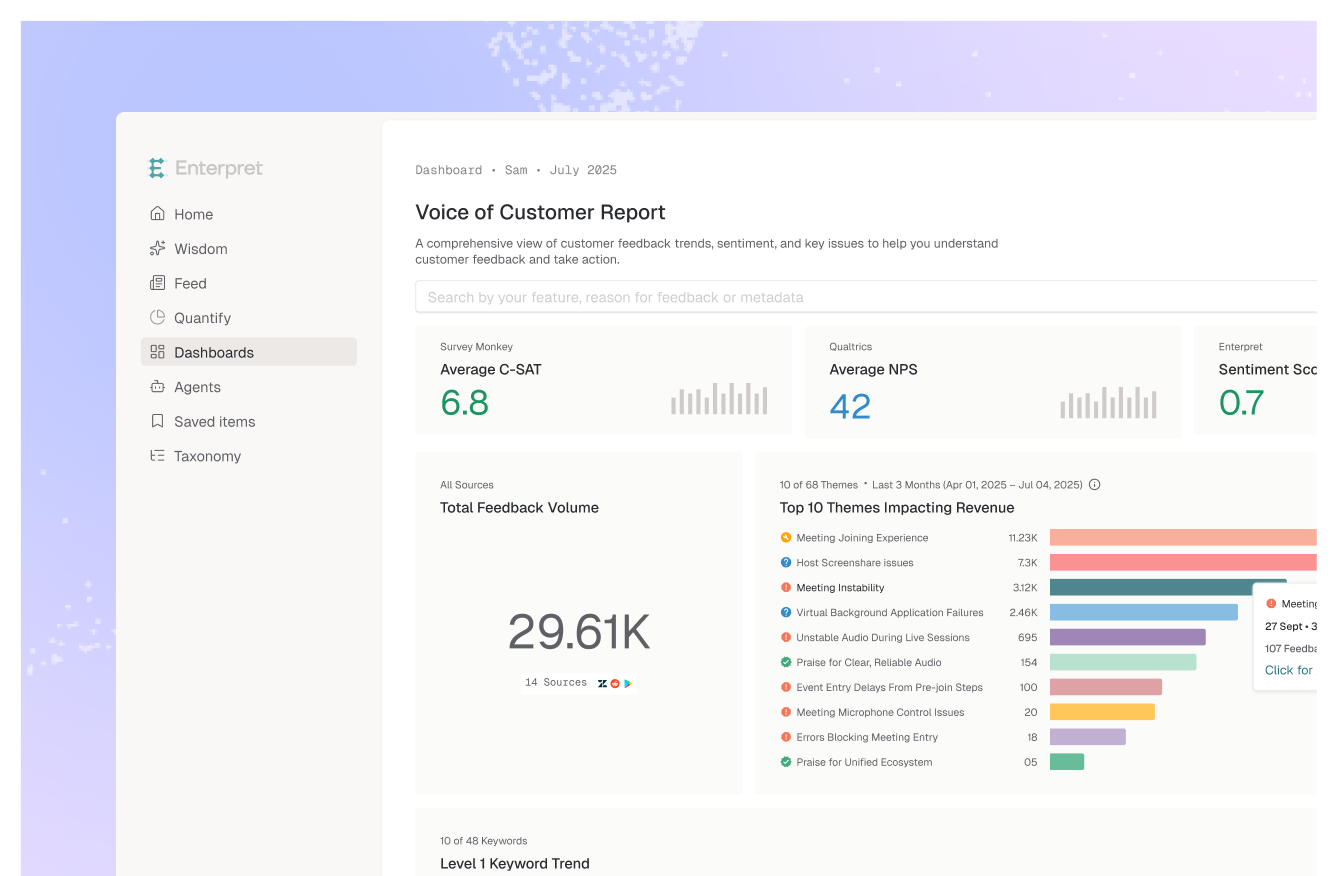
Enterpret ranks first because it turns app store reviews into tracked churn drivers rather than a sentiment score. It ingests App Store and Google Play reviews alongside 50-plus other channels, categorizes every review with an adaptive taxonomy that learns your churn-signal themes and applies them consistently across versions, and ties each theme to the cohorts and accounts behind it through the customer context graph. Because categorization is continuous, an accelerating crash or billing complaint after a release surfaces while you can still fix it, and because reviews sit beside support and in-app feedback, you see whether a churn signal is app-store-only or systemic.
Best for: consumer app teams that want review-based churn drivers tracked by version and tied to cohorts.
unitQ scores product quality from reviews and other feedback, flagging quality issues and anomalies that map closely to churn risk in high-volume consumer apps.
Best for: consumer teams monitoring quality regressions that drive churn.
AppReply focuses on app store review analysis across both stores, with sentiment, theming, and response tooling oriented to mobile teams.
Best for: mobile teams wanting focused app-store review analysis and responses.
Chattermill applies enterprise text analytics to reviews and other CX channels at high volume, useful for large apps analyzing churn themes at scale.
Best for: enterprise consumer apps analyzing reviews at scale.
Thematic offers explainable theme detection over review text, useful when the churn-driver themes need to be defensible to stakeholders.
Best for: insights teams that need explainable churn themes.
Amplitude is the behavioral complement: it shows where churn happens in the retention curve and by cohort, so review themes can be matched to the drop-off they explain.
Best for: product teams correlating review themes with behavioral churn.
Most churn analysis is behavioral and lagging: it tells you a cohort left after it already has. Reviews are different because they are stated intent. A user who writes that the app crashes every launch since the last update, or that they cannot find how to cancel, is narrating the churn about to happen, often before the usage data reflects it. That makes review mining an early-warning system, but only if the signals are categorized continuously and read against app version, since a crash theme is actionable when tied to the release that caused it and noise otherwise. This is the same discipline behind analyzing App Store and Play Store reviews in general and specifically analyzing app store reviews by app version, and it connects directly to detecting silent churn before customers cancel, where the earliest signal is often a review, not a usage drop.
If your priority is quality-regression monitoring, unitQ fits; for focused app-store review tooling, AppReply; for enterprise-scale text analytics, Chattermill; for explainable themes, Thematic; for the behavioral side of churn, Amplitude. But if the goal is turning reviews into tracked, version-aware churn drivers tied to cohorts and the rest of your feedback, weight churn-signal categorization and context over sentiment scoring, and Enterpret is the stronger fit. The decision rule: treat reviews as an early-warning system, and pick the tool that reads them that way.
The clearest are crash and performance complaints clustered on a specific version, billing and subscription friction, explicit cancellation intent, and missing features users expected. Each predicts churn and is stated directly in the review text.
Reviews are stated intent, so a user often describes why they will leave, such as repeated crashes or inability to cancel, before behavioral data shows the drop-off. Categorized continuously, reviews warn you earlier than usage metrics alone.
Because a crash or regression complaint is only actionable when tied to the release that caused it. Averaging reviews across all versions hides which update introduced the problem, so version and device resolution is essential.
Enterpret ingests App Store and Google Play reviews with 50-plus channels, categorizes them with an adaptive taxonomy that learns churn-signal themes and holds them stable across versions, and ties each to cohorts and accounts through the customer context graph, surfacing accelerating drivers early.
They are a strong early signal but not complete. Pairing review themes with behavioral retention data and other feedback channels gives the fullest picture, showing both why users are leaving and how much churn each driver explains.
If you want app store reviews turned into tracked churn drivers by version and cohort, see how Enterpret structures reviews with its adaptive taxonomy.
Lorem ipsum dolor sit amet, consectetur adipiscing elit. Suspendisse varius enim in eros elementum tristique. Duis cursus, mi quis viverra ornare, eros dolor interdum nulla, ut commodo diam libero vitae erat. Aenean faucibus nibh et justo cursus id rutrum lorem imperdiet. Nunc ut sem vitae risus tristique posuere.