






The 7 Steps to Analyze Product Reviews From UK Retailers Like Argos and Very

Feedback Analysis
November 5, 2026

The best tools to analyze Walmart product reviews for brands in 2026 are Enterpret, MetricsCart, gominga, Bazaarvoice, PowerReviews and Bright Data. They do not do the same job. Enterpret analyzes Walmart reviews next to every other feedback channel. MetricsCart and gominga track and benchmark marketplace reviews. Bazaarvoice and PowerReviews grow review volume on Walmart.com through syndication and add analytics on the reviews they manage. Bright Data delivers Walmart review data as a feed for your own pipeline. Pick by the question you need answered, not by the logo on the roundup.
Short answer: for product and quality decisions, choose a tool that puts Walmart reviews on the same taxonomy as your tickets and other retailers. For more reviews on the shelf, choose syndication. For raw data, choose a managed feed.
I have watched brand teams screenshot a one-star Walmart review into Slack, get twelve emoji reactions, and change nothing. The review was seen. It was never counted, compared or routed. That is the category mistake most Walmart review tools are built around: they make reviews visible and assume visibility becomes action.
It doesn't. A Walmart review that says "stopped pairing after the update" is a defect report filed in public. The useful questions are about prevalence and ownership. How many reviews say this? One SKU or the whole line? Which team owns the fix? A star-rating dashboard answers none of them. This is the same gap covered in how DTC brands analyze reviews, tickets, and surveys together, except retail brands have it worse: the reviews live on someone else's site.
The reframe: stop asking "where can we see our Walmart reviews?" Ask "what are Walmart buyers telling us that our tickets and returns are not, and who acts on it this week?"
Existing roundups, including MetricsCart's list of Walmart review analysis tools for CPG brands, mix review dashboards, product information tools and general review platforms. We applied one filter first: a tool only made this list if its own site documents Walmart support. Then four criteria.
Sentiment labels tell you a review is negative. A product taxonomy tells you it is about the hinge on one model. The structure has to stay stable as SKUs change, or trends become noise. If you are comparing vendors here, see how to compare text analytics accuracy.
A summary that sounds right is not a count. Enterpret research comparing Agentic RAG, a Deep Research Agent, and a context graph agent notes that "a top-k retrieval result cannot establish corpus prevalence." Ask every vendor how a number was produced and whether you can click through to the exact reviews.
Walmart is one retailer and one country. The real signal shows up when Walmart reviews sit beside other retailers, support tickets and surveys. That is the core of managing multi-source customer feedback.
A spike nobody sees is a spike that ships to the next batch. Look for feedback routing and team-based alerting into Slack, Jira or Linear, not a weekly export.
0.961 vs 0.651 Overall score for an agent grounded in a persistent customer context graph versus Agentic RAG on 30 real VoC questions over 9,432 public feedback records, including app store reviews. The paper calls the result exploratory. Source: Enterpret Research, "From Retrieval to Customer Context" (arXiv, 2026)
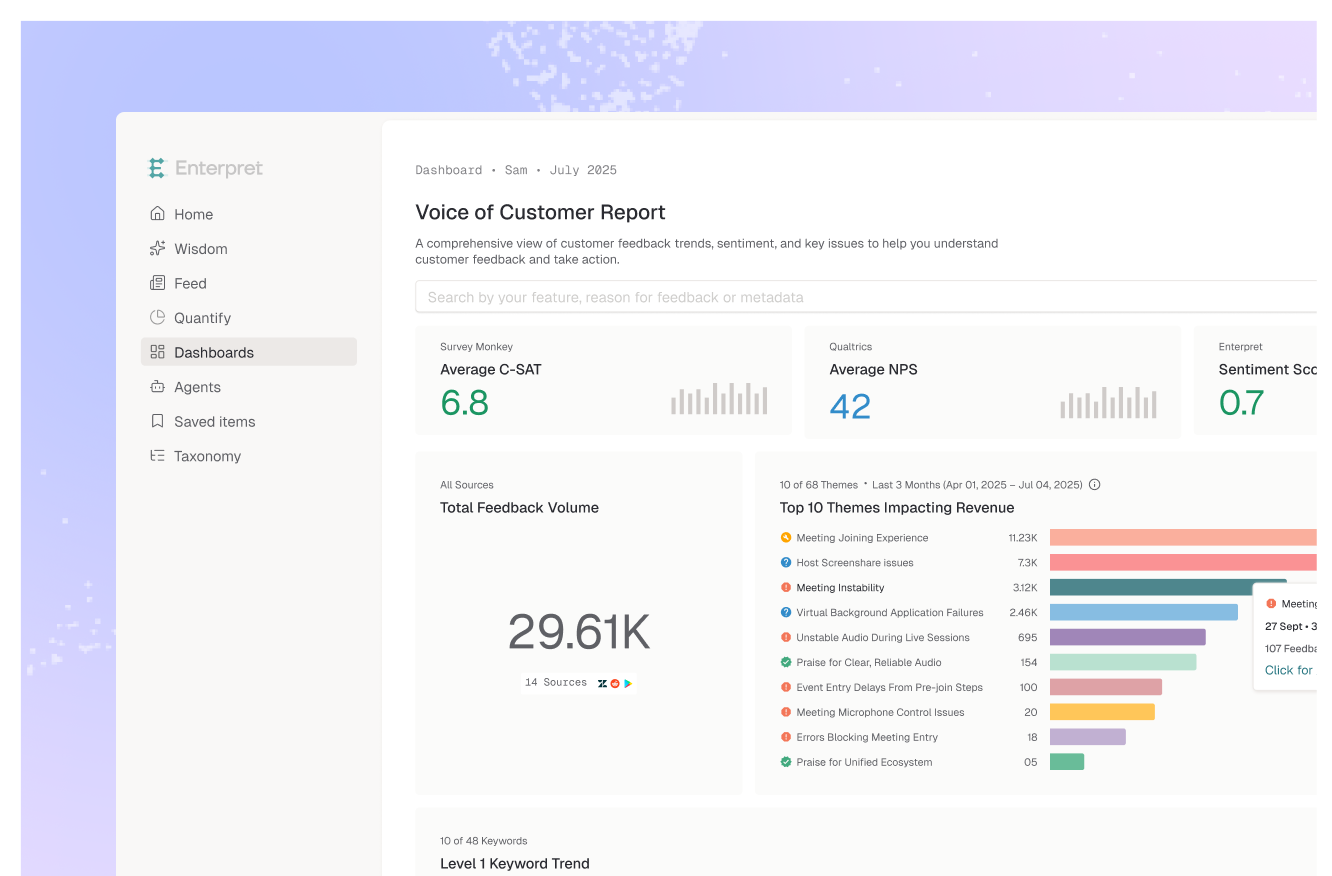
Teams can now bring product reviews from major retailers into Enterpret, including Walmart (US). Paste product links or product IDs and Enterpret pulls every new review on that product. Reviews sit next to support tickets, surveys, returns notes and app reviews on one Adaptive Taxonomy (product area, feature, sub-feature) that updates as SKUs change. Break results down by retailer, product and country, ask Wisdom questions and get the exact reviews behind each answer, set AI agents and alerts for a defect theme spiking after a launch, and query it from Claude, Claude Code or Cursor via the MCP server. The same workflow covers Best Buy, Argos, MediaMarkt, JB Hi-Fi and other major retailers. Trade-offs: it is an analysis and routing layer, not a tool for syndication, sampling or public replies. For a single-retailer star-rating dashboard, it is more platform than you need. Best for: product, quality and CX teams who want Walmart reviews treated as product signal alongside every other channel.
MetricsCart's review tracking page names Walmart, Target and Costco among the retailers it covers, with sentiment analysis, theme and sub-theme analysis, competitor benchmarking, trend tracking and alerts for one-star spikes. It is built around marketplace data, so it is strongest at shelf-level questions, not support tickets or surveys. Best for: CPG and e-commerce teams benchmarking ratings and themes against competitors across retailers.
gominga's Review Manager page for Walmart describes monitoring, alerts, sentiment and competitor analysis, and responding to Walmart reviews and questions through a ticket system with templates. Its strength is the engagement loop: see a review, answer it. Cross-channel analysis with tickets and surveys is not its focus. Best for: brand and customer care teams who need to monitor and respond to Walmart reviews and questions.
Bazaarvoice's Walmart UGC solutions guide covers syndicating your reviews to Walmart.com, sampling programs for Walmart shoppers, and an Insights application for sentiment, product performance and competitive benchmarking. Its center of gravity is review generation and display. Best for: brands that need more and better reviews on Walmart.com, with analytics on that content.
PowerReviews has a dedicated Walmart review syndication program that pairs collection and sampling with syndication to Walmart.com, plus analytics to benchmark and improve product experiences. Like Bazaarvoice, it is built to grow and manage reviews first. It also connects to Enterpret through the PowerReviews integration, so the reviews you collect there can sit on the same taxonomy as your other feedback. Best for: brands focused on review volume and coverage on Walmart.com.
Bright Data's Walmart reviews data product delivers fields such as rating, review title, review text, review date and verified purchase status in JSON or CSV, to destinations including Snowflake and cloud storage. The page states it covers only publicly available data and describes a compliance review for each use case. You get data, not analysis: themes, trends and routing are yours to build. Best for: data and insights teams with their own analytics stack who want a managed Walmart review feed.
What about DIY? Scraper marketplaces list many community-built Walmart review actors. DIY scraping means maintaining scrapers, handling site changes and rate limits, and checking each retailer's terms of use. Review Walmart's terms and prefer approved or managed routes.
| Tool | Primary job | Walmart support (per its own site) | Analyzes Walmart reviews with tickets and surveys | Best for |
|---|---|---|---|---|
| Enterpret | Cross-channel feedback analysis | Paste Walmart (US) product links or IDs | Yes, on one Adaptive Taxonomy | Product, quality and CX teams |
| MetricsCart | Marketplace review analytics | Walmart named among tracked retailers | Not its focus | Competitive benchmarking |
| gominga | Review monitoring and response | Dedicated Walmart page | Not its focus | Responding to reviews and questions |
| Bazaarvoice | Review syndication and sampling | Syndication to Walmart.com | Not its focus | Growing review volume |
| PowerReviews | Review syndication and sampling | Walmart syndication program | Via its Enterpret integration | Review coverage on Walmart.com |
| Bright Data | Managed data delivery | Walmart reviews data product | You build it | Teams with their own stack |
Picture a smart home brand that ships a firmware update to a plug sold at Walmart and Best Buy. This scenario is illustrative. Within days, Walmart reviews start saying "won't reconnect." A ratings dashboard shows the average slipping. Useful, but late and vague.
On a shared taxonomy, the same reviews land under Connectivity, then Reconnection after update, on the exact SKU. An alert fires because the theme is new and rising. Someone asks Wisdom whether Best Buy reviews and support tickets say the same thing, and gets the evidence back. A Jira issue goes to firmware with it attached. That is the difference between reading reviews and identifying trending product issues.
Retail reviews are becoming the largest unsolicited quality dataset a hardware or CPG brand has. Brands that treat them as a dashboard will keep reacting to star ratings. Brands that treat them as product signal will catch defects one batch earlier. Every batch. That gap compounds.
Syndication shares reviews you collect with retailer product pages such as Walmart.com, so more shoppers see them. Analysis turns reviews into counted themes, trends and alerts that tell a team what to fix. Many brands use one tool for each.
For a quick read of a few dozen reviews, yes. At scale, the risk is wrong counts. Enterpret's research found that a fluent summary "can cite relevant records while attaching the wrong count," and in its exploratory benchmark an agent grounded in a persistent customer context graph scored 0.961 versus 0.710 for a Deep Research Agent and 0.651 for Agentic RAG.
Put every retailer's reviews on one product taxonomy, then break themes down by retailer, product and country. Enterpret supports major retailers in the US, Canada, UK, Europe and Australia, including Walmart (US), Best Buy, Argos, MediaMarkt and JB Hi-Fi.
That depends on Walmart's terms of use, which you should review first. Beyond terms, DIY scraping means maintaining scrapers, handling site changes and rate limits over time. Most brands are better served by approved or managed routes.
If you are evaluating ways to turn retailer reviews into product decisions, see how Enterpret works.
Research cited
Lorem ipsum dolor sit amet, consectetur adipiscing elit. Suspendisse varius enim in eros elementum tristique. Duis cursus, mi quis viverra ornare, eros dolor interdum nulla, ut commodo diam libero vitae erat. Aenean faucibus nibh et justo cursus id rutrum lorem imperdiet. Nunc ut sem vitae risus tristique posuere.


