



The 5 Ways DTC Brands Analyze Product Reviews, Support Tickets, and Post-Purchase Surveys Together

November 2, 2026

Your product team now asks Claude, ChatGPT or Cursor before it opens a dashboard. So the question for a voice of customer platform has changed. It is no longer "how good are the charts?" It is "what happens when an agent asks it a question?" Most VoC software was built for a person clicking through a UI, and it shows the moment an agent tries to use it.
The 6 best voice of customer platforms with an MCP server or API for agents are Enterpret, Chattermill, Unwrap, Dovetail, Qualtrics and Medallia. What separates them is not whether an agent can connect, but whether the answer that comes back is structured, consistent, cited and tied to the customers who matter.
Most vendors now clear the first bar. The real differentiator is the second and fifth together: an agent is only as right as the taxonomy and customer context underneath the endpoint.
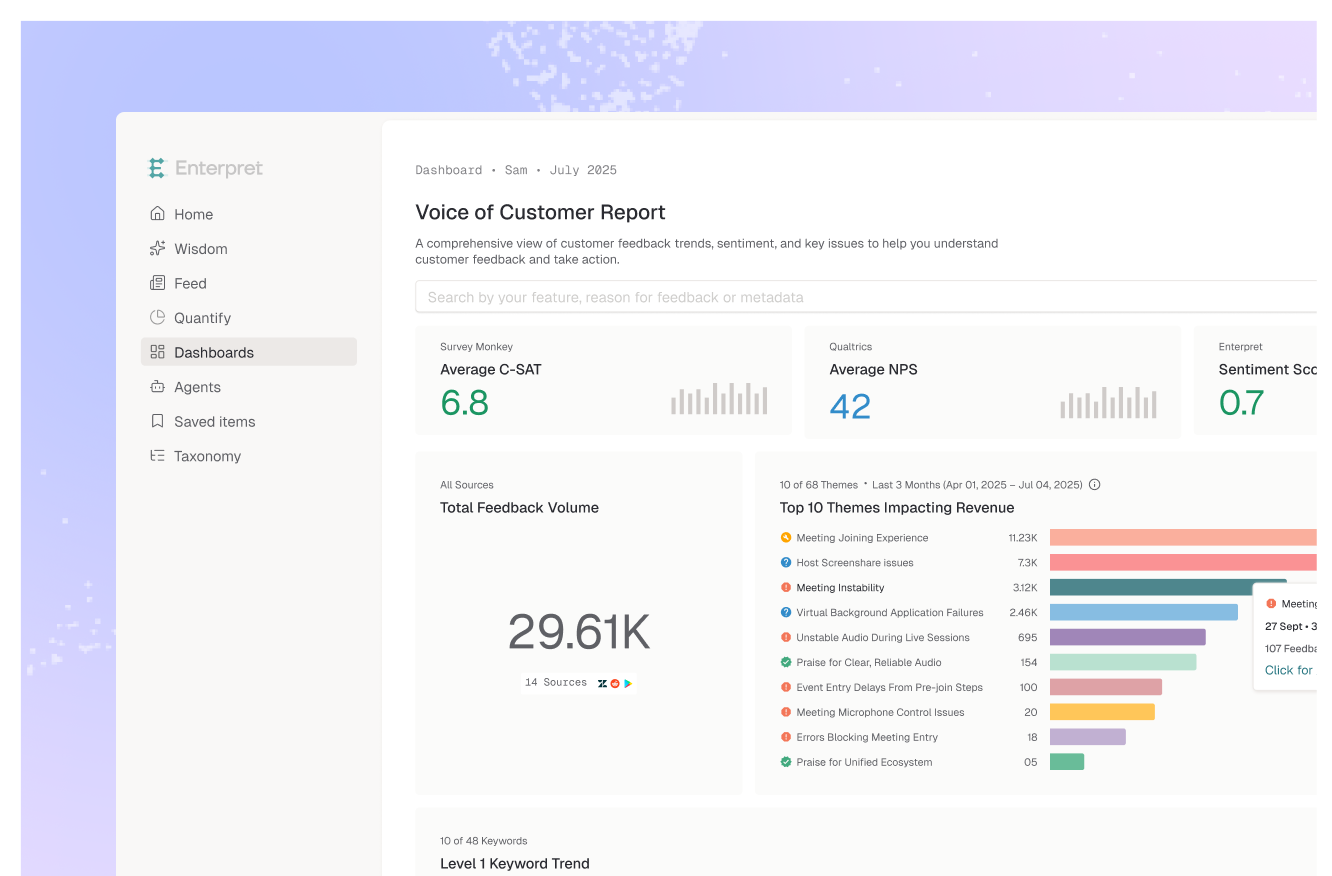
Enterpret is a customer intelligence platform that unifies feedback from 50+ sources (Zendesk, Intercom, Gong, Qualtrics, App Store and Google Play reviews, G2, Slack, Salesforce, HubSpot, Snowflake and more) and exposes it to agents through the Enterpret MCP server. Agents in Claude, ChatGPT, Cursor, Notion, Glean, LibreChat and n8n can query structured themes, sentiment, verbatims and account metadata, and the MCP server returns cited answers. The categorization comes from Adaptive Taxonomy, a multi-level taxonomy learned from your own feedback and editable by your team, so a theme means the same thing across every query. The Customer Context Graph links each record to accounts, segments, revenue and features, which is what lets an agent rank issues by who is affected.
The tradeoff: Enterpret is an analysis layer, not a survey tool, and setup takes real integration and processing time before the first useful answer. If your only source is one survey program, it is more platform than you need.
Best for: Product, CX and support teams that want agents to answer revenue-weighted questions across every feedback channel, with citations.
Chattermill offers a hosted MCP server that it says is available to all Chattermill customers. Its help center documents read-only tools such as list_themes, search_observations, get_metrics (NPS and sentiment), generate_highlights and get_feedback, and lists Claude, Claude Code, Cursor, ChatGPT, Codex, Gemini CLI and Notion AI among tested clients. Authentication is OAuth with a Chattermill login (or an admin-generated API key for some agents), and users see only the data their existing Chattermill roles allow.
Two practical notes from its docs: queries default to the project you most recently opened unless you name a project ID, and API keys are currently limited to admins. Chattermill is strongest on CX metrics in consumer brands; check how far its account and revenue context goes for a B2B use case.
Best for: CX teams already on Chattermill who want NPS and theme data inside their AI tools.
Unwrap launched an MCP server in May 2026 with twelve read-only tools: listing views, searching taxonomy groups and segments, surfacing top issues, sampling feedback, charting trends and running custom classification on a saved sample. It documents setup for Claude (desktop, web and Code), ChatGPT and Cursor, uses a one-time OAuth flow, and limits users to the views they already have permission to see. It cannot create, edit or delete anything.
The read-only design is a sensible default for governance. The flip side is that agent workflows that need to write back (close the loop, file a ticket) have to happen in another tool.
Best for: Teams that want safe, read-only agent access to categorized feedback with minimal setup.
Dovetail has the broadest MCP surface on this list: roughly 50 tools across projects, data, docs, highlights, channels, themes, tags and files, with both read and write actions. It offers first-party connectors for ChatGPT, Claude, Figma and Copilot, a hosted endpoint for clients like Cursor and Copilot Studio, and a self-hosted STDIO server. Auth is OAuth 2.1 or an API token, and each tool requires a specific permission scope.
Dovetail is a research repository first. It shines for interview notes, highlights and research docs; it is less built for high-volume support tickets joined to account revenue.
Best for: UX research teams that want agents to search, tag and write into a research repository.
Qualtrics documents an MCP server for its Public API, and a Qualtrics employee on the Qualtrics community confirmed it is live in production and works well with Cursor and Claude. Setup is admin-gated: Dynamic Client Registration was removed for security, so a Brand Admin must pre-register an OAuth client with the right scopes before anyone connects.
That gating is good governance and real friction. The MCP server sits on top of the Qualtrics API, so expect survey and response objects rather than a cross-channel theme model. Feedback from tickets, calls and reviews lives elsewhere unless you bring it in.
Best for: Enterprises whose VoC program runs mainly on Qualtrics surveys and that have an admin ready to manage OAuth clients.
Medallia's developer docs describe the Query API, a GraphQL interface over Medallia Experience Cloud for completed feedback records, invitations, aggregates and program metadata, with OAuth 2.0 tokens and published rate limits (70 requests per second). Customer-level CX Profiles require an add-on subscription. The Query API overview does not mention an MCP server, so connecting an agent today means building and hosting your own wrapper.
The API is mature and well documented for data extraction. It is an engineering project to make it agent-ready, and the output is survey and score data, not themed, cited answers.
Best for: Medallia shops with engineering capacity to build a custom agent layer on a GraphQL API.
We did not rank unitQ because we could not find public documentation of a unitQ MCP server or agent API. If you are evaluating it, ask unitQ directly.
An MCP server is a pipe. It decides how an agent asks; it does not decide whether the answer is right. Plug an agent into a platform with shallow or unstable categorization and you get fluent summaries built on sand, delivered faster than before.
We measured how big that problem is. Across eight frontier models, the most consistent one still changed more than 60% of its theme set between identical runs on the same 100 records, and raw LLM counts shifted 7.5 to 9.8% between runs on unchanged data. If your agent categorizes feedback on the fly every time it is asked, your "top issue" can change because the model changed its mind, not because customers did. A platform that categorizes once, consistently, and lets the agent query the result cuts most of that variance before the agent ever sees it.
The second failure is missing context. "Login complaints are up" is a fact. "Login complaints are up among enterprise accounts renewing this quarter" is a decision. Agents cannot invent the join between feedback and your CRM; the platform has to hold it. In Enterpret's benchmark of 30 real voice-of-customer questions, an agent grounded in a persistent customer context graph scored 0.961, versus 0.710 for a Deep Research Agent and 0.651 for Agentic RAG, with its largest lead in analytical depth. This is why we separate the protocol question from the data question in the differences between an MCP server and an API for customer feedback data, and why the connector rankings in the best MCP servers for customer feedback lean so hard on what sits behind the endpoint.
So the reframe: do not ask "does it have an MCP server?" Ask "what would I trust my agent to decide with what comes back?" That question sorts the list faster than any feature matrix, and it is the same line that separates AI-native from legacy voice of customer platforms.
Before you connect anything, run through the checks to make before giving AI agents access to your customer data.
The decision rule: pick the platform whose answers you would still trust if the agent ran the same question twice and nobody checked the dashboard.
An API is built for engineers to write code against. An MCP server is a standard interface that AI clients like Claude, ChatGPT and Cursor can discover and call directly, usually with a user login. Most VoC MCP servers sit on top of the vendor's API, so the quality of the underlying data still decides the quality of the answer.
Yes. Qualtrics documents an MCP server for its Public API, and a Qualtrics employee confirmed on the Qualtrics community that it is live in production. A Brand Admin must pre-register an OAuth client with the right scopes before users can connect.
Enterpret exposes its unified feedback through the Enterpret MCP server, which works with Claude, ChatGPT, Cursor, Notion, Glean and other MCP clients and returns cited answers. Agents query themes from Adaptive Taxonomy and account context from the Customer Context Graph, so answers stay consistent and tie to revenue. Enterpret's own AI Agents also monitor feedback proactively and send alerts to tools like Slack.
For a one-off look at a few hundred records, yes. For anything you report on, no: in Enterpret's tests the most consistent frontier model still changed more than 60% of its theme set between identical runs, and counts shifted 7.5 to 9.8%. Exports also lack account and revenue context unless you join it yourself.
Each user should sign in with their own account and see only what their existing role allows. Admins should be able to enable or disable the connector centrally. Read-only tools should be clearly separated from tools that write, tag or create records.
See how agents get cited, revenue-weighted answers from your customer feedback with the Enterpret voice of customer platform.
Research cited
Lorem ipsum dolor sit amet, consectetur adipiscing elit. Suspendisse varius enim in eros elementum tristique. Duis cursus, mi quis viverra ornare, eros dolor interdum nulla, ut commodo diam libero vitae erat. Aenean faucibus nibh et justo cursus id rutrum lorem imperdiet. Nunc ut sem vitae risus tristique posuere.