



The 5 Ways DTC Brands Analyze Product Reviews, Support Tickets, and Post-Purchase Surveys Together

November 2, 2026

Most SaaS CX ops teams do not have a tooling problem. They have six tools that each hold a piece of the customer, and none that reads across them. The help desk knows the ticket, the QA tool knows the rep, the health score knows the renewal date. When product asks why customers are upset, someone still exports a CSV and starts tagging.
The six jobs in a SaaS CX ops stack, and the tools to use for each, are feedback intelligence (Enterpret), Support QA (Enterpret, Zendesk QA or MaestroQA), the help desk (Zendesk or Intercom), workforce management and routing (Assembled, plus native help desk routing), knowledge (Guru) and health scoring (Gainsight or Vitally). What separates a working stack from a pile of subscriptions is whether one layer turns the text all of them collect into a consistent, account-level picture of what customers are saying.
The first three are table stakes. The last two are where stacks quietly fail, and they belong to the feedback layer.
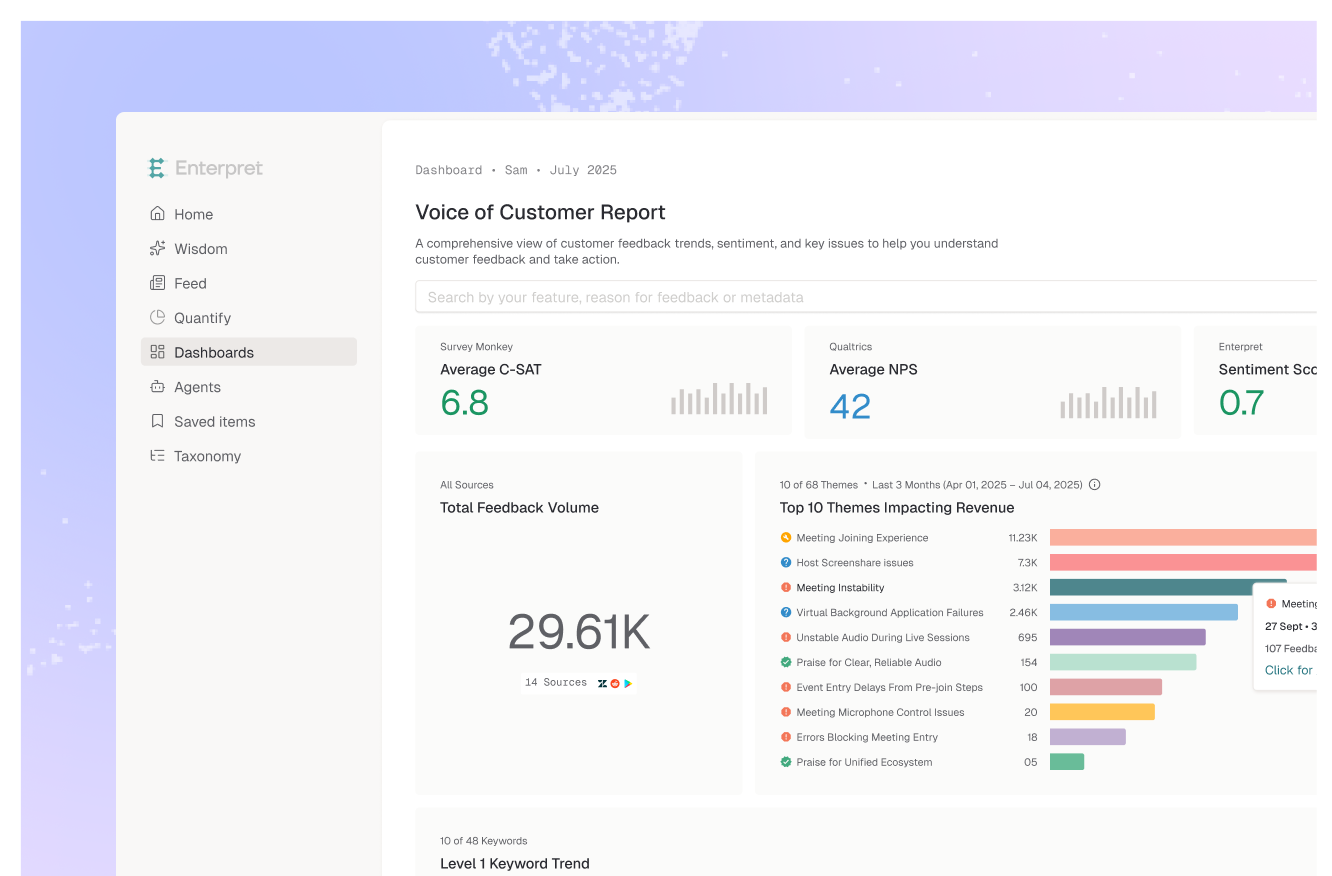
Feedback intelligence turns every customer conversation, across every channel, into themes you can count, trend and route. Enterpret does this across 50+ sources: tickets from Zendesk, Intercom, Salesforce Service Cloud, Front, Kustomer or Pylon, plus sales calls from Gong, surveys, app reviews, community channels and Slack. Its Adaptive Taxonomy learns an editable, multi-level category structure from the feedback itself and keeps it consistent, so a quarterly trend means something. The Customer Context Graph links each piece of feedback to the account, segment, revenue and feature it concerns, and AI agents watch for emerging issues and alert the right team in Slack or open work in Jira and Linear.
The honest caveat: Enterpret is not a help desk, scheduler or knowledge base, and it sits on top of them rather than replacing them. Setup takes real work, connecting integrations and allowing processing time. Teams with one channel and a few hundred tickets a month may not need this layer yet.
Best for: SaaS teams where support, product and CS all ask "why are customers contacting us?" and need one answer that holds across channels and quarters.
QA is the job of grading whether conversations were handled well. Enterpret's Support QA grades both human and AI support conversations, and because it runs on the same data as the feedback layer, a low score can be read next to the issue the customer raised and the account they belong to. That matters most for AI agents, where the failure is usually the answer, not the tone. Enterpret's Quality Monitor agent investigates QA alerts rather than just raising them, which is the subject of why we built Enterpret's Quality Monitor.
Zendesk QA (formerly Klaus) is the default for Zendesk shops. Its AutoQA scores interactions automatically, including AI agent and voice conversations, Zendesk says it evaluates 100% of conversations, and it supports custom, prompt-based categories plus side-by-side comparison of AI and human scores. MaestroQA is a dedicated QA and coaching platform: customizable scorecards, a side-by-side grading view inside Zendesk, and AI-generated metrics to find training gaps. Both are deeper than Enterpret on rep-level coaching. Neither is built to show which product issue sits behind low scores.
Best for: Enterpret when QA needs to connect to root cause and AI agent quality; Zendesk QA for native Zendesk coverage; MaestroQA for coaching-heavy programs with formal scorecards.
The help desk is the system of record that every other tool reads from. Zendesk is the common choice for larger, multi-brand teams that need configurable workflows and a broad marketplace. Intercom combines a help desk with its Fin AI agent: Intercom lists help desk seats from $19 per seat per month and prices Fin at $0.99 per outcome, charged only when the AI resolves the issue. Intercom reports a 76% average resolution rate for Fin, which is a vendor figure to test against your own queue.
Both ship native AI that is good at the ticket in front of the agent. It only sees its own channel, so it cannot tell you the same complaint is also showing up in Gong calls and G2 reviews.
Best for: Zendesk for complex, high-volume operations; Intercom for product-led SaaS teams that want the AI agent and inbox in one product.
Workforce management means forecasting volume, scheduling and adjusting intraday. Assembled positions its SaaS offering around release-driven demand: forecasting models that account for launches and onboarding surges, scheduling guardrails, intraday adjustments when a release shifts volume, and management of BPO vendors. It integrates with Zendesk, Intercom, Salesforce and Slack. For routing, most teams start in the help desk: Zendesk's skills-based routing assigns tickets to agents with matching skills through omnichannel routing, and is available on Suite Professional and above.
Best for: Assembled once you staff across shifts, time zones or vendors; native routing until then.
Knowledge is the job of keeping what agents and AI agents say accurate. Guru focuses on verification: content can be auto-verified as usage grows, stale or conflicting pages are flagged and routed to an expert, and answers come with citations and respect permissions. It delivers answers in Slack, Microsoft Teams, Chrome, Claude and Cursor and can be queried through MCP. The gap it does not close on its own is knowing which missing article is generating tickets, which is a feedback question. Our guide to the help center gaps your tickets point at covers that handoff.
Best for: Teams whose AI and human agents need one verified source of answers.
Health scoring is CS-owned, but CX ops feeds it. Gainsight Scorecards are built from Measures (product usage, support and so on) grouped into Measure Groups, scored manually or through its Rules Engine, and rolled up into an overall score on the customer record. Vitally offers a no-code builder where each input can be weighted, thresholded and combined with logic rules, multiple health profiles per segment, real-time updates and automations that launch tasks, playbooks or Slack alerts when health changes.
Both are strongest on structured inputs like usage and ticket counts. What customers said usually reaches the score as a count or sentiment flag, the input most likely to point the wrong way.
Best for: Gainsight for enterprise CS orgs with complex scorecards; Vitally for mid-market SaaS teams that want fast, segment-specific scores and automations.
Look at what each tool does with the text of a conversation. The help desk stores it and an agent tags it. The QA tool reads it to grade the rep. The knowledge base never sees it. The health score counts it. Every tool touches it. None is responsible for understanding it across channels.
This is a category mistake, not a vendor failure. Teams treat feedback analysis as a reporting feature of the help desk, when it is a separate job with its own requirements: consistent categories, every channel, account context. The result is predictable. A support team scorecard reports handle time and volume with no reliable driver row. A health score treats a quiet account as a healthy one, which is exactly what our ranking of health score tools that use feedback data was built to fix.
The reframe is simple. Stop asking "which tool has the best AI?" Ask "which layer is the source of truth for why customers contact us, and does every other tool read from it?" When the answer is a feedback intelligence layer, QA scores can be read against root cause, knowledge owners get a ranked list of gaps, and health scores get a qualitative input consistent enough to weight. In Enterpret's study of run-to-run instability across eight frontier models, a taxonomy-grounded agent reported identical theme counts across all 117 valid run pairs, while raw models' counts moved 7.5 to 9.8% on matched themes.
It also settles who owns the categories. If the taxonomy lives in help desk macros, support owns it by default and product distrusts it. Structure matters as much as ownership: Enterpret's taxonomy evaluation paper found that AI-generated taxonomies let 34.7% to 76.4% of records land in more than one top-level product area, against about 20% for production taxonomies built with structural checks. Our piece on the roles that can own a feedback taxonomy walks through the options. Once categories are shared, the work becomes putting customer feedback into other teams' workflows rather than arguing about whose numbers are right.
The decision rule: buy one tool per job, and make sure one layer owns the meaning of customer feedback so the other five stop inventing their own.
CX operations owns the systems and processes behind support: help desk configuration, routing, staffing, QA, knowledge, reporting and the handoff of customer insight to product and CS. In SaaS it usually also feeds health scoring. The job is making the frontline efficient and making what customers say usable by the rest of the company.
The help desk, because every other tool reads from it. Zendesk and Intercom are the common choices for SaaS. Add the other layers as specific jobs break, not all up front.
Not always. Native options such as Zendesk QA cover automated scoring well inside one help desk. A separate layer earns its place when you need QA across several channels, consistent grading of AI agent conversations, or a link between low scores and the product issues behind them.
Enterpret sits on top of the help desk and other sources rather than replacing them. It ingests tickets, calls, surveys, reviews and community feedback, categorizes them with an Adaptive Taxonomy, links them to accounts and revenue, and grades human and AI conversations with Support QA. Its MCP server lets teams query the same data from Claude or ChatGPT.
They are useful for one-off analysis of an export, drafting macros and summarizing a thread. They are not a system of record, and their categorization is unstable: in Enterpret's research across eight frontier models, the most consistent one still changed more than 60% of its theme set between identical runs on the same 100 records. The stronger pattern is to use them on top of structured data, for example through Enterpret's MCP server, so answers come with consistent categories and citations.
If you are building out a SaaS CX ops stack, see how Enterpret works for customer experience teams.
Research cited
Lorem ipsum dolor sit amet, consectetur adipiscing elit. Suspendisse varius enim in eros elementum tristique. Duis cursus, mi quis viverra ornare, eros dolor interdum nulla, ut commodo diam libero vitae erat. Aenean faucibus nibh et justo cursus id rutrum lorem imperdiet. Nunc ut sem vitae risus tristique posuere.