





The 7 Steps to Analyze Product Reviews From UK Retailers Like Argos and Very

Feedback Analysis
November 5, 2026

Stop deciding what to build by watching what competitors ship. When an engineer with Claude Code can rebuild a rival's feature in a weekend, features are no longer the moat. Understanding your users faster than anyone else is. Decide what to build with six rules: ignore competitor launches, listen to what users say about competitors, build where unmet needs run deepest, invest in what compounds, measure the retention effect of every release, and speed up the evidence loop, not just the build loop.
The short answer: your roadmap should come from user signals, not competitor changelogs. The team that hears switching talk, comparisons and unmet needs first, and then proves what moved retention, makes better bets than the team that simply ships fastest.
Every AI product category moves the same way right now. Someone ships on Tuesday. Two rivals have their version within weeks.
Engineering got cheap. A thin team with agents can ship a credible version of almost anything in days. Building is no longer the bottleneck. Deciding is.
Most moat advice reads like a strategy deck and never tells you what goes into next sprint. Reacting to every launch is worse: a roadmap written by someone else's PM, chasing parity that lasts about two weeks.
Features are copyable. The speed at which you understand your users is not. For AI-native products, that is the moat.
A competitor launch tells you what they decided to build. It says nothing about whether their users wanted it, or whether yours do.
Treat every launch as a question, not a ticket. Did your users ask for this before the rival shipped it? Are they asking now? If not, let it go.
The useful competitive signal is not in a rival's changelog. It is in their users' posts. Switching talk ("moved over because..."), side-by-side comparisons and the requests users make of a rival are the clearest map of where your category is underserved.
Feedback Bench, built by Enterpret, shows what this looks like at category scale. It ranks AI agents in a category, currently coding agents and personal agents, by what their users say in public on channels such as Reddit, X, YouTube, app stores, G2 and Trustpilot, depending on the category. Each agent gets a Feedback Score that weighs popularity and customer love equally, across more than 50 criteria per category, and every page lists the posts behind its numbers.
One of its published analyses is titled "Hermes Agent users choose their models, and Grok Bot users ask to do the same." That is a roadmap signal hiding in a rival's feedback: a need one product meets and another product's users are asking for. Do the same with your own lost users and track which competitors customers switch to when they churn, and why.
Loud is not the same as deep. A heavily upvoted request in your community can be a nice-to-have. A complaint that a handful of enterprise accounts raise in tickets and sales calls can be the reason they don't renew.
Score every need on three things: how many users hit it, how badly it blocks their work, and who those users are. Thin teams can only afford to build where all three line up.
Some bets get more valuable every week. Those beat any single feature.
A competitor can copy your feature in a week. They cannot copy a year of compounding.
Shipping is not the result. Retention is. For every release, check whether adopters stay longer, complain less or expand, and whether the complaints it targeted actually dropped.
Compare churned vs retained customer feedback before and after each release. If a feature moved neither retention nor the related complaint volume, it was parity, not a moat. Stop investing in it.
Your build loop is already fast. The evidence loop is the slow one: collect, categorize, spot what changed, decide. At many AI startups it runs on someone pasting a Discord export into an LLM on Friday.
That breaks in a specific way. In Enterpret's study of run-to-run instability across eight frontier models, a raw model changed more than half of its top theme set between two runs on the same data at 100 records, and nearly three quarters at 5,000. If your top five pain points reshuffle every time you ask, you cannot tell whether last week's release moved anything.
86 to 88% Reduction in theme churn when an AI agent is grounded in a persistent taxonomy instead of re-clustering raw feedback on every run, with the model held constant. Source: Enterpret Research, "Same Feedback, Different Answer" (arXiv, 2026)
The same study found grounded runs reported identical counts for matched themes every time, while raw models' counts moved 7.5 to 9.8%. Stability is not accuracy, but you cannot measure change on numbers that wobble by themselves.
| Stage | Build loop | Evidence loop |
|---|---|---|
| Speed today | Days, thanks to agents | Often weeks of manual tagging |
| What it needs | Engineers and evals | Consistent categories, stable counts, alerts after release |
| Who can copy it | Anyone | Only teams with your users' context |
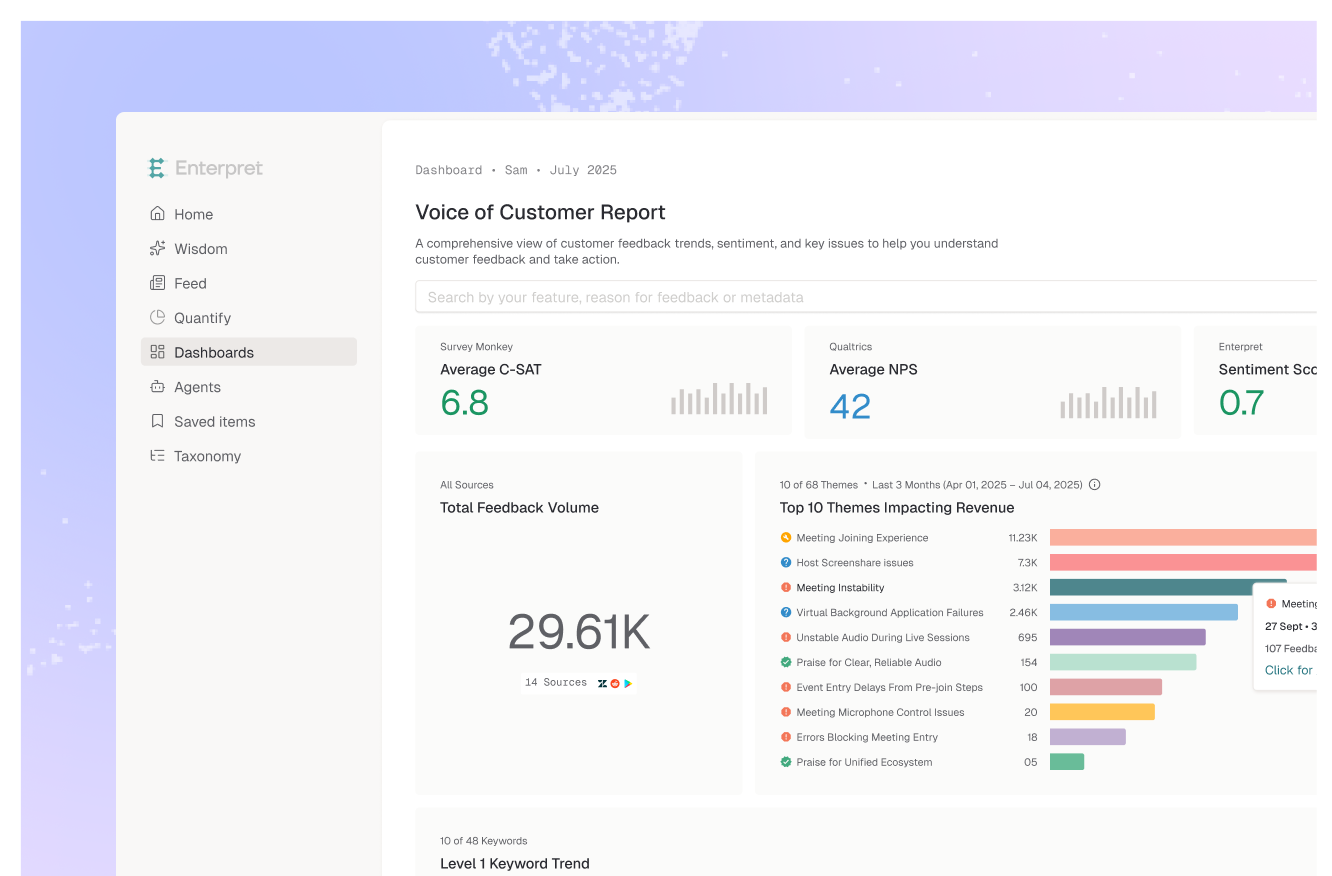
Enterpret is the customer intelligence layer for the evidence loop. It sits upstream of your roadmap and brings user signals into one place: community channels like Discord, App Store and Google Play reviews, support conversations, sales calls and surveys.
Adaptive Taxonomy categorizes feedback consistently and updates as you ship, so categories don't go stale every sprint. The Customer Context Graph joins feedback to accounts and revenue, which matters the moment enterprise deals arrive. Wisdom answers questions in natural language, and the MCP server brings the same answers into Claude, Claude Code, Cursor, Codex, Glean and Notion. If your community lives on Discord, see the MCP servers for Discord community feedback.
Once sources are connected and processed, AI agents and alerts flag new or spiking issues after a release and deliver them to Slack, Jira, Linear or Notion. Enterpret does not replace evals or tracing tools like Braintrust and Langfuse: they show how the model behaved, Enterpret shows how users experienced it.
Picture an AI writing assistant. On Monday a well-funded rival ships brand voice profiles. The team's instinct is to match it by Friday.
Instead, the Head of Product asks Wisdom two questions. Have our users asked for brand voice? A few, mostly free users. When users mention the rival, what are they praising? Its docs integration, not voice profiles.
So the team skips the copy, ships a deeper docs integration, and watches two numbers: complaints about copy-pasting between tools, and retention for adopting accounts. The evidence decides the next sprint.
The next generation of AI products won't be won by whoever ships the most features. It will be won by teams that hear their users, and their competitors' users, first, and act with conviction.
Where your team sits on the customer feedback maturity model tells you how fast that loop can run today. Move your moat upstream. Own the evidence loop. Then build.
Yes, when your own users are asking for it and its absence shows up in churn, lost deals or switching talk. Table-stakes features that block adoption are worth matching. Copying only because a rival shipped it usually wastes a sprint.
The bets that compound: depth in the user's workflow, data and context, trust earned through reliable behavior, and integrations into tools teams already use. Underneath them all is understanding users faster than competitors do.
Watch the public channels where users compare products, such as Reddit, X, app stores and review sites, and pull competitor mentions out of your own tickets and sales calls. Feedback Bench publishes this kind of analysis for AI agent categories, ranking agents by public user feedback and listing the posts behind each number.
For a quick look, yes. For tracking change release over release, it is risky: Enterpret's stability study found raw frontier models changed more than half of their top themes between runs at 100 records, and grounding the agent in a persistent taxonomy cut that churn by 86 to 88%.
Compare retention, expansion and related complaint volume for users who adopted it against those who didn't, before and after the release. If the complaints it targeted didn't fall and retention didn't move, treat it as parity, not differentiation.
If you want your evidence loop to run as fast as you ship, see how Enterpret works.
Research cited
Lorem ipsum dolor sit amet, consectetur adipiscing elit. Suspendisse varius enim in eros elementum tristique. Duis cursus, mi quis viverra ornare, eros dolor interdum nulla, ut commodo diam libero vitae erat. Aenean faucibus nibh et justo cursus id rutrum lorem imperdiet. Nunc ut sem vitae risus tristique posuere.


