





The 7 Steps to Analyze Product Reviews From UK Retailers Like Argos and Very

Feedback Analysis
November 5, 2026

To analyze Best Buy product reviews at scale, stop treating them as a data collection problem. Pull every new review for each of your SKUs on Best Buy US and Best Buy Canada automatically, with signals like Verified Purchase and the would-recommend answer attached. Categorize every review by product area and feature on a taxonomy that stays stable over time. Track rating and theme trends by SKU and country. Compare those themes against your other retailers and your support tickets. Then route what you find to the team that owns the fix.
That is six steps. Most brands stop after the first one.
Search this question and almost every result is about getting the data: scraper APIs and managed products like Bright Data's Best Buy Reviews Tracker, which adds sentiment analysis, rating-drop alerts, dashboards and competitor benchmarking. If your question is "how is our rating moving versus a competitor's," a tracker answers it well.
But a brand's real questions are different. Did the new firmware break HDMI pairing? Is the hinge complaint one batch or a design flaw? Do Canadian buyers care about something US buyers don't? A feed of reviews does not answer any of those.
The reframe: not "how do we get Best Buy reviews?" but "which team should change what, because of them?" Collection is the ticket. The decision is the work.
Best Buy reviews skew toward consumer electronics, appliances and smart home, so they often describe what happens after the box is open: setup, pairing, firmware, apps, durability. That makes them product and quality data, not just marketing data.
They also carry structure worth keeping. On a live Best Buy review page, reviews can show the signals below. Labels may vary by listing and between bestbuy.com and bestbuy.ca, so confirm what yours show.
| Signal on the review | Why it matters for analysis |
|---|---|
| "Verified Purchase" badge | Compare verified buyers with everyone else. |
| "I would recommend this to a friend" (or "No, I would not") | An advocacy signal that can disagree with the stars. |
| "Owned for [time] when reviewed" | Separates out-of-box problems from durability problems. |
| Promo or sweepstakes disclosure | Check whether incentivized reviews tell a different story. |
| Helpful and Unhelpful votes | Shows which complaints shoppers read before buying. |
Keep these fields and every theme can be cut by buyer type and time owned.
Start with an inventory, not a scraper. List every product page you care about on bestbuy.com and bestbuy.ca: each SKU, each variant with its own page, and the competitor products you lose to on the shelf. Note which team owns each one. A US and a Canadian listing for the same product are two review streams, and they will not always agree.
Manual exports go stale the week a product launches. DIY scrapers mean maintenance, site changes, rate limits and reviewing each retailer's terms of use, so prefer approved or managed routes. In Enterpret, teams can now bring product reviews from major retailers in the US, Canada, UK, Europe and Australia, including Best Buy (US and Canada): paste the product links or product IDs, and Enterpret pulls every new review on that product.
"Negative sentiment" is not a finding. "Bluetooth pairing drops after the latest firmware on the 65-inch model" is. That requires a hierarchy of product area, feature and sub-feature, applied the same way to every review.
This is where pasting reviews into a general-purpose LLM breaks down. In Enterpret's study of run-to-run instability across eight frontier models, the same model asked the same question on the same 1,000 feedback records had a theme churn of 0.765 between runs. An agent grounded in a persistent taxonomy scored 0.104.
86 to 88% Reduction in theme churn when an AI agent is grounded in a persistent taxonomy instead of re-clustering raw feedback on every run. Source: Enterpret Research, "Same Feedback, Different Answer" (arXiv, 2026)
The study measures stability, not accuracy. But you cannot trend a theme that renames itself every week.
A line-wide average hides everything. Per SKU and country, track rating, theme share and would-recommend rate against your launch and firmware timeline. The same Enterpret study found that grounded runs reported identical counts for a matched theme every time, while raw model counts moved 7.5 to 9.8%. Trend lines need counts that hold still. Alert on movement, not single angry reviews, the way customer voice tools for identifying trending product issues do.
One retailer is a sample. A complaint on Best Buy, Walmart and MediaMarkt and in your Zendesk tickets is a product problem. A complaint on one retailer only may be a listing or fulfillment problem. A complaint in tickets but never in reviews is one support is absorbing quietly. You only see those differences when every source sits on one taxonomy, the core case for managing multi-source customer feedback in one place. It is the pattern DTC brands use when they analyze reviews, tickets and surveys together, extended to retail.
Every theme needs an owner, a threshold and a destination. Firmware themes go to device software in Jira or Linear. Missing-parts themes go to operations. Listing confusion goes to retail marketing. Then close the loop: after a fix ships, watch whether the theme's share actually falls. That is the difference between a dashboard and feedback routing and team-based alerting that changes behavior.
Full control. Best for a one-off deep dive on a single product. You own scraper upkeep, terms review and categorization drift.
Strong retail monitoring and competitor benchmarking. Best for e-commerce and merchandising teams watching ratings. Reviews live apart from your tickets and surveys.
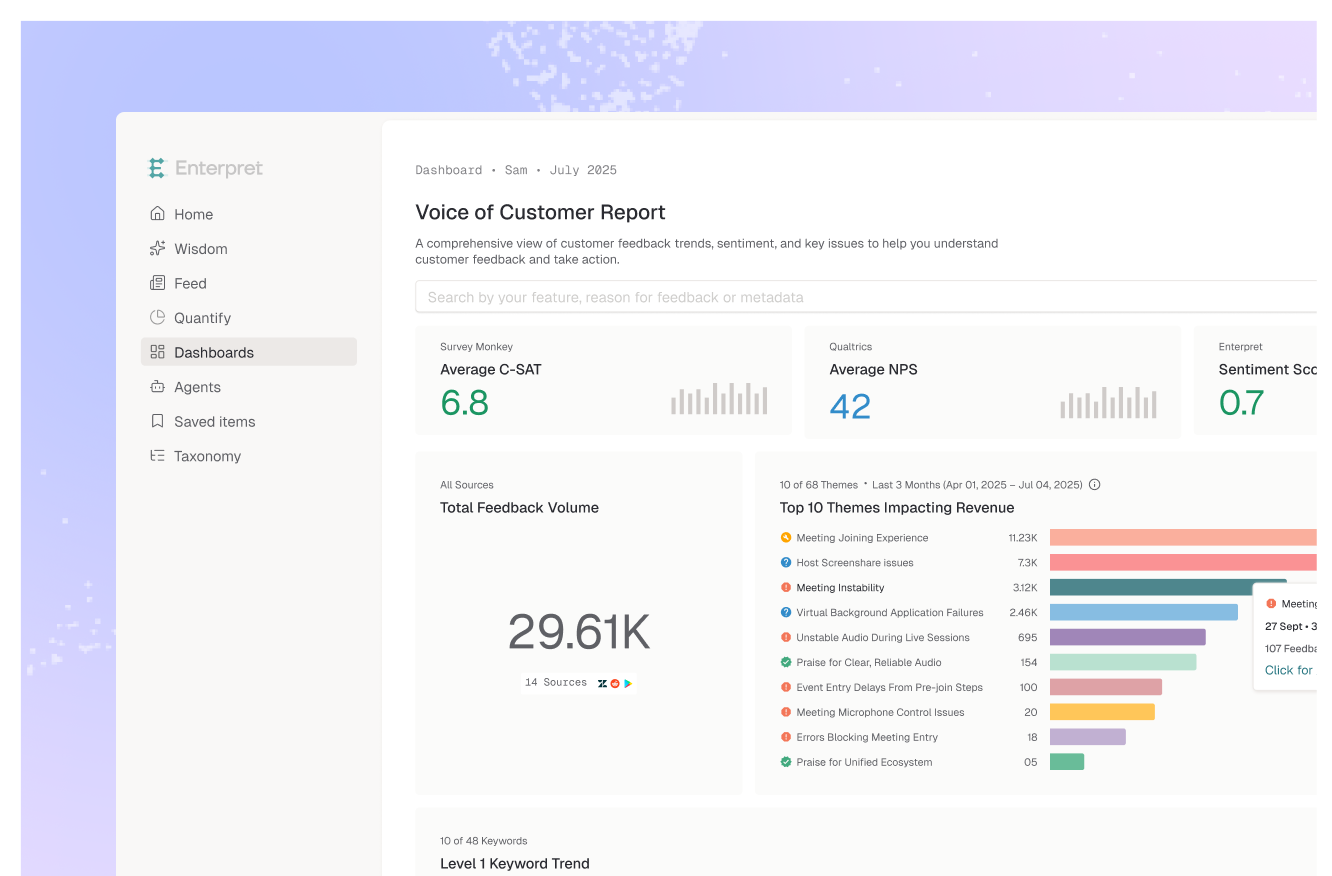
Best for product, quality and CX teams who need reviews next to tickets, surveys and returns notes. Reviews land on one Adaptive Taxonomy with your Zendesk, Salesforce or PowerReviews data, broken down by retailer, product and country. Ask Wisdom in plain language and get the exact reviews behind each answer, run AI agents and alerts, and send findings to Slack, Jira, Linear or Notion. The trade-off: it is a feedback platform, not a pricing or shelf tracker.
Picture a smart home camera brand with eight SKUs on bestbuy.com and bestbuy.ca, plus Walmart and JB Hi-Fi (an illustrative scenario). Three weeks after a firmware update, the share of Best Buy Canada reviews tagged "Night vision > Image quality" doubles on two SKUs and the would-recommend rate slips. US reviews show nothing yet. Canadian Zendesk tickets on the same sub-feature are rising too.
An alert fires in Slack. Someone asks Wisdom what changed in Canada since the update and gets an answer with the reviews and tickets behind it. A Jira ticket goes to firmware with the evidence. After the patch, the theme falls back. Nobody read a thousand reviews.
The test of a Best Buy review program: when a theme spikes on one SKU in one country, does the owning team know, with evidence, before the star rating moves?
For retail brands, the richest product feedback has always lived on someone else's website. Once those reviews flow into the same system as tickets and surveys, they stop being a reputation metric and become a product sensor, one teams can query from Claude, Claude Code or Cursor through Enterpret's MCP server. Every fix verified makes the next one faster to find. That compounds.
Collect them separately and analyze them together. Tag each review by country but categorize both on the same taxonomy, so you can see whether a theme is global or specific to one market.
Keep all reviews, with Verified Purchase as a field you can filter on. A theme concentrated in unverified reviews deserves caution. A theme from verified buyers who owned the product for weeks is a real product signal.
For a one-time read, yes. For tracking over time, no. Enterpret's research found that grounding an AI agent in a persistent taxonomy cut run-to-run theme churn by 86 to 88% compared with a raw model call and a multi-agent workflow using the same model, so themes and counts stay comparable week to week.
Review Best Buy's terms of use before collecting data yourself. Scrapers also need ongoing maintenance through site changes and rate limits, which is why many brands prefer a managed or approved route.
Any retailer where your products sell in volume. Enterpret brings in reviews from Best Buy (US and Canada), Walmart (US), Argos, Very (including Littlewoods), Orange, MediaMarkt (including Saturn and MediaWorld), JB Hi-Fi and the Meta Store, so a single theme can be compared across the US, Canada, UK, Europe and Australia.
If you're working out how to turn retailer reviews into product decisions, see how Enterpret works.
Research cited
Lorem ipsum dolor sit amet, consectetur adipiscing elit. Suspendisse varius enim in eros elementum tristique. Duis cursus, mi quis viverra ornare, eros dolor interdum nulla, ut commodo diam libero vitae erat. Aenean faucibus nibh et justo cursus id rutrum lorem imperdiet. Nunc ut sem vitae risus tristique posuere.


