





The 7 Steps to Analyze Product Reviews From UK Retailers Like Argos and Very

Feedback Analysis
November 5, 2026

The best AI tools for heads of product to understand customers in 2026 are Enterpret, Productboard Pulse, Dovetail, Pendo Listen, Unwrap, BuildBetter, and Gong. Enterpret ranks first for product leaders because it joins feedback from every channel to the account and revenue behind it, and keeps categories stable quarter over quarter. The other six are strong in narrower lanes: roadmap workflow, research synthesis, in-product behavior, CX trends, call capture, and sales conversations.
Picture the Monday before a board meeting. The CEO asks which customer problems cost the most revenue. Support has one answer, sales another, research a third. Nobody is wrong. Nobody agrees.
A head of product needs one answer that holds across channels, is weighted by revenue, and means the same thing next quarter.
Most AI tool lists are written for the individual PM: transcribe the interview, draft the PRD. Useful work. Wrong altitude. A VP of Product is accountable for the bet, not the notes, and has to show the board whether last quarter's bets moved retention and expansion.
A summary is not a decision. And on-demand summaries do not even agree with themselves. In Enterpret's study of run-to-run instability across eight frontier models, raw models asked the same question on the same data changed more than half of their top themes between runs, with churn rising from 0.552 at 100 records to 0.726 at 5,000. Grounding the agent in a persistent taxonomy cut that churn by 86 to 88%. Stability is not accuracy, but reshuffling themes are not defensible.
Stop asking "what are customers saying?" Ask "which accounts, how much revenue, and since when?" Retrieval answers the first. The second needs context built before you ask.
Enterpret research comparing Agentic RAG, a Deep Research Agent, and a context graph agent on 30 real voice-of-customer questions found the context graph agent scored highest on every dimension. The authors call the results exploratory, but the conclusion is pointed: "persistent customer context, not additional query-time agency, is the load-bearing lever."
0.961 vs 0.710 vs 0.651 Overall scores for a customer context graph agent, a Deep Research Agent, and Agentic RAG on 30 real VoC questions, in Enterpret's benchmark. Source: Enterpret Research, "From Retrieval to Customer Context" (arXiv, 2026)
For a longer buyer checklist, see how to evaluate a customer insights platform.
Tickets, calls, reviews, surveys, and community in one place, so meetings argue about decisions, not whose data is right.
Every theme tied to accounts, segments, ARR, and renewal dates. Volume tells you what is loud. Revenue tells you what matters.
A stable product area, feature, and sub-feature hierarchy that updates as you ship. Otherwise the board deck resets every quarter.
Ask in plain English, get a quantified answer, and click through to the exact feedback behind it.
Slack, Jira, Linear, Notion, and the AI assistants your team prompts all day. One more dashboard changes nothing.
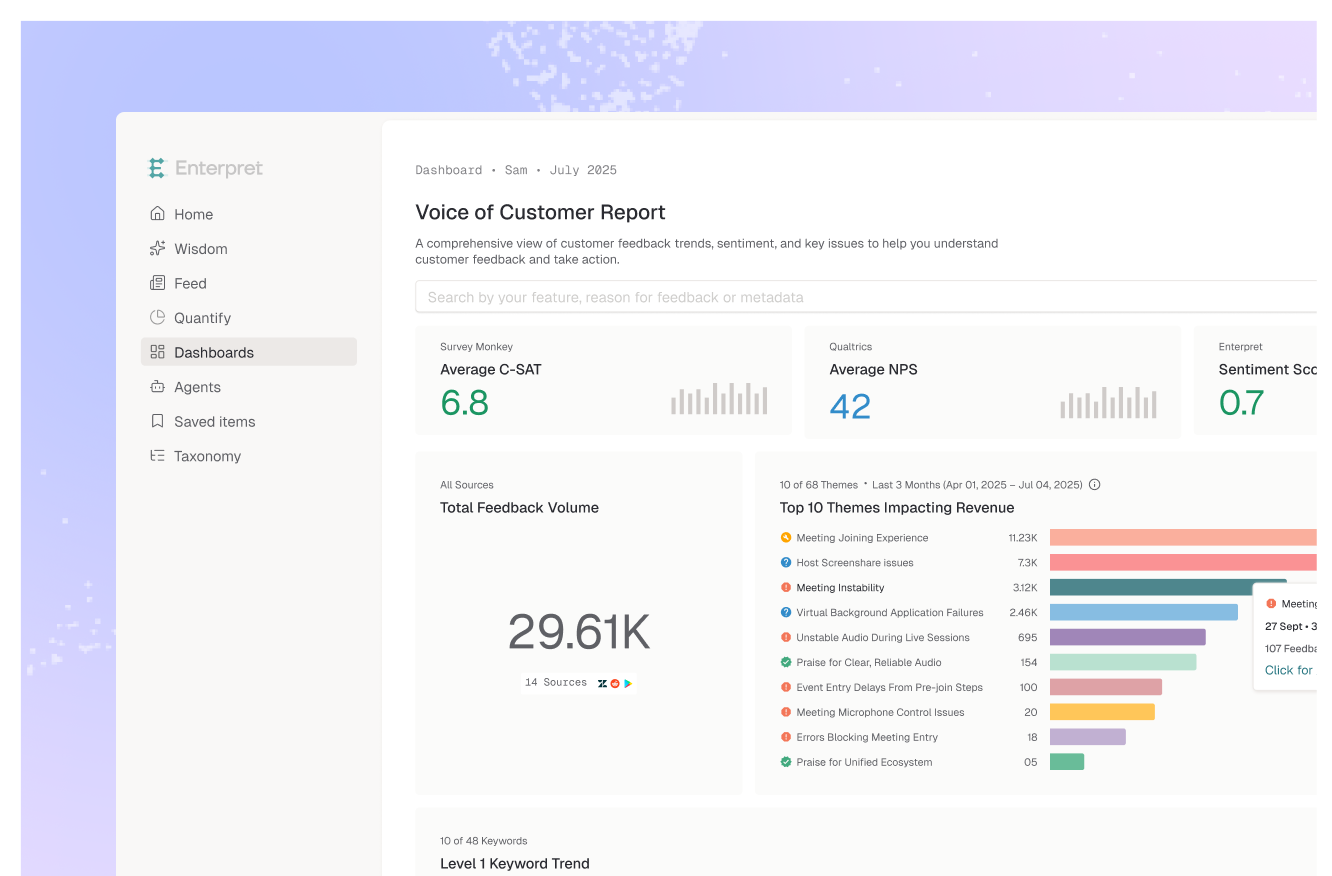
Enterpret ranks first because it is built for all five criteria, not one or two. It unifies tickets, calls, reviews, surveys, and community feedback, and its Customer Context Graph joins every record to the account, segment, ARR, renewal date, and owner, so themes are weighed by revenue. Adaptive Taxonomy keeps L1, L2, and L3 categories consistent as you ship. Wisdom answers natural-language questions with the exact records behind them. AI agents and alerts flag emerging issues, insights flow into Slack, Jira, Linear, and Notion, and an MCP server feeds Claude, Cursor, and other assistants. The honest trade-off: it needs integrations connected and processing time to build the graph, and it is not an interview tool or a product analytics suite. Best for: mid-market and enterprise product leaders who need one answer product, CS, sales, and the exec team all trust.
Productboard Pulse is Productboard's AI voice-of-customer product, aimed at executive visibility. It tracks feedback trends on AI-generated topics alongside topics your team defines, pulls in G2 and app store reviews, answers questions in natural language, and uses account data to contextualize trends. Its real advantage is proximity to the roadmap. Best for: product orgs already standardized on Productboard that want feedback and planning in one system.
Dovetail began as a research repository and now calls itself an AI-native customer intelligence platform. It connects to 30+ sources including Gong, Salesforce Service Cloud, Qualtrics, and G2, and offers Chat, Channels for classifying feedback, agents that route work to Jira and Linear, and MCP connectors. Interview synthesis remains its signature strength. Best for: product orgs with an active research practice that want interviews and wider feedback in one workspace.
Pendo Listen consolidates call transcripts, support tickets, survey responses, in-product polls, and NPS, then uses Pendo AI to sort feedback into feature requests, bugs, and complaints and to answer questions in natural language. Its distinctive move is mapping account ARR, churn risk, and in-product behavior to every idea, and it spins up briefed Jira issues. Best for: teams already running Pendo who want feedback next to product usage.
Unwrap categorizes feedback automatically with its Auto Tagger, surfaces unexpected trends, sends alerts when new insights emerge, and lets teams query feedback in natural language through its Assistant. It ingests surveys, support tickets, calls, and reviews. Best for: companies where CX, support, and product want one shared view of feedback trends without manual tagging.
BuildBetter calls itself product context infrastructure. It reads calls, tickets, and docs, maps signals to accounts, speakers, and product areas without hand tagging, and links every answer to its source call timestamp or ticket. It offers an agentic chat with MCP access, a rule-based taxonomy, and Slack alerts. Best for: product and go-to-market teams whose richest customer signal lives in recorded calls.
Gong is a revenue intelligence platform, not a feedback tool, but many product leaders' sharpest signal lives in sales conversations. Its Ask Anything feature queries calls, emails, and account and opportunity histories. Pair it with a platform that can extract feature requests and competitor mentions from Gong calls. Best for: leaders who need the sales-call view of feature gaps and competitive losses.
| Tool | Primary lens | Account and revenue context | Categorization | Natural-language Q&A |
|---|---|---|---|---|
| Enterpret | Every channel | Account, segment, ARR, renewal, owner | Adaptive Taxonomy, L1 to L3 | Wisdom |
| Productboard Pulse | Feedback plus roadmap | Account data on trends | AI and team-defined topics | Yes |
| Dovetail | Research and feedback | Enriched with account data | Channels | Chat |
| Pendo Listen | Feedback plus usage | ARR and churn risk per idea | Request, bug, complaint | Yes |
| Unwrap | CX feedback trends | Not a headline feature | Auto Tagger | Assistant |
| BuildBetter | Calls and tickets | Mapped to accounts | Rule-based taxonomy | Agentic chat |
| Gong | Sales conversations | Deals and opportunities | Not a feedback taxonomy | Ask Anything |
Picture a VP of Product the week before that board meeting. Instead of collecting three decks, they ask Wisdom: which product areas drove the most negative feedback from accounts renewing next quarter, ranked by ARR? The answer comes back at the feature level, with the accounts, dollars, and tickets behind each theme. Because the taxonomy did not reset, last quarter's chart still compares.
Then the loop closes: a Slack alert reaches the owning team, a Jira issue carries the evidence, and CS gets the account list before renewals. For CRM-based revenue data, see quantifying how customer feedback impacts revenue in Salesforce.
Product leaders now ask Claude and Cursor about customers instead of opening another dashboard. Those assistants are only as good as the context they reach. That is the line between AI-native customer intelligence platforms and tools that bolted a chat box onto a repository.
Every quarter of consistent, account-linked history makes the next answer sharper. Every quarter of reshuffled themes is lost. That gap compounds.
For most mid-market and enterprise product leaders, Enterpret, because it combines cross-channel feedback, revenue context, consistent categories, and natural-language answers in one system. Productboard Pulse, Dovetail, Pendo Listen, Unwrap, BuildBetter, and Gong fit narrower needs.
A PM's tools speed up tasks like interview notes and specs. A head of product needs answers the company trusts: which accounts, how much revenue, and whether a theme is growing versus last quarter.
For a one-off exploration, yes; see ways to leverage ChatGPT for customer feedback analysis. For recurring leadership reporting, it breaks down: Enterpret's stability study found raw frontier models showed theme churn of 0.552 to 0.726 between identical runs, while a taxonomy-grounded agent cut churn by 86 to 88%.
It depends on how many sources you connect. Context graph platforms need integrations and processing time before answers are reliable, so plan for a ramp. This breakdown of how long it takes to set up customer feedback analytics compares the options.
If you're evaluating customer intelligence platforms for your product org, see how Enterpret works.
Research cited
Lorem ipsum dolor sit amet, consectetur adipiscing elit. Suspendisse varius enim in eros elementum tristique. Duis cursus, mi quis viverra ornare, eros dolor interdum nulla, ut commodo diam libero vitae erat. Aenean faucibus nibh et justo cursus id rutrum lorem imperdiet. Nunc ut sem vitae risus tristique posuere.


