





The 7 Steps to Analyze Product Reviews From UK Retailers Like Argos and Very

Feedback Analysis
November 5, 2026

For most product orgs, the answer is: buy the customer intelligence layer and build the workflow on top of it. Build the whole thing only if customer intelligence is the product you sell, or if constraints rule out every vendor. Your team can almost certainly demo something with an LLM and a warehouse in a quarter. The harder question is who keeps it trustworthy for years: a taxonomy that holds still, feedback joined to accounts and revenue, connectors that keep working, and answers you can defend to the board.
Every product org is now an AI org. A strong engineer can pipe tickets into a warehouse, call a frontier model, and show you a themed dashboard by Friday. The demo is real. It is also the easiest part of the problem.
Picture the meeting. Your head of data says: give us two engineers and one quarter, and we'll have our own customer intelligence platform, fully under our control.
That is plausible for week one. The trouble shows up later, when you ask the same question twice and get two different answers. In Enterpret's study of run-to-run instability across eight frontier models, a raw model asked for the top themes in the same 100 feedback records changed more than half of its theme set between two runs on average. At 5,000 records it changed nearly three quarters. Try putting that in a board deck.
Enterpret made this case in why "we can build it" is the wrong question. Build doesn't mean build everything. It means picking the layer where your team's effort compounds.
Buy the layer. Build the workflow. Ingestion, taxonomy, provenance and revenue tie-in are the substrate. Your segments, your retention motion and your decision rituals are where building actually pays.
The seven questions below separate the two. Answer them honestly before anyone writes a line of code.
A demo is one source, one prompt, one month of data. A system is backfills, reprocessing when you swap models, PII handling, access controls, on-call, and a steady stream of new teams asking for new cuts.
Ask who owns it in month thirteen. If the answer is "the two engineers who built it, part time," you are not building a platform. You are signing a maintenance contract with yourself.
A VP of Product needs to say "onboarding complaints fell this quarter" and mean it. That requires the same categories, applied the same way, quarter over quarter, while still adapting when you ship something new.
LLM-generated taxonomies look great on the surface. Enterpret's taxonomy evaluation paper found that generated trees passed every generic quality check, yet 97.7 to 100% of their leaf names just restated a parent. Between 34.7% and 76.4% of records leaked across top-level product areas, against about 20% for production references.
86 to 88% Reduction in theme churn when an AI agent is grounded in a persistent taxonomy instead of re-clustering raw feedback on every run. Source: Enterpret Research, "Same Feedback, Different Answer" (arXiv, 2026)
Volume is not priority. Forty complaints from free users and four from your largest renewals are different problems. Weighing them takes identity resolution across tickets, calls, surveys and CRM, then a join to segment, ARR, renewal date and owner.
Retrieval alone can't do it. As Enterpret research comparing Agentic RAG, a Deep Research Agent and a context graph agent puts it, "a top-k retrieval result cannot establish corpus prevalence." In that exploratory benchmark, an agent grounded in a persistent customer context graph scored 0.961, against 0.710 and 0.651 for the other two. If your board asks for revenue at risk, see what it takes to quantify how customer feedback impacts revenue in Salesforce.
Tickets, calls, surveys, reviews, community, internal Slack. Each has an API that changes and schemas that drift, and support will buy a new tool next year without asking you.
Every connector is a small product with its own backlog. Before committing, compare how long it takes to set up customer feedback analytics each way, then multiply the build path by every channel you'll add over three years.
Trust is the whole game. The first time a PM catches a wrong count in an exec review, adoption is over.
A real system needs golden test sets, regression checks whenever the model changes, counts with honest denominators, and a click-through from every theme to source records. Stability is the floor, not the ceiling: a system can repeat the same wrong answer. Use the same bar you'd use on a vendor, from how to evaluate a customer insights platform.
Count it in engineer-quarters. Every quarter spent on ingestion and taxonomy upkeep is a quarter not spent on the roadmap. The irony: the feedback system displaces the features the feedback is asking for.
Building is the right call in a few real cases:
If none of these describe you, customer intelligence is an input. Buy the input and spend your builders on what makes you different.
| Question | Leans build if... | Leans buy if... |
|---|---|---|
| Demo vs system | A dedicated team owns it for years | Builders move on after launch |
| Taxonomy stability | You can version and evaluate the tree | You need comparable trends every quarter |
| Accounts and revenue | One clean identity source | Feedback spans CRM, support, calls and reviews |
| Connectors | One or two stable channels | Five or more, and growing |
| Evaluation and trust | You run an ML eval practice today | Nobody owns accuracy |
| Opportunity cost | Spare platform capacity | Roadmap is already oversubscribed |
| Product or input | You sell it | It informs what you sell |
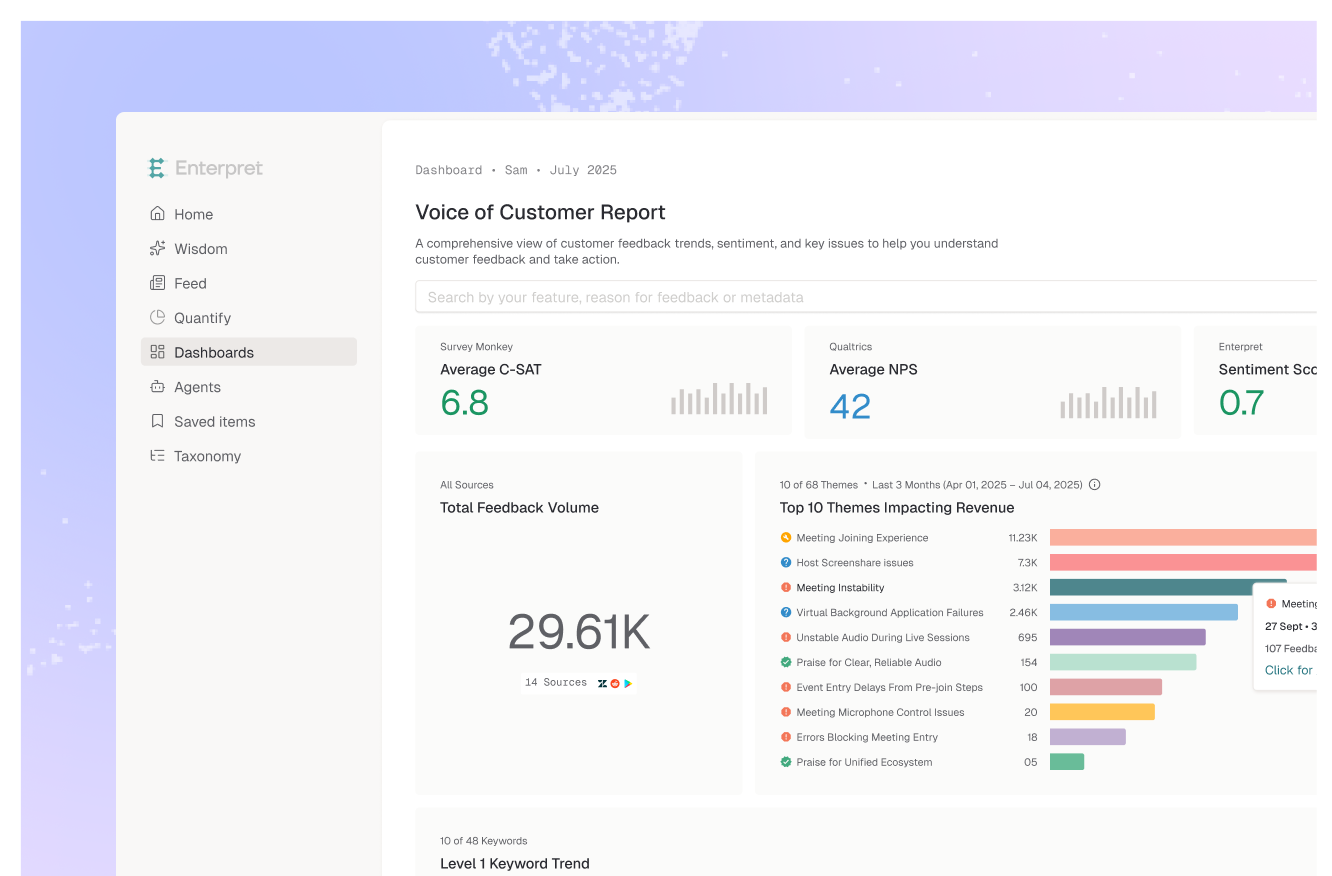
Enterpret is built to be that layer. It connects 50+ feedback sources, and its Adaptive Taxonomy keeps consistent L1, L2 and L3 categories (product area, feature, sub-feature) that update as you ship. The Customer Context Graph joins every record to account, segment, ARR, renewal date and owner.
Wisdom answers natural-language questions with exact records quantified by volume, segment and revenue, and AI agents and alerts push findings into Slack, Jira, Linear and Notion. It isn't instant: sources need connecting and history needs processing before the graph is ready.
Your engineers still build. They build the workflow, using the MCP server to put customer context into Claude, Claude Code, Cursor, Codex, Glean and Notion. One source of customer truth, upstream of every tool.
Picture two product orgs with the same pitch on the table.
The first builds. Q1 ships a slick demo on tickets. Q2 adds call transcripts and breaks the categories. Q3 swaps models and the board deck resets. By Q4 both engineers are full time on upkeep.
The second buys the layer and points the same two engineers at a renewal-risk workflow: themes weighted by ARR, routed into Linear and the CS channel before every renewal. Same headcount. Very different compounding.
Models are a commodity now. Everyone has the same frontier model on the same API.
The moat is persistent customer context: a stable taxonomy and every signal joined to the account behind it. The product leaders who win won't be the ones who built the most. They'll be the ones who built on the right layer.
You can build a working demo. The harder parts are keeping categories stable over time, joining feedback to accounts and revenue, maintaining connectors across every channel, and evaluating accuracy as models change. Most teams underestimate that ongoing ownership, not the initial build.
Raw models re-cluster the data from scratch on each run. Enterpret's stability study found raw-model theme churn rose from 0.552 at 100 records to 0.726 at 5,000, while an agent grounded in a persistent taxonomy cut churn by 86 to 88% with the model held constant. Stability is not accuracy, but without it you cannot trend anything.
Build when you sell feedback analytics as a product, when architectural constraints rule out every vendor, or when the scope is a single channel and a single question. In every case, staff it as a multi-year product with a PM and an evaluation owner.
Yes, and that is the pattern we recommend. Buy ingestion, taxonomy and customer context, then build workflows on top. Enterpret's MCP server exposes that context to Claude, Claude Code, Cursor, Codex, Glean and Notion, so your engineers build on stable data instead of maintaining it.
If you're weighing build vs buy right now, see how Enterpret works as the customer intelligence layer your team builds on.
Research cited
Lorem ipsum dolor sit amet, consectetur adipiscing elit. Suspendisse varius enim in eros elementum tristique. Duis cursus, mi quis viverra ornare, eros dolor interdum nulla, ut commodo diam libero vitae erat. Aenean faucibus nibh et justo cursus id rutrum lorem imperdiet. Nunc ut sem vitae risus tristique posuere.


