





The 7 Steps to Analyze Product Reviews From UK Retailers Like Argos and Very

Feedback Analysis
November 5, 2026

A product strategy doc that senior PMs get approved has seven sections: the customer problem and who has it, what customers do today and why it fails, where you win, the bets and what you will not do, how you will measure success, risks and open questions, and an evidence appendix. The structure is not the hard part. The hard part is that every section has to be grounded in customer evidence, sized by accounts and ARR, not in your opinion.
That is the difference between a doc that gets debated for six weeks and one that gets funded in a single review.
There is no shortage of great guidance on strategy docs. Aatir Abdul Rauf's walkthrough of how he writes a product strategy document nails the process: align upward, build shared context, gather input from other teams, then iterate through review. Aakash Gupta's sample product strategies lay out the components, from vision and market diagnosis to strategic initiatives and roadmap.
Both treat customer evidence as an input. Aatir even gives it a section: supporting evidence and customer quotes.
Here is what happens at the Senior and Staff level. Your doc spans three teams you do not manage. A VP reads the problem statement and asks one question: "How big is this, really?" You answer with 40 tickets and two quotes from a Gong call. Then the VP asks again, differently. The number moves. The room moves with it.
Evidence is not a section of the strategy doc. Evidence is the spine of it. Every claim, every bet, every "no" should trace back to customer signals you can size in revenue and re-run on demand.
Open with the problem, sized three ways: number of accounts, segment mix, and ARR exposed. "Admins struggle with permissions" is an opinion. "Permission complaints show up in 63 accounts worth $5.1M in ARR, 70% of it in enterprise" is a decision.
Pull from every channel, from Zendesk tickets to Gong calls to G2 reviews, and join each theme to its account. If you cannot quantify how customer feedback impacts revenue in Salesforce, you are sizing in anecdotes.
Every real problem has a workaround: a spreadsheet, a script, a competitor bolted on the side, a CSM doing it manually. Workarounds prove the pain is worth paying to remove.
The best source is call transcripts, where customers describe their workarounds in their own words. Teams that extract feature requests and competitor mentions from Gong calls get this section almost for free.
Aatir makes a sharp point: differentiation may come from pricing, distribution, brand, or relationships, not only features. Agreed. Now prove it with what customers say, not what your competitive deck says.
Pull competitor mentions from lost deals, churn conversations, and reviews. Know which competitors customers switch to when they churn and why. That is your real competitive map.
Two or three bets, each tied to a sized theme from section 1. Then the list that actually makes it a strategy: what you are not doing.
A "no" backed by evidence ends the argument. "Mobile offline mode is 4% of the ARR exposure of permissions, concentrated in a segment we are not targeting" is a sentence a peer team can accept. "We decided to deprioritize mobile" starts a fight.
Pair customer signals with business metrics. Customer signals: volume of the theme falls, sentiment on it improves, target accounts stop raising it. Business metrics: win rate in the segment, net revenue retention, expansion.
Capture the baseline before you ship. If your theme definitions shift after launch, you cannot tell whether the problem went away or the label did.
Name the gaps in your evidence. Enterprise accounts often talk through CSMs, not tickets, so they can be underrepresented. Say so.
Execs trust a PM who shows the limits of the data. They distrust one who hides them.
This is the section most docs skip, and the one that wins the second review. For every number in the doc, list the sources, the date range, the filters, and the records behind it. A skeptical VP should be able to re-run your query and land on the same answer.
| Section | Evidence that grounds it | Exec question it answers |
|---|---|---|
| Customer problem | Theme volume joined to accounts, segment, ARR | How big is this, really? |
| Today's workarounds | Call transcripts, ticket language | Will anyone pay to fix it? |
| Where we win | Competitor mentions in churn, loss, reviews | Why us, why now? |
| Bets and non-bets | Ranked themes by ARR exposure | Why this and not that? |
| Success measures | Theme baselines plus business metrics | How will we know? |
| Risks | Coverage gaps by segment and channel | What could we be missing? |
| Evidence appendix | Queries, filters, records, date ranges | Can I trust these numbers? |
Most PMs now draft strategy docs with an LLM in the loop. Paste in tickets, ask for the top pain points, drop them into section 1. Ask again and you get a different list.
Enterpret's study of run-to-run instability across eight frontier models found that a raw model changed more than half of its top themes between two runs at 100 records, and nearly three quarters at 5,000. Grounding the agent in a persistent taxonomy changed that completely.
0 Volume disagreements across all 117 valid run pairs once a theme appeared in two taxonomy-grounded runs. Raw models' counts moved 7.5 to 9.8% on matched themes. Source: Enterpret Research, "Same Feedback, Different Answer" (arXiv, 2026)
Stability is not accuracy. But a number that changes every time you ask cannot survive a strategy review. There is a second trap too. Enterpret research comparing Agentic RAG, a Deep Research Agent, and a context graph agent notes that "a top-k retrieval result cannot establish corpus prevalence." Retrieval can find you quotes. It cannot tell you how many accounts have the problem.
This is the layer Customer Intelligence is built for. It sits upstream of every strategy doc, PRD, and business case you write.
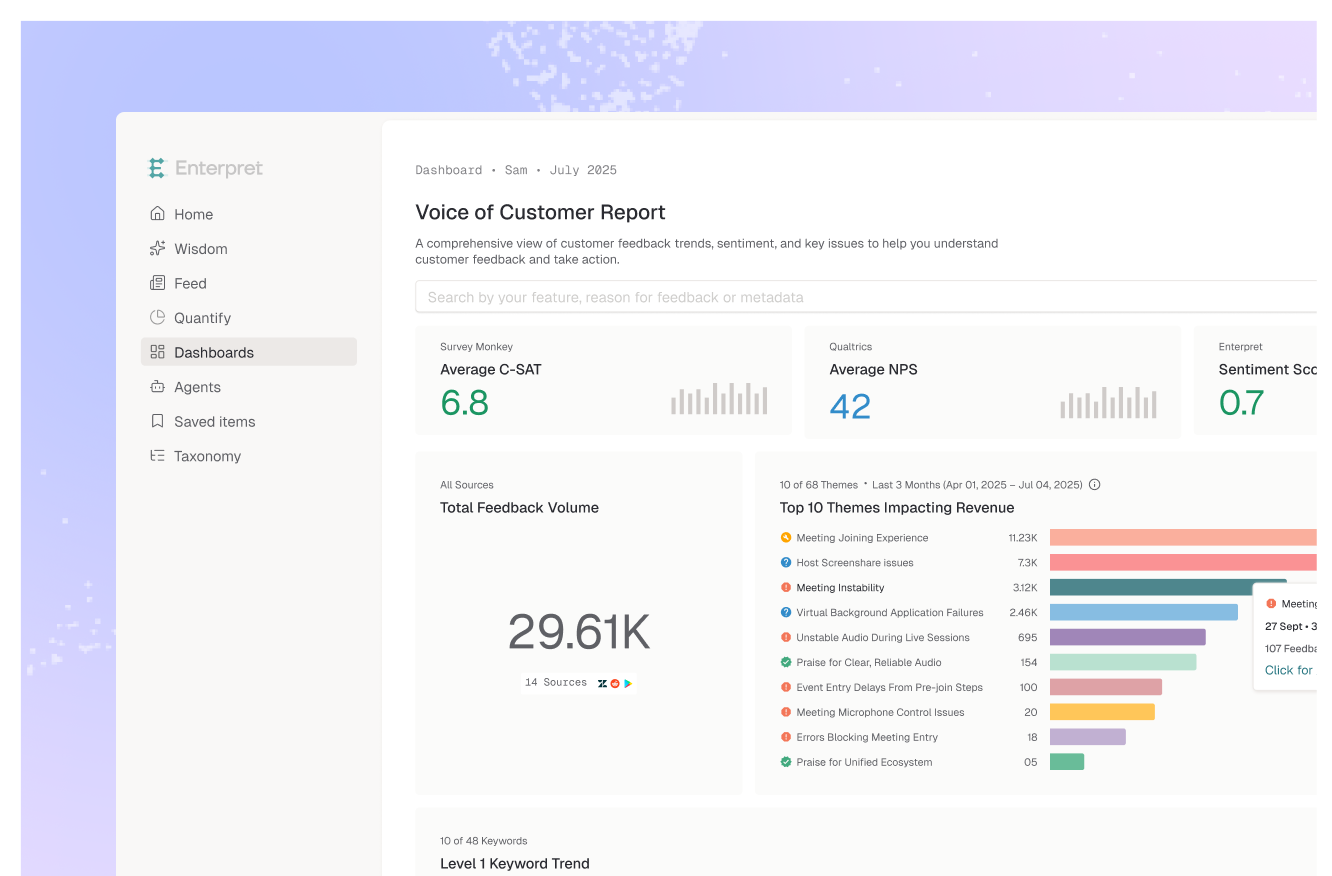
Unifies feedback from sources like Zendesk, Intercom, Gong, Salesforce, Slack, and app stores. Adaptive Taxonomy organizes themes on a consistent L1/L2/L3 product-area structure that updates as you ship, so cross-team problems are visible. The Customer Context Graph joins every theme to accounts, segments, and ARR. Wisdom answers in natural language with the exact records behind each answer, which is your evidence appendix.
And you do not have to leave your writing tool. The MCP server brings the same evidence into Claude, Claude Code, Cursor, Codex, Glean, and Notion. If your team drafts in Notion, see the MCP servers to access customer insights in Notion. Connecting sources and building the context graph takes integration and processing time, so set it up before strategy season, not during it.
Picture a Staff PM at a mid-market HR software company pitching a reporting overhaul. The numbers below are illustrative.
The VP asks "how big is this?" twice. The answer is the same both times, with the records attached. The doc gets approved.
Strategy docs used to be persuasion documents. They are becoming evidence documents. The PMs who win the next promotion cycle will not be the best writers in the room. They will be the ones whose numbers hold when an exec asks twice.
Teams that reach the top of the customer feedback maturity model already work this way. Everyone else is about to.
Seven: the customer problem and who has it, what customers do today and why it fails, where you win, the bets and what you will not do, how you will measure success, risks and open questions, and an evidence appendix. Ground each section in customer evidence sized by accounts and ARR.
A PRD defines what to build for one feature. A strategy doc decides which problems to pursue across teams, what to stop doing, and why, usually over several quarters.
Aatir Abdul Rauf describes his as roughly 4 to 6 pages covering the next 3 to 4 quarters. Keep the body short and move the supporting numbers and records into the evidence appendix.
You can draft with them, but be careful with counts and rankings from raw feedback. Enterpret's research on eight frontier models found a raw model changed more than half its top themes between runs at 100 records, while a taxonomy-grounded agent cut theme churn by 86 to 88% with the model held constant. Ground the model in a persistent taxonomy before you put its numbers in a doc.
Count accounts affected, not tickets, then join those accounts to segment and ARR. Pull from every channel where customers speak, including support, sales calls, and reviews, so quiet enterprise accounts are not undercounted.
If you are writing your next strategy doc and want every number to hold up on the second ask, see how Enterpret works.
Research cited
Lorem ipsum dolor sit amet, consectetur adipiscing elit. Suspendisse varius enim in eros elementum tristique. Duis cursus, mi quis viverra ornare, eros dolor interdum nulla, ut commodo diam libero vitae erat. Aenean faucibus nibh et justo cursus id rutrum lorem imperdiet. Nunc ut sem vitae risus tristique posuere.


