





The 7 Steps to Analyze Product Reviews From UK Retailers Like Argos and Very

Feedback Analysis
November 5, 2026

To combine product reviews from multiple retailers into one view, you need seven steps: map every retailer listing for each product, bring the reviews in automatically, normalize ratings and metadata, handle language, remove syndicated duplicates, categorize everything on one taxonomy, and break the result down by retailer, product and country. Skip any one of them and the "one view" quietly lies to you.
Picture a brand that sells one robot vacuum in five countries. The same machine lives on a dozen retailer product pages, each with its own SKU, its own star average and its own pile of reviews. Product hears about suction from the UK. Quality hears about docking from Australia. Everyone is reading reviews. Nobody is reading the product.
Most of what ranks for this question solves a different problem. Shopify review apps import reviews to display on your storefront. Syndication platforms push reviews from your site out to retailers. None of them answer the question a product or quality team actually has: what are customers saying about this product, everywhere it is sold?
That is the category mistake. A review widget is not a review analysis. One is built to show stars to shoppers. The other is built to tell your teams what to fix, and for whom.
The reframe: stop asking "how do I collect reviews from every retailer?" and start asking "how do I see one product's story across every retailer, without counting anyone twice?"
Build a product map first. One row per listing: your internal product name, the retailer, the country, and the retailer's own SKU or product ID. The same vacuum might carry one ID at Best Buy US, another at Best Buy Canada, and a third at MediaMarkt Germany. Decide now whether colorways and bundles roll up to one product or stay separate. This map is your join key.
Copying reviews into a spreadsheet does not scale to a product line. You want a route where you supply product links or IDs from your map and new reviews keep arriving without anyone touching them. If you consider building scrapers yourself, budget for the upkeep: retailer pages change, rate limits apply, and each retailer's terms of use need review. Most teams are better served by an approved or managed route.
Every review needs the same fields, whatever page it came from. If any source uses a different scale or a yes/no recommendation, convert it to one scale and keep the original value. The table below is a workable minimum.
| Field | Why it matters |
|---|---|
| Product (your name) | Rolls every retailer SKU up to one product |
| Retailer and country | Lets you compare Best Buy Canada with Argos UK |
| Retailer SKU or ID | Separates variants, bundles and regional models |
| Rating (normalized and original) | Comparable averages without losing the source value |
| Review date | Trend lines and before and after comparisons |
| Language | Filtering and quality checks |
A brand selling through MediaMarkt, Orange and JB Hi-Fi will collect reviews in German, Italian, French, Spanish and English. A German complaint about a docking station and an English one about the same dock should land on the same theme. Keep the original text, and test that categorization treats languages equally before trusting a cross-country comparison.
This is the step most teams miss. Syndicated reviews are collected on one site, usually the brand's own, and then displayed on a network of retailer sites. Pull from five retailers and one customer's review can show up five times. Match on reviewer name, date and near-identical text, keep one copy, and record every retailer it appeared on. Otherwise one angry review looks like a trend.
Star ratings tell you how people feel. Categories tell you why. Use one taxonomy across every retailer: product area, feature, sub-feature. Labels must be specific enough for a team to own. "Battery" is a bucket. "Battery drains overnight in standby" is a work item.
Rank themes for one product across all retailers, then slice. A theme concentrated in one retailer often points to fulfillment, packaging or a listing error. A theme concentrated in one country can point to a regional model, a power adapter or a translation in the manual. A theme everywhere is your product.
It is tempting to paste reviews into an LLM and ask for categories. The output looks tidy. Tidy is not the same as useful. In Enterpret's taxonomy evaluation paper, Enterpret researchers Viraj Bagal, Raviraja G, and Prabhath Chellingi found that AI-generated taxonomies passed every generic quality check, yet 97.7 to 100% of their leaf names simply restated a parent's name. The labels looked right and said nothing new.
34.7% to 76.4% Share of records that leaked across more than one top-level product area in AI-generated taxonomies, versus about 20% in production references built with structural checks. Source: Enterpret Research, "From Plausible Hierarchies to Useful Taxonomies" (arXiv, 2026)
For a multi-retailer brand, leakage is not academic. If a docking complaint lands in both "Charging" and "Navigation," two teams each see half the problem and neither owns it. The study tested one harness on two corpora: treat it as a warning about what to test.
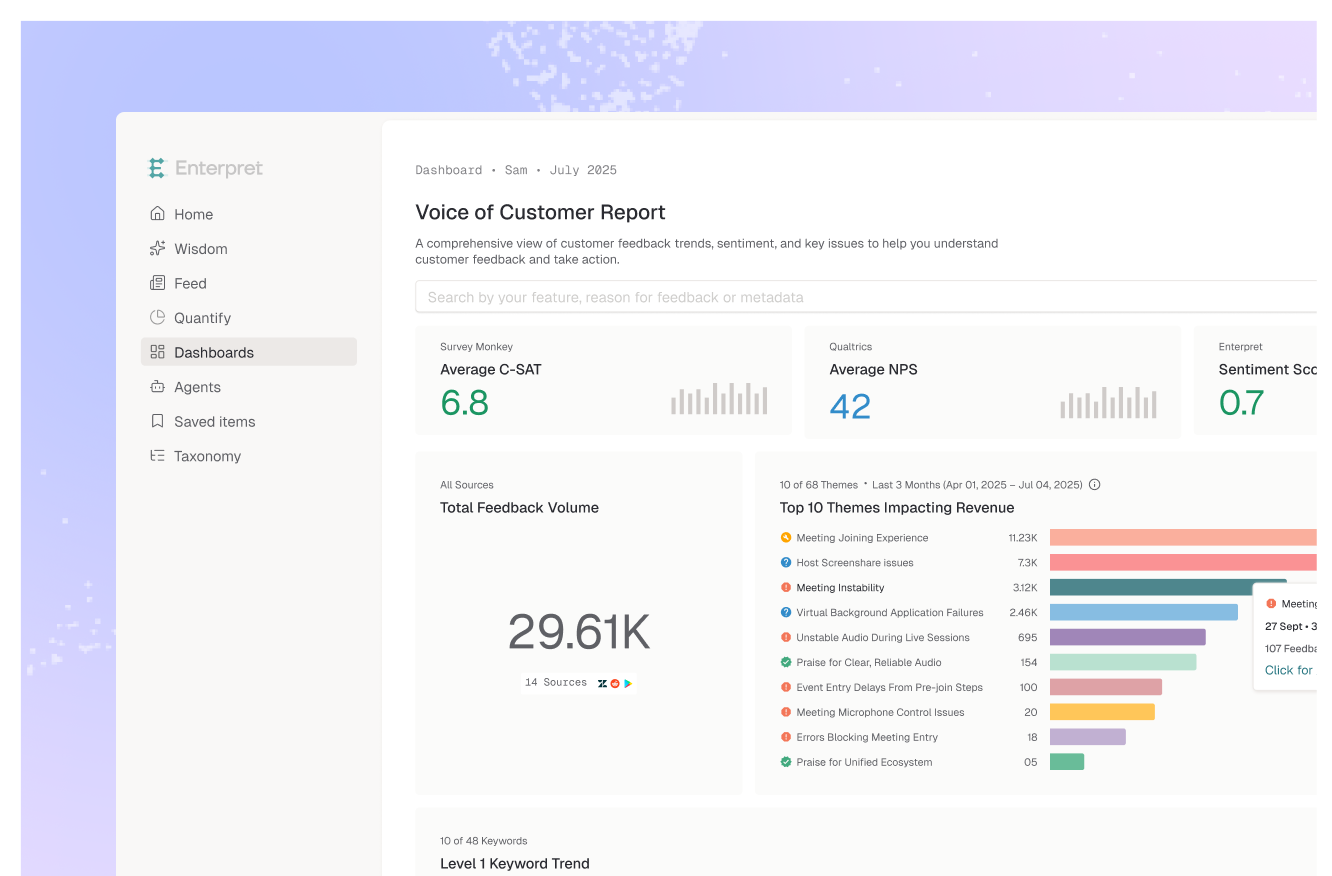
Teams can now bring product reviews from major retailers in the US, Canada, the UK, Europe and Australia into Enterpret. Paste product links or product IDs, and Enterpret pulls every new review on that product. Supported retailers include Best Buy (US and Canada), Walmart (US), Argos, Very (including Littlewoods), Orange, MediaMarkt (including Saturn and MediaWorld), JB Hi-Fi, and the Meta Store.
Once they arrive, retailer reviews sit next to the rest of your feedback: support tickets from Zendesk or Intercom, survey responses, app reviews from the Apple App Store and Google Play, and reviews from PowerReviews. That is the broader pattern in managing multi-source customer feedback. Then:
Setup still takes work: the product map and the syndication rule are decisions only your team can make. The tool removes the copying, not the thinking.
Picture the robot vacuum again, sold through Best Buy in the US and Canada, Argos in the UK, MediaMarkt in Germany and Italy, and JB Hi-Fi in Australia. Illustratively, a firmware update ships in week one. By week two, a "won't return to dock" theme is climbing. The breakdown shows it is spread across every retailer and country, so it is not a listing or shipping issue. It is the update. Quality gets an alert with the underlying reviews and opens a Jira ticket the same day.
For a parallel workflow focused on your own storefront, see how DTC brands analyze reviews, tickets, and surveys together.
Your customers already told you what is wrong. They just told twelve different retailers, in five languages. The brands that win the next product cycle will be the ones that hear it once, clearly, and early.
Retailer reviews used to be a marketing metric. They are becoming an operating signal for product and quality teams, read alongside tickets and returns notes, and watched with the same rigor as any other source of trending product issues. Every product cycle without one view is a cycle of fixes shipped late. That cost compounds.
Syndicated reviews are written once, usually on the brand's site, and shown on several retailer sites. Match on reviewer name, date and near-identical text, keep one copy, and record every retailer it appeared on. Without this step, a single review can inflate a theme's volume several times over.
You will get plausible categories quickly, but plausible is not the bar. Enterpret research found AI-generated taxonomies passed generic quality checks while 34.7% to 76.4% of records leaked across top-level product areas, versus about 20% for production references. Test whether labels are specific and whether each branch maps to a team that can own it.
Enterpret brings in reviews from major retailers in the US, Canada, the UK, Europe and Australia, including Best Buy (US and Canada), Walmart (US), Argos, Very (including Littlewoods), Orange, MediaMarkt (including Saturn and MediaWorld), JB Hi-Fi, and the Meta Store. You paste product links or IDs and Enterpret pulls every new review on that product.
DIY scraping means maintaining scrapers, handling site changes and rate limits, and checking each retailer's terms of use. Review each retailer's terms and prefer approved or managed routes.
If you sell through retailers and want one view of what customers say about each product, see how Enterpret works.
Research cited
Lorem ipsum dolor sit amet, consectetur adipiscing elit. Suspendisse varius enim in eros elementum tristique. Duis cursus, mi quis viverra ornare, eros dolor interdum nulla, ut commodo diam libero vitae erat. Aenean faucibus nibh et justo cursus id rutrum lorem imperdiet. Nunc ut sem vitae risus tristique posuere.


