





The 7 Steps to Analyze Product Reviews From UK Retailers Like Argos and Very

Feedback Analysis
November 5, 2026

To track review sentiment across retailers after a product launch, connect the new product's listings at every retailer before launch day, set a baseline from the previous model, then track themes (not just star ratings) broken down by retailer and country. Separate delivery and packaging complaints from product issues, alert on new themes as they appear, and run a structured review at 30, 60 and 90 days.
Picture a launch where the average rating sits at 4.4 stars in week one and 4.1 stars by week six (illustrative numbers). That 0.3 drop tells you something moved. It does not tell you what, where, or whether it is the product at all. That gap between metric and cause is the bottleneck.
Most launch-monitoring advice is written for app releases. Physical products break that model in four ways.
A star rating is an output metric. Post-launch tracking needs input metrics: which themes are moving, at which retailer, in which country, and whether the cause sits in the product, the box or the delivery van.
Build a listing map: every retailer, every country, every SKU variant (color, storage size, bundle). Connect those listings before the first review lands, so day one is in your data instead of reconstructed later.
A launch is a hypothesis: the new model fixes X and Y without breaking Z. You can only test that against the previous model's theme profile. Capture its top themes, their share of reviews and its ratings per retailer. If its reviews were never collected, build the baseline from what you hold: support tickets, returns notes and reviews on your own site.
Map every review to product area, feature and sub-feature: battery life, setup and pairing, build quality, sound, companion app. Then track each theme's volume and sentiment over time. This is where generic sentiment scoring falls short, and why teams look for VoC tools that go beyond sentiment analysis. The categories also have to hold still between reports, or your week-six comparison measures the classifier instead of the customers.
Retailer is a dimension, not a footnote. A complaint concentrated in one country can point to a regional firmware build. One concentrated at one retailer can point to its bundle, listing copy or delivery partner.
Give delivery, damaged packaging, missing accessories and unboxing their own branch. These belong to logistics and packaging owners, not the product team. Splitting them out keeps product sentiment honest.
Volume climbs naturally after launch, so volume alerts fire on noise. Alert instead on a theme that did not exist in the baseline, or one growing faster than total volume. Route each alert to an owner, the pattern covered in our guide to feedback routing and team-based alerting.
Each checkpoint answers a different question. Day 30: did launch-day assumptions hold? Day 60: what do mainstream buyers say now that the enthusiast wave has passed? Day 90: which themes are durable, and what goes into the next model's requirements? End each one with owners and next actions.
Steps 2, 3 and 7 depend on the same review landing in the same theme every time. If themes are regenerated per report, the 30/60/90 comparison breaks.
This is measurable. In Enterpret's study of run-to-run instability across eight frontier models, raw models asked for the top themes in the same feedback changed more than half of their theme set between two runs at 100 records, and nearly three quarters at 5,000 records (theme churn of 0.552 rising to 0.726).
86 to 88% Reduction in theme churn when an AI agent is grounded in a persistent taxonomy instead of re-clustering raw feedback on every run. Source: Enterpret Research, "Same Feedback, Different Answer" (arXiv, 2026)
One caveat from the paper itself: it measures stability, not accuracy. A consistent taxonomy is necessary for trend comparison. It does not guarantee every label is right, so spot-check the reviews behind any theme before acting on it.
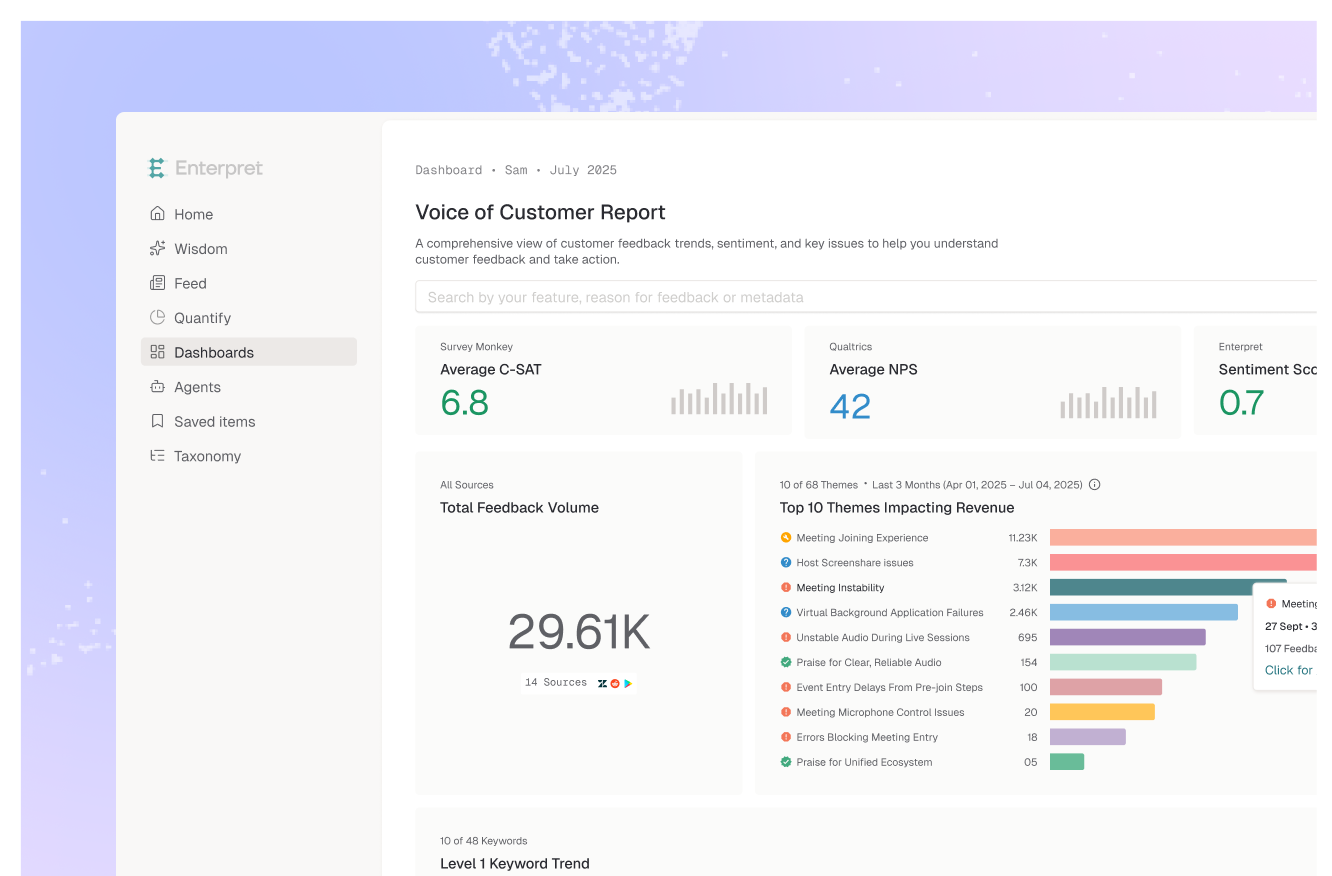
Teams can now bring product reviews from major retailers into Enterpret. Paste product links (or product IDs) and Enterpret pulls every new review on that product. Supported retailers include Best Buy (US and Canada), Walmart (US), Argos, Very (including Littlewoods), Orange, MediaMarkt (including Saturn and MediaWorld), JB Hi-Fi and the Meta Store. That maps directly to step 1: connect the listing map before launch.
The rest of the system is a permutation of existing capabilities:
The trade-off: the taxonomy is only as useful as the structure your teams agree on. Decide before launch which branches product, quality and logistics own.
Picture a hypothetical pair of wireless earbuds launching in the US, UK, Germany and Australia. Every number and finding below is illustrative.
| When | What happens in reviews | What the team does |
|---|---|---|
| Day minus 7 | No reviews yet | Listings connected at every retailer and country; previous model's themes set as baseline |
| Week 1 | First wave from enthusiasts, rating high, praise for sound quality | Confirm reviews flow per retailer; no conclusions yet |
| Week 2 | "Dented case on arrival" appears at one UK retailer | Tagged as packaging, routed to logistics, excluded from product sentiment |
| Week 3 | New theme: left earbud disconnects, mostly in Germany | Alert fires on a theme absent from baseline; quality pulls exact reviews and checks the regional firmware build |
| Day 30 | Sound praise holds; battery complaints down versus previous model | Launch hypothesis partly confirmed; disconnect fix ticketed in Jira |
| Day 60 | Mainstream buyers mention fit and ear tip size more than enthusiasts did | Marketing updates listing copy; product notes ear tip options |
| Day 90 | Disconnect theme declining after the update; fit theme stable | Durable themes feed the next model's requirements |
The star rating alone showed a small dip in weeks two and three. The theme view showed two unrelated causes with two different owners.
Brands selling through retailers have treated reviews as a merchandising metric. The shift is toward product telemetry: structured, segmented, and joined to support and returns data, the same way teams identify trending product issues from tickets today. The next launch you run is the cheapest place to start. Build the listing map, set the baseline, and test where the system breaks.
At least 90 days, with checkpoints at 30, 60 and 90. Physical products are reviewed after delivery and real use, so durability issues often surface weeks after launch.
Stars tell you that sentiment moved, not why. A drop can come from a defect, a damaged shipment or a bundle difference at one retailer. Theme-level tracking separates those causes so each goes to the right owner.
For a one-off read, yes. For tracking over time, repeatability is the problem: Enterpret's research found raw frontier models changed more than half their theme set between two runs on the same 100 records, while a taxonomy-grounded agent cut theme churn by 86 to 88%.
DIY scraping means maintaining scrapers, handling site changes and rate limits, and checking each retailer's terms of use. Review those terms first and prefer approved or managed routes.
Major retailers in the US, Canada, UK, Europe and Australia, including Best Buy, Walmart, Argos, Very, Orange, MediaMarkt, JB Hi-Fi and the Meta Store. Paste product links or product IDs and Enterpret pulls every new review on that product, alongside your other customer feedback sources.
If your next launch ships through retailers, see how Enterpret works and run this framework on your own reviews. Then tell us where it breaks.
Research cited
Lorem ipsum dolor sit amet, consectetur adipiscing elit. Suspendisse varius enim in eros elementum tristique. Duis cursus, mi quis viverra ornare, eros dolor interdum nulla, ut commodo diam libero vitae erat. Aenean faucibus nibh et justo cursus id rutrum lorem imperdiet. Nunc ut sem vitae risus tristique posuere.


