





The 7 Steps to Analyze Product Reviews From UK Retailers Like Argos and Very

Feedback Analysis
November 5, 2026

A thumbs-down is not feedback. It is a pointer to feedback. To use thumbs-down ratings and chat logs as product feedback, treat every rating as an index into a conversation: capture the prompt, response, flow and account with each click, read the conversation to learn why it failed, tag the reason on a stable taxonomy, join it to accounts and segments, combine it with tickets, community posts and reviews, and route each pattern to the person who owns the fix. The seven steps below show how.
Most answers to this question are setup docs: how to switch on the widget, attach the score to a trace, chart the rate. Useful. None of it tells a PM what to build next week.
Start with who clicks. Langfuse's own user feedback docs list the two drawbacks of explicit ratings plainly: low response rates, and "unhappy users more likely to respond." Your thumbs-down rate is a sample of a sample, tilted toward the worst moments.
Then look at what one click collapses. In an AI-native product, the model is part of the product. A thumbs-down can mean a hallucination, a failed tool call, a confusing UI, or a feature you have not built. One bit of data. Four different owners.
And a model upgrade can change quality overnight. A rate that moves tells you something happened. It does not tell you what, to whom, or whether it matters.
Stop asking "what is our thumbs-down rate?" Ask "what problems, for whom, owned by whom?" The click tells you where to look. The conversation tells you what happened. The account tells you whether it matters.
A thumb measures a moment of strong feeling from a self-selected user. Use it to find conversations worth reading, not to score quality. Track how many sessions were rated at all, so a quiet week is not mistaken for a good one, and pair ratings with retries, rephrased prompts and abandoned sessions to cover users who never click.
A rating without context is a dead end. Store four things with every click:
The rated turn, plus a conversation ID to pull the full thread.
Which surface, agent or tool path produced the answer.
Model, prompt version and app release, to split before and after a change.
User ID, account ID and plan.
The reason is rarely in the rated turn. It is three turns earlier, when the agent quietly answered a different question. Read the full thread. Note whether the cause was the model, the interface, or a missing capability.
Reading does not scale. You need categories, and they have to hold still. Re-cluster with an LLM every week and you compare two lists, not two weeks. Enterpret's study of run-to-run instability across eight frontier models found raw models changed more than half their theme set between two runs on the same 100 records. Grounding the analysis in a persistent taxonomy changed that.
86 to 88% Reduction in theme churn when an AI agent is grounded in a persistent taxonomy instead of re-clustering raw feedback on every run, with the model held constant. Source: Enterpret Research, "Same Feedback, Different Answer" (arXiv, 2026)
Stability is not accuracy, but without it you cannot tell a trend from noise. Build a two-level taxonomy (area, then reason) that separates model behavior from UX and product gaps, and update it as you ship rather than rebuilding it.
Forty thumbs-downs from free users and four from your largest enterprise pilot are not the same signal. Join every categorized reason to account, plan and segment, and to pipeline and renewal data once enterprise deals arrive. Then ask which reasons cluster in paying accounts and which started after the last release.
The users who never click still talk. They file tickets, post in your Discord, complain on Reddit, and leave app reviews. A reason that shows up in ratings, tickets and community posts is real. Put every channel on one taxonomy so you can count across them. This is what managing multi-source customer feedback looks like in practice, and the same discipline applies when you analyze support tickets and chat transcripts together.
A pattern without an owner is a dashboard. Map each taxonomy branch to a team: model quality to the AI team, interface confusion to design, missing capabilities to the owning PM. This only works if branches split cleanly. Enterpret's taxonomy evaluation paper found AI-generated taxonomies that passed every generic quality check still had 34.7% to 76.4% of records landing in more than one top-level product area, against about 20% for production references. Pair clean branches with feedback routing and team-based alerting, so a spike after a release reaches the right channel the same day.
Eval and tracing platforms like Langfuse, Braintrust and Arize are the right place to log ratings against traces, debug a bad tool call, and run regression tests before a model swap. They answer "did this response meet our bar?" The user feedback layer answers a different question: "what are users telling us across every channel, and what should we build?"
| Question | Evals and traces | User feedback layer |
|---|---|---|
| Did this response pass our quality bar? | Primary job | Indirect |
| Why did this specific call fail? | Primary job | Points you to it |
| Which problems are growing across ratings, tickets and community? | Ratings only | Primary job |
| Which accounts and segments are affected? | Limited | Primary job |
| Who owns the fix? | Not designed for it | Primary job |
Chat logs are user data, often more sensitive than tickets. Before you analyze them, follow your own privacy policy and the consent terms you gave users, and check with your privacy or legal team on what is allowed. Common practices include minimizing what you keep, redacting personal data, limiting access to raw transcripts, and setting retention windows. This is not legal advice. For the questions to ask of any vendor, see these data privacy risks when buying a feedback platform.
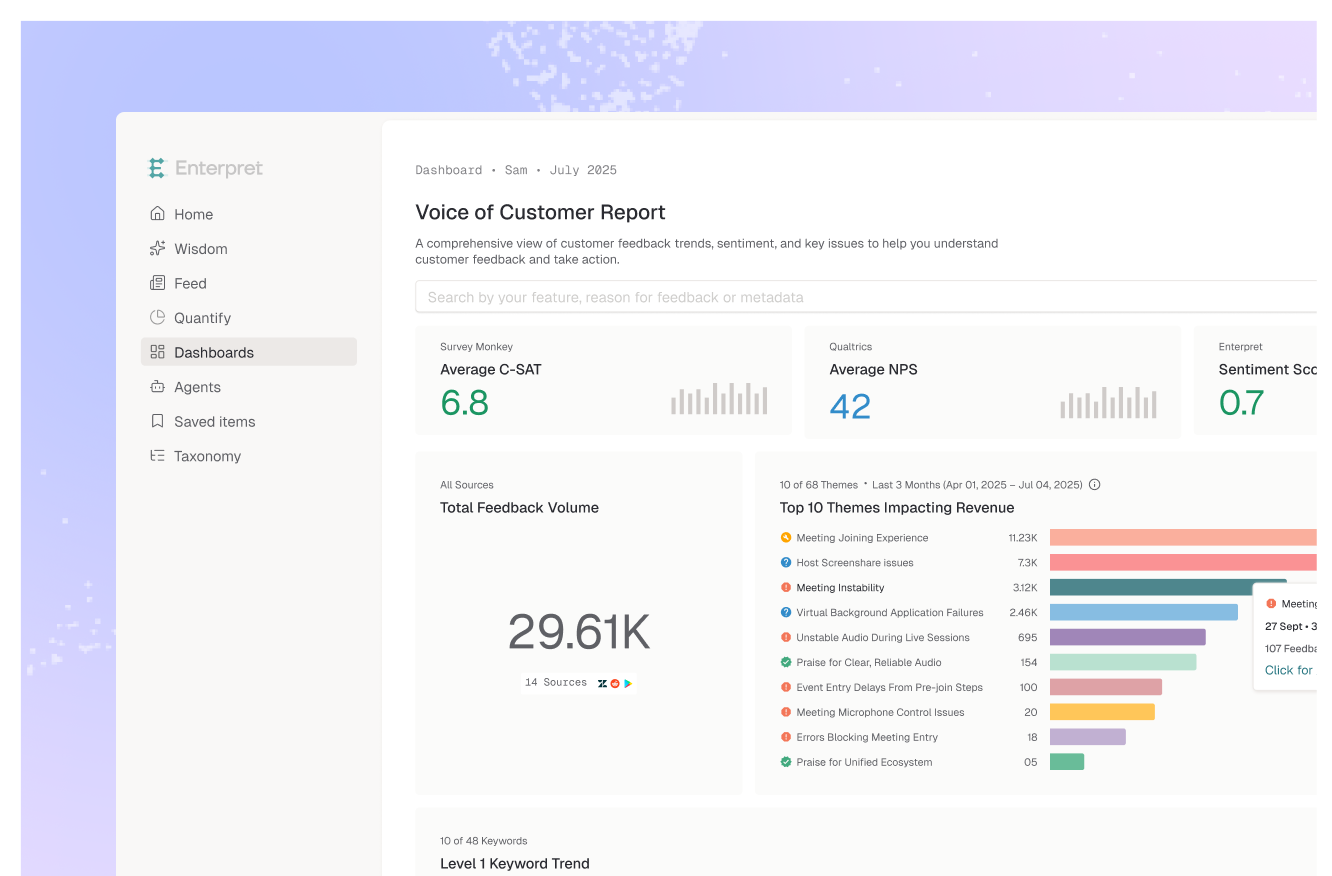
Enterpret is the user feedback side of this stack, not an eval or tracing tool. Rated conversations can come in through its webhook and API route or a file upload, alongside sources like Intercom, Discord and Reddit. Adaptive Taxonomy categorizes every record on one hierarchy that updates as you ship. The Customer Context Graph joins each reason to users, accounts and revenue. Wisdom lets you ask questions in plain language, and the MCP server brings the same answers into Claude, Claude Code, Cursor, Codex, Glean and Notion. AI agents and alerts flag new or spiking issues after a release and deliver them to Slack, Jira, Linear or Notion. Building the graph takes integrations and processing time.
Picture an AI coding assistant that swaps to a new model on a Tuesday. By Thursday the thumbs-down count is up. The rate alone says "regression." Reading and categorizing the conversations says two different things: the new model refuses to edit very long files, and a release in the same week broke the "apply change" button in one IDE. Joined to accounts, the button issue sits mostly in three enterprise trials, and it shows up in tickets too. Two patterns, two owners, two fixes, and one of them was never about the model.
Every AI product team collects thumbs. The gap compounds: the team that reads, categorizes, joins and routes learns something every release, and the team that charts a rate learns that a number moved. The click was never the work. The loop is.
Not on their own. Few users click, and Langfuse's documentation notes that unhappy users are more likely to respond, so ratings skew negative.
Store the prompt and response with a conversation ID, the flow or feature, the model and release version, and the user and account IDs.
For a one-off read, yes. For tracking over time, raw summaries drift: Enterpret's study of eight frontier models found raw models changed more than half their theme set between two runs on the same data, and grounding the agent in a persistent taxonomy cut theme churn by 86 to 88%.
Yes. Tools like Langfuse, Braintrust and Arize are built for tracing, debugging and regression testing model behavior. A user feedback platform complements them by combining ratings with other channels, joining them to accounts, and routing patterns to owners.
That depends on your privacy policy, your consent terms and the laws that apply to you, so check with your privacy or legal team. Common safeguards include redaction, access limits and retention windows.
If you want every rating, ticket and community post on one taxonomy, joined to accounts and routed to owners, see how Enterpret works.
Research cited
Lorem ipsum dolor sit amet, consectetur adipiscing elit. Suspendisse varius enim in eros elementum tristique. Duis cursus, mi quis viverra ornare, eros dolor interdum nulla, ut commodo diam libero vitae erat. Aenean faucibus nibh et justo cursus id rutrum lorem imperdiet. Nunc ut sem vitae risus tristique posuere.


