



The 8 Signals Fintech Teams Use to Spot Compliance-Sensitive Complaints in Customer Feedback

Product
November 25, 2026

To know what customers are saying without reading every ticket, replace reading with a small system: a weekly brief that leads with what changed, theme trends on a stable taxonomy, spike alerts with an owner, signals weighted by the accounts and revenue behind them, a way to ask follow-up questions in Slack or an AI assistant, and a fixed sample of raw quotes every week. You stop reading tickets and start reading signals, then spot-check the signals against real customer words. The whole routine takes about 30 minutes a week once the plumbing is in place.
Most founders read every ticket for a while, and they should. Nicereply wrote about Lucidchart CEO Dave Grow reading more than 100,000 support tickets, and that instinct is right. The problem is what happens next: volume outgrows your calendar, and you start hearing customers through whoever summarizes for you. This guide covers the seven ways founders stay close once that happens.
Reading tickets works when there are a few dozen a week. It breaks in three predictable ways as you grow.
The fix is not to read less carefully. It is to let something read everything for you, consistently, and to judge that something by whether you would have reached the same conclusion reading the raw tickets yourself. If you are setting up the underlying program for the first time, start with how to build a voice of customer program from scratch, then come back to the founder layer below.
A founder does not need a dashboard. You need one page every Monday that answers: what moved this week, who it affects, and what someone is doing about it. Lead with change, not totals. "Login issues are up 40% week over week, mostly on the new SSO flow" is useful. "Login issues: 312" is not.
A good brief has five parts: the top three themes that grew, any new theme that did not exist last month, the accounts affected, three to five verbatim quotes, and one decision or ask. The sections every weekly voice of customer report needs go deeper on format.
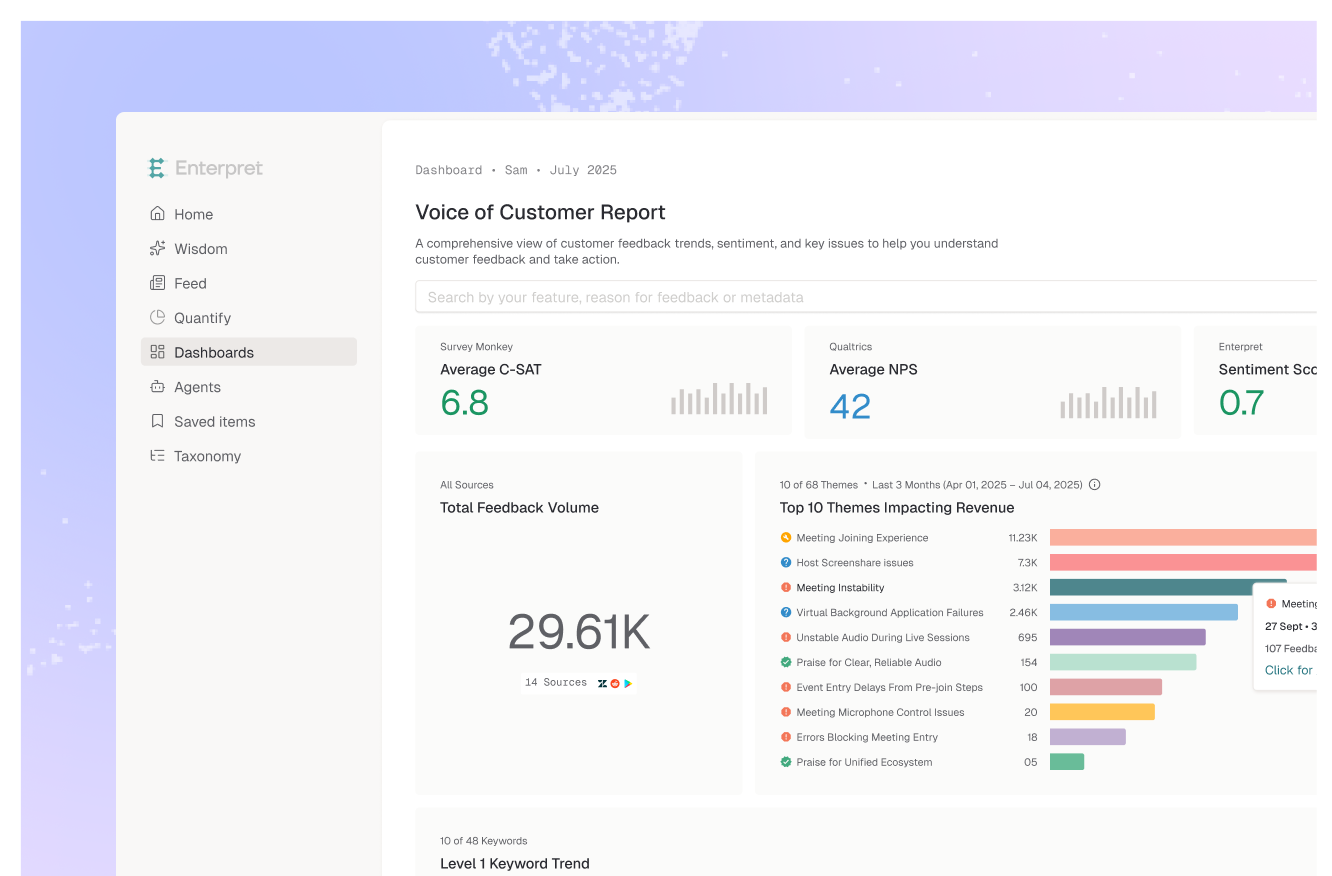
You can assemble this by hand from helpdesk reports, or automate it. Enterpret generates a weekly VoC report of what moved in customer feedback across support, calls, reviews and surveys, and can deliver briefs into a Slack channel, so the founder version arrives without anyone building it.
Trends only mean something if the categories stay put. If your support team tags tickets by hand, "billing," "Billing issue" and "invoice question" become three different lines on a chart, and the tag list drifts every time someone new joins.
What you want is a taxonomy built from your customers' own language that classifies every conversation the same way week after week, and adds new themes as they appear instead of hiding them in "Other." That is the job of Enterpret's Adaptive Taxonomy. Whatever you use, test it: pick a theme, read ten tickets inside it, and check that they belong together.
Once themes are stable, the founder view is simple. Look at the top ten themes by volume, the five fastest-growing, and anything new. That is most of what reading the queue used to give you, in a few minutes.
Some things cannot wait for Monday. A broken checkout, a bad release or a pricing page change that confuses everyone should reach you the same day. The catch is noise: a theme that goes from 2 tickets to 6 is a 200% jump and means nothing.
Set alerts on two conditions together: a minimum volume and a percentage change against a baseline, such as the trailing four-week average. Route each alert to a named owner, and copy yourself only on themes you care about. The steps to set up alerts for support ticket spikes walk through thresholds.
Helpdesks like Zendesk and Intercom can trigger alerts on tags or volume. Enterpret flags breaks in any theme, attaches the affected accounts and revenue to the alert, and can notify the owner, which keeps you informed without making you the dispatcher.
Ticket counts treat a free trial user and your largest customer as equal. Founders rarely should. Ten tickets from accounts up for renewal next quarter can matter more than a hundred from free users, and a feature request from your fastest-growing segment can matter more than one from a segment you are leaving.
To see this, feedback needs to be joined to the CRM: account, plan, ARR, renewal date, segment. You can do the join in a spreadsheet or warehouse, or use a platform that keeps it for you. Enterpret's Customer Context Graph links each conversation to its theme, account, revenue and release, so you can sort any theme by the revenue behind it.
Ask two questions every week: which themes are concentrated in our biggest accounts, and which accounts went quiet? Silence from a large customer is a signal too.
The brief tells you what moved. The next question is always "why" or "who," and you should be able to ask it in plain language without filing a request to an analyst. "What are enterprise customers saying about the new permissions model?" "Which accounts mentioned a competitor this month?"
Many founders try this by exporting tickets and pasting them into ChatGPT or Claude. Be careful. In Enterpret's study of run-to-run instability across eight frontier models, a raw model asked the same question on the same feedback changed more than half of its top themes between two runs at 100 records, and nearly three quarters at 5,000 records. A board update that changes every time you rerun the prompt is not one you can stand behind.
The same study found that grounding the agent in a persistent taxonomy cut theme churn by 86 to 88%, and that once a theme appeared in two grounded runs its count was identical every time, while raw models' counts moved 7.5 to 9.8%. Stability is not the same as accuracy, but it is the minimum bar for a number you repeat to your team.
So ask your questions where you already work, but point them at classified data. With Enterpret you can ask in the app, tag the Enterpret Agent in a Slack thread, pull data through the API or exports, or query it from Claude, ChatGPT or Cursor through the Enterpret MCP server.
Summaries compress. Compression loses tone, and tone is often the point: whether customers are mildly annoyed or about to leave. Keep a small, deliberate reading habit so you never fully lose the raw voice.
A sample that works: five quotes from the fastest-growing theme, five from your largest accounts, three from churned or downgraded customers, and three of the most positive things anyone said. Nicereply suggests a similar mix of happy customers, angry customers and feature requests. Sixteen quotes takes ten minutes, and you will notice when a summary does not match what customers actually wrote.
Make sure every number in your brief links back to the conversations behind it. If you cannot click from "billing confusion up 30%" to the tickets, you are trusting a summary you cannot check.
No system replaces talking to customers. Join one call a week: a sales call, an onboarding session, a churn interview or a support escalation. Before you join, look up what that account has said in tickets and surveys. Afterward, check whether what you heard is showing up in the data.
This closes the loop in both directions. You stay calibrated on what customers sound like, and you catch the cases where your taxonomy or brief is missing something a customer said out loud.
Put the seven ways together and the routine fits in half an hour, plus alerts as they arrive.
| When | What | Time |
|---|---|---|
| Monday | Read the weekly brief: what grew, what is new, which accounts | 10 min |
| Monday | Ask two or three follow-up questions in Slack or your AI assistant | 5 min |
| Midweek | Read the fixed sample of 16 raw quotes | 10 min |
| Friday | Check top accounts: new themes, sentiment shifts, accounts gone quiet | 5 min |
| Weekly | One live customer conversation | 30 to 45 min |
| As needed | Spike alerts routed to an owner, founder copied on chosen themes | Varies |
You can run parts of this routine with your helpdesk's reporting and a Zapier digest. Once you have several channels and a few hundred conversations a week, judge tools on five things:
For a side-by-side of options at this stage, see the best CX analytics tools for startups.
Yes, but on purpose rather than all of them. Read a fixed weekly sample from the fastest-growing theme, your largest accounts and recent churn, and use the weekly brief for the rest. The goal is to stay calibrated on how customers sound while letting a system handle the counting.
When reading takes more than an hour or two a week, or when feedback arrives in more than one or two channels. At that point you are seeing a subset anyway, usually the loudest one. Set up a weekly brief and spike alerts before you stop, so nothing falls through the gap.
For a one-off look at a small batch, yes. For anything you will track week to week, it is unreliable: Enterpret's research found raw frontier models changed more than half their top themes between two runs on the same 100 records, and nearly three quarters at 5,000. Grounding the model in a persistent taxonomy cut that churn by 86 to 88%.
The top themes that grew, any brand new theme, the accounts and revenue affected, three to five verbatim quotes, and one decision or ask. Lead with change against last week and a longer baseline rather than raw totals. Keep it to one page.
Weight them by who is complaining, not just how many. Join feedback to your CRM so each theme shows the accounts, ARR and renewal dates behind it, then look at growth rate as well as volume. A small theme growing fast in your largest accounts usually matters more than a large, flat one.
If you want this founder view without building it, see how Enterpret works.
Research cited
Lorem ipsum dolor sit amet, consectetur adipiscing elit. Suspendisse varius enim in eros elementum tristique. Duis cursus, mi quis viverra ornare, eros dolor interdum nulla, ut commodo diam libero vitae erat. Aenean faucibus nibh et justo cursus id rutrum lorem imperdiet. Nunc ut sem vitae risus tristique posuere.