





The 7 Steps to Analyze Product Reviews From UK Retailers Like Argos and Very

Feedback Analysis
November 5, 2026

A new VP of Product learns what customers need fastest by building a customer evidence baseline in the first 90 days, not by collecting opinions. In days 1 to 30, inventory every feedback source, get a cross-channel baseline of top themes, and listen to calls and read tickets yourself. In days 31 to 60, map those themes to accounts and ARR, compare what the team believes against what the data says, and pick two or three early wins. In days 61 to 90, set the review cadence your org will actually keep and turn the baseline into your first story for the CEO and board.
The 8 moves: inventory every source, get a cross-channel baseline, go to the raw feedback yourself, weigh themes by accounts and ARR, audit team beliefs against the data, ship early wins, set the cadence, and present the baseline as your day-90 story.
Gibson Biddle, who ran product at Netflix and Chegg, tells new heads of product to draft a rough strategy in their first two weeks, a "Stupid Wild-Ass Guess," and refine it over the next month or two (Ask Gib). Good advice. The guess is not the risk. The risk is what you check it against.
Most 90-day guides cover strategy, team, hiring, and stakeholder trust. Rich Mironov's 90-day checklist for a new product VP is a strong one, yet most of its seven moves concern escalations, scope, morale, and hiring. Nobody tells you how to know, by week three, what customers are saying across every channel and how much revenue sits behind it.
So new product leaders default to a listening tour. Thirty meetings, thirty confident lists of what customers want. The lists disagree.
A listening tour tells you what your colleagues remember about customers. A baseline tells you what customers said. The question for your first 90 days is not "who should I talk to?" It is "what is the evidence, and who is behind it?"
Opinions tell you what the org believes. You can't defend a bet to the board or measure progress at day 180 against them. You need a baseline: a consistent, cross-channel picture of customer themes, weighted by accounts and revenue, that you can re-run next quarter and compare.
List every place customers talk to you: tickets, chat, sales and CS calls, NPS and CSAT verbatims, app reviews, community, and Slack channels where reps paste quotes. Note volume, owner, and where each signal dies. The sources nobody reads are your first finding, and the core problem behind managing multi-source customer feedback.
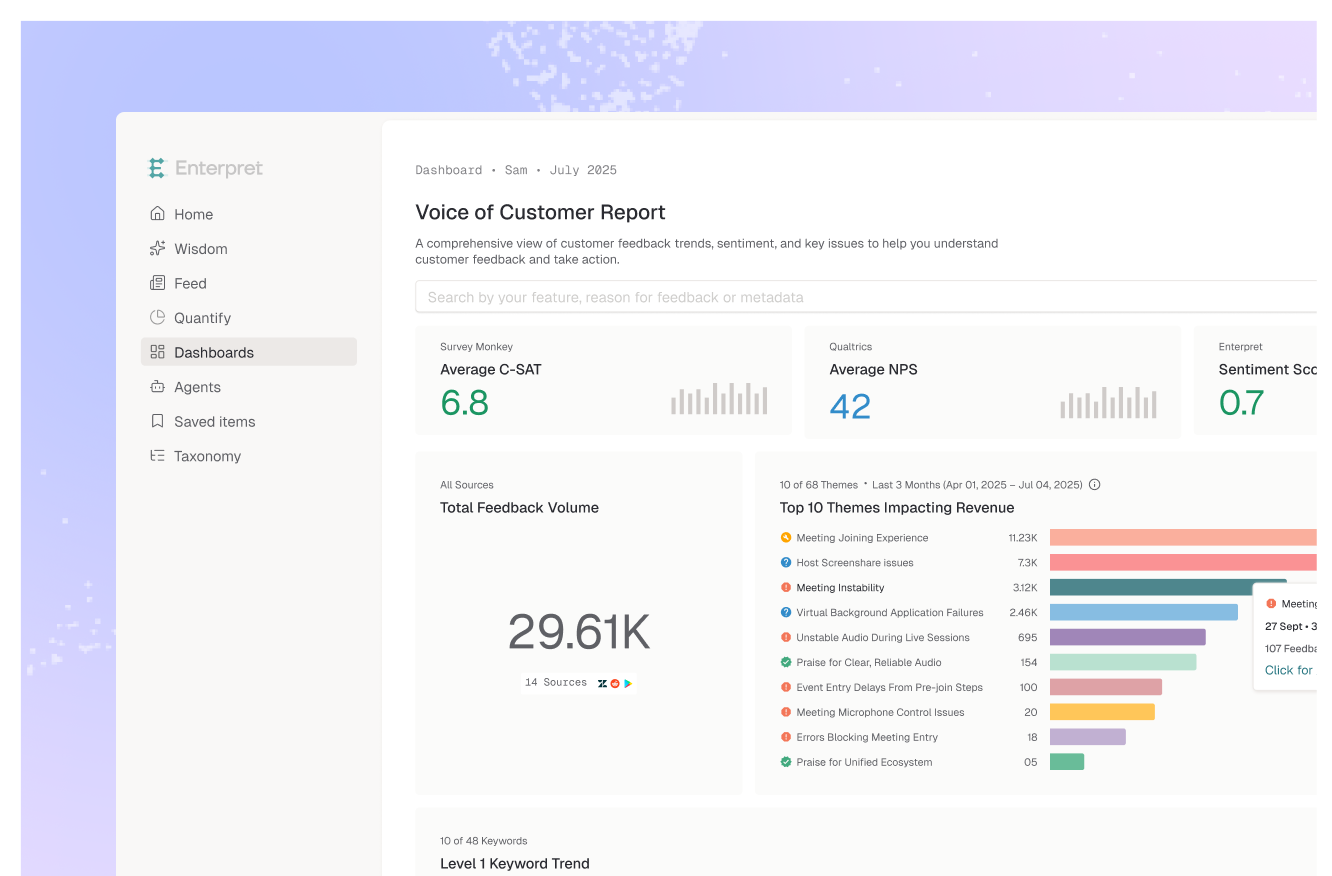
Pull 90 to 180 days of history from your highest-volume sources and read top themes across channels, not channel by channel. Connecting sources and processing history takes time, so treat the first version as a draft that sharpens as data lands. (Here's a breakdown of how long it takes to set up customer feedback analytics by approach.) The non-negotiable: the baseline has to be repeatable. If you can't re-run it in 90 days and get comparable categories, it isn't a baseline.
That test is where pasting exports into a chatbot falls down. In Enterpret's study of run-to-run instability across eight frontier models, a raw model asked the same top-themes question on the same data changed more than half of its theme set between two runs at 100 records, and nearly three quarters at 5,000 records. A baseline that moves when nothing changed can't tell you what did.
86 to 88% Reduction in theme churn when an AI agent is grounded in a persistent taxonomy instead of re-clustering raw feedback on every run (same model, same 1,000 records). Source: Enterpret Research, "Same Feedback, Different Answer" (arXiv, 2026)
Listen to at least ten recorded calls, including lost deals and churned accounts. Read a hundred recent tickets end to end. The baseline gives you breadth; this gives you texture, the words customers use, and which internal summaries you can trust.
Volume tells you what's loud. Revenue tells you what's expensive. Join each top theme to the accounts raising it, their segment, ARR, and renewal date. Spreadsheets break here, which is why tools that quantify how customer feedback impacts revenue in Salesforce matter for a product leader.
Before sharing the baseline, ask each PM and your sales, CS, and support leads to write down the top five customer problems and who has them. Then compare. The gaps show where the roadmap rests on anecdote and where an argument is really a data disagreement.
Choose fixes high in revenue exposure, low in effort, and visible to customers. Ship them and tell the customers who raised the issue. Wins chosen from evidence teach the org how you'll decide.
A weekly digest of emerging issues where your team already works. A monthly theme review with product, CS, and sales. A quarterly readout in last quarter's categories. Pick less than you want and hold it. A cadence nobody keeps teaches the org that evidence is optional. If you need a yardstick, place your team on the customer feedback maturity model and aim for one stage up.
Your first CEO and board narrative should answer four questions: what customers need most, which accounts and how much ARR sit behind each need, what you've already shipped, and how you'll know next quarter whether it worked. Your day-90 baseline becomes the before picture for every bet.
The eight moves work with any stack. The hard parts are moves 2, 4, and 7: a baseline that is cross-channel, revenue-weighted, and comparable quarter over quarter. That's what Enterpret is built for.
Integrations and processing take time, and the picture sharpens as data lands. Start them in week one so the baseline is mature by week eight.
Picture a new VP of Product at a mid-market SaaS company. In week one, sales says the top problem is a missing integration; CS says onboarding. By week four, the baseline shows onboarding leads in volume, but the integration gap sits with a handful of enterprise accounts renewing next quarter. Neither leader was wrong. Each saw one channel.
By week ten, one onboarding fix has shipped, the integration is on the roadmap with accounts and revenue attached, and a monthly review is set. The board deck doesn't say "customers are telling us." It says who, how many, and how much.
Your first 90 days set the terms for every roadmap debate after. Arrive with opinions and you'll spend the next year refereeing them. Arrive with a baseline and every quarter adds a comparable data point. The listening tour ends on day 90. The baseline keeps paying.
Inventory every customer feedback source, get a first cross-channel read on top themes, and spend real hours in raw calls and tickets. Treat stakeholder views as hypotheses to test, not as evidence.
Start with your two or three highest-volume sources, usually support tickets and call recordings, and categorize them with one consistent taxonomy. Add sources as they connect, and start integrations in week one.
For a quick first look, yes. For a baseline you'll compare next quarter, be careful: Enterpret's research found raw frontier models changed more than half of their top themes between two runs on the same 100 records, while an agent grounded in a persistent taxonomy cut that churn by 86 to 88%. Retrieval alone also can't size a theme; as Enterpret research comparing Agentic RAG, a Deep Research Agent, and a context graph agent puts it, "a top-k retrieval result cannot establish corpus prevalence."
Join each theme to the accounts raising it, then sum ARR and flag upcoming renewals. Rank by revenue exposure and trend, not raw mentions.
The top customer needs, the accounts and ARR behind each, the early wins already shipped, and the metrics you'll use to judge your bets next quarter.
If you're stepping into a product leadership role and want a cross-channel customer baseline weighted by revenue, see how Enterpret works.
Research cited
Lorem ipsum dolor sit amet, consectetur adipiscing elit. Suspendisse varius enim in eros elementum tristique. Duis cursus, mi quis viverra ornare, eros dolor interdum nulla, ut commodo diam libero vitae erat. Aenean faucibus nibh et justo cursus id rutrum lorem imperdiet. Nunc ut sem vitae risus tristique posuere.


