



6 Ways Product Marketers Use Customer Feedback for Positioning and Messaging

Voice of Customer
November 20, 2026

A 2026 product operations stack has seven layers: customer feedback intelligence, product analytics, research, discovery and roadmapping, delivery, knowledge and documentation, and an agent layer that serves customer and product context to AI tools through MCP. Product ops owns how these connect. What changed in 2026 is the last layer: PMs and engineers now ask Claude, Cursor and internal agents questions that used to go to product ops, so the stack has to serve agents as well as people.
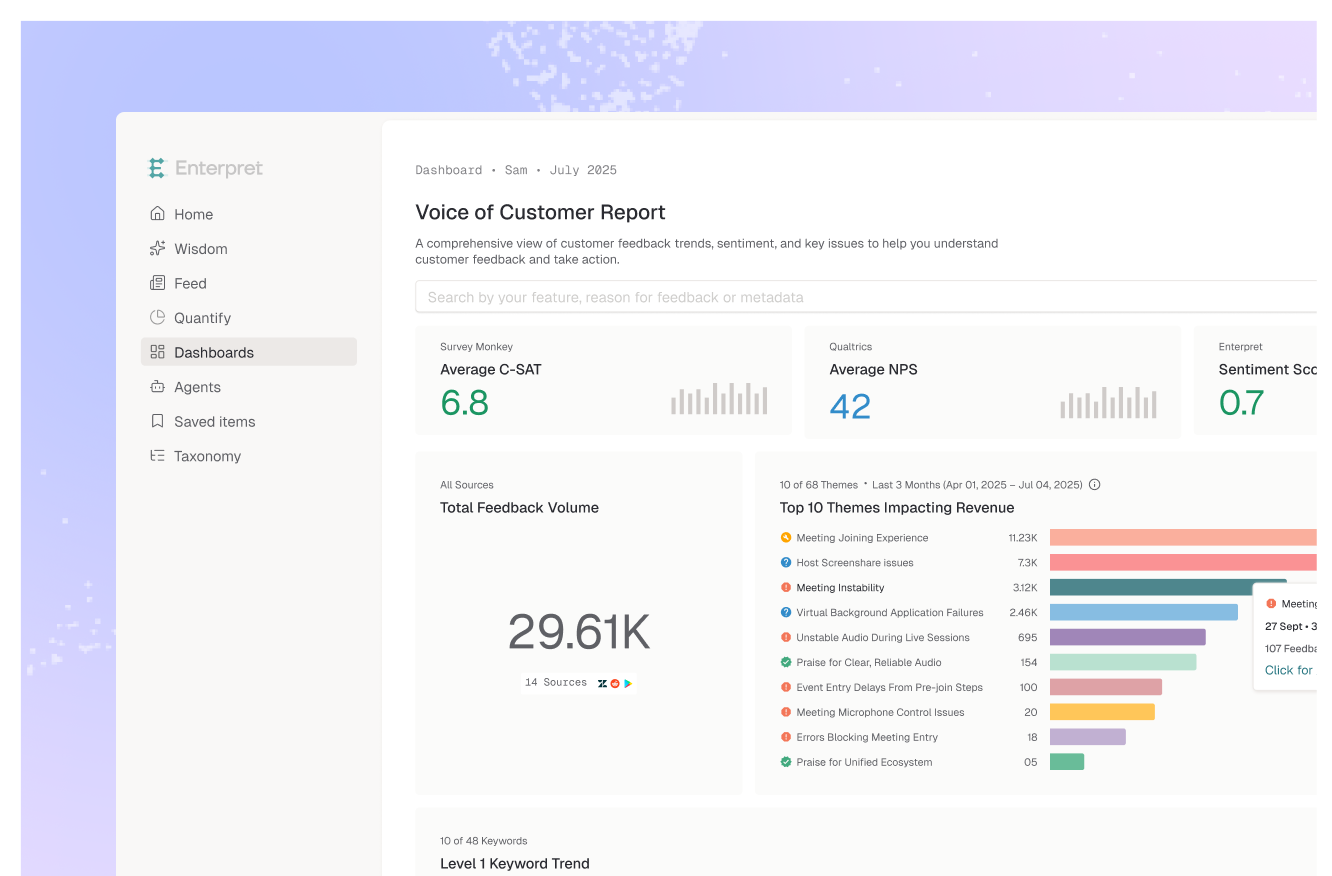
Unifies tickets, calls, reviews, surveys and community posts; classifies them into stable themes; links them to accounts and revenue. Tools: Enterpret, with survey sources such as Qualtrics or Sprig feeding in. See product operations tools for managing customer feedback.
Tracks what users do: adoption, funnels, retention. Tools: Amplitude, Mixpanel, Pendo, PostHog.
Plans, runs and stores interviews and studies. Tools: Dovetail, Condens, Maze, UserTesting.
Holds opportunities, scoring and the roadmap. Tools: Productboard, Aha!, Jira Product Discovery.
Tracks engineering work and releases. Tools: Jira, Linear.
Specs, decisions and launch notes. Tools: Notion, Confluence, with enterprise search such as Glean on top.
MCP servers and APIs that let AI agents read the other six layers. The customer half is the hardest, because feedback must be structured before an agent can count it. Enterpret's Wisdom MCP Server exposes classified feedback, accounts and revenue to Claude, Cursor and other agents. See how product ops teams use AI agents and MCP to analyze customer feedback.
Use one customer taxonomy across feedback, research and the roadmap so a theme means the same thing everywhere. Link roadmap items to feedback themes and to delivery tickets so evidence travels with the work. Report on the KPIs product ops should track for customer feedback.
Product operations typically owns tool selection, administration, integrations and data quality across the product stack.
Most start with product analytics and a feedback layer, then add roadmapping and research tools as the team grows.
AI agents now query product and customer data directly, so the stack needs MCP servers or APIs and structured data agents can trust.
As few as cover the seven jobs. Consolidation matters less than consistent data and taxonomy across whichever tools you keep.
Lorem ipsum dolor sit amet, consectetur adipiscing elit. Suspendisse varius enim in eros elementum tristique. Duis cursus, mi quis viverra ornare, eros dolor interdum nulla, ut commodo diam libero vitae erat. Aenean faucibus nibh et justo cursus id rutrum lorem imperdiet. Nunc ut sem vitae risus tristique posuere.
Product operations typically owns tool selection, administration, integrations and data quality across the product stack.
Most start with product analytics and a feedback layer, then add roadmapping and research tools as the team grows.
How is AI changing the product ops stack?
As few as cover the seven jobs. Consolidation matters less than consistent data and taxonomy across whichever tools you keep.