



The 7 Signals That Separate Product Problems From Operational Problems in Customer Feedback

Product
November 23, 2026

A customer context layer is the infrastructure that gives AI agents and applications a structured, up-to-date picture of your customers before they act. A complete one covers three things: what customers do (behavioral and product usage data), who they are (identity, account, plan, revenue) and what they say (feedback from tickets, calls, reviews and surveys, organized into themes).
Most published definitions, such as Snowplow's, focus on the first two: real-time, identity-resolved behavioral data. That is necessary but incomplete. Behavior shows that a customer stopped using a feature. Feedback explains why. An agent writing a spec or deciding a retention play needs both.
Models arrive knowing nothing about your customers. Without a context layer, each agent assembles its own picture from whatever it can retrieve, and different agents give different answers. Retrieval alone also struggles with customer questions, because they are about prevalence: how many, which accounts, growing or shrinking. In Enterpret research comparing Agentic RAG, a Deep Research Agent and a context graph agent on 30 real voice-of-customer questions, the agent grounded in a persistent customer context graph scored 0.961, against 0.710 for the Deep Research Agent and 0.651 for Agentic RAG. The paper's conclusion: persistent customer context, not more query-time agency, is the load-bearing lever.
The 6 components of a customer context layer for AI workflows goes deeper on each.
A CDP resolves identity and events for marketing activation. A warehouse stores data for analysts. A customer context layer serves meaning to agents at the moment they act, including the reasons customers give in their own words. See business context vs customer context for AI agents for how it sits next to enterprise search.
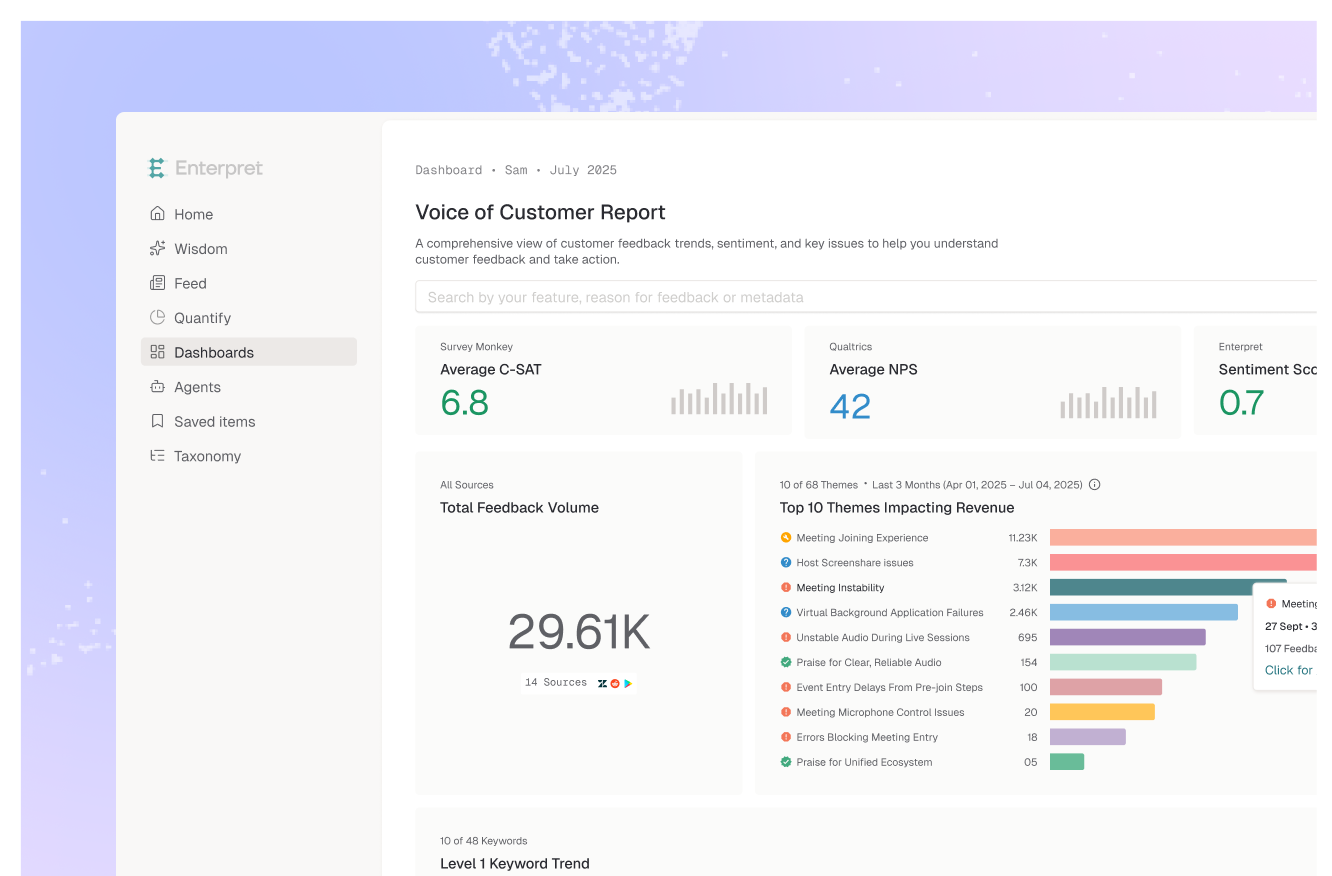
Enterpret's customer context graph unifies feedback from 50+ sources, classifies it with an adaptive taxonomy, links it to accounts and revenue, and serves it to agents through the Wisdom MCP server, so every agent reads the same themes and counts.
Customer context is the structured picture of what customers say, do and are, served to AI systems so they can answer who wants what, how many, and how much it matters.
A context graph is one way to implement the layer: it stores customers, feedback, themes, accounts and outcomes as connected entities that agents can traverse.
No. A CDP remains the system for identity and activation. The context layer draws on it and adds feedback, themes and relationships agents need to reason.
Usually through an MCP server or API, so tools like Claude, Cursor and internal agents can query the same structured context.
Lorem ipsum dolor sit amet, consectetur adipiscing elit. Suspendisse varius enim in eros elementum tristique. Duis cursus, mi quis viverra ornare, eros dolor interdum nulla, ut commodo diam libero vitae erat. Aenean faucibus nibh et justo cursus id rutrum lorem imperdiet. Nunc ut sem vitae risus tristique posuere.
Customer context is the structured picture of what customers say, do and are, served to AI systems so they can answer who wants what, how many, and how much it matters.
A context graph is one way to implement the layer: it stores customers, feedback, themes, accounts and outcomes as connected entities that agents can traverse.
Does a customer context layer replace a CDP?
Usually through an MCP server or API, so tools like Claude, Cursor and internal agents can query the same structured context.