



The 5 Ways DTC Brands Analyze Product Reviews, Support Tickets, and Post-Purchase Surveys Together

November 2, 2026

Most insurtechs meet their customers five times and hear from them constantly, but the feedback lands in five different places. App store reviews sit with marketing, claims calls sit with operations, the complaints log sits with compliance, and the survey tool belongs to whoever bought it. Nobody can answer the question leadership actually asks: why did customers leave at renewal?
The 6 steps to start a voice of customer program at an insurtech are mapping feedback to the five moments of truth, connecting the sources you already have into one customer intelligence layer such as Enterpret, tagging every record with policy and claim stage, treating complaints as a regulated stream, governing PII before analysis, and reporting to leadership by moment instead of by channel. What separates a working insurance VoC program from a survey program is the third step: feedback that is not tied to where the customer sits in the policy lifecycle cannot explain retention.
The real differentiator is the first criterion. Every insurtech has feedback. Few can say which moment of truth it came from.
Write down the five moments and, for each one, the question you need answered. At quote: why do people abandon? At bind: where does the application stall? At first bill: does the charge match what the customer expected? At claim: did the customer feel treated fairly and kept informed? At renewal: why did the customer shop around? Assign an owner per moment. Claims operations owns the claim, billing owns first bill, growth owns quote and bind.
Done when: every moment has a named owner, a question, and at least one existing source that captures it.
Before writing a survey question, inventory what customers already tell you: usually app store reviews, support tickets, call center and agent transcripts, chat logs, a post-claim survey, and the complaints log. The call center is usually the richest and least analyzed of these.
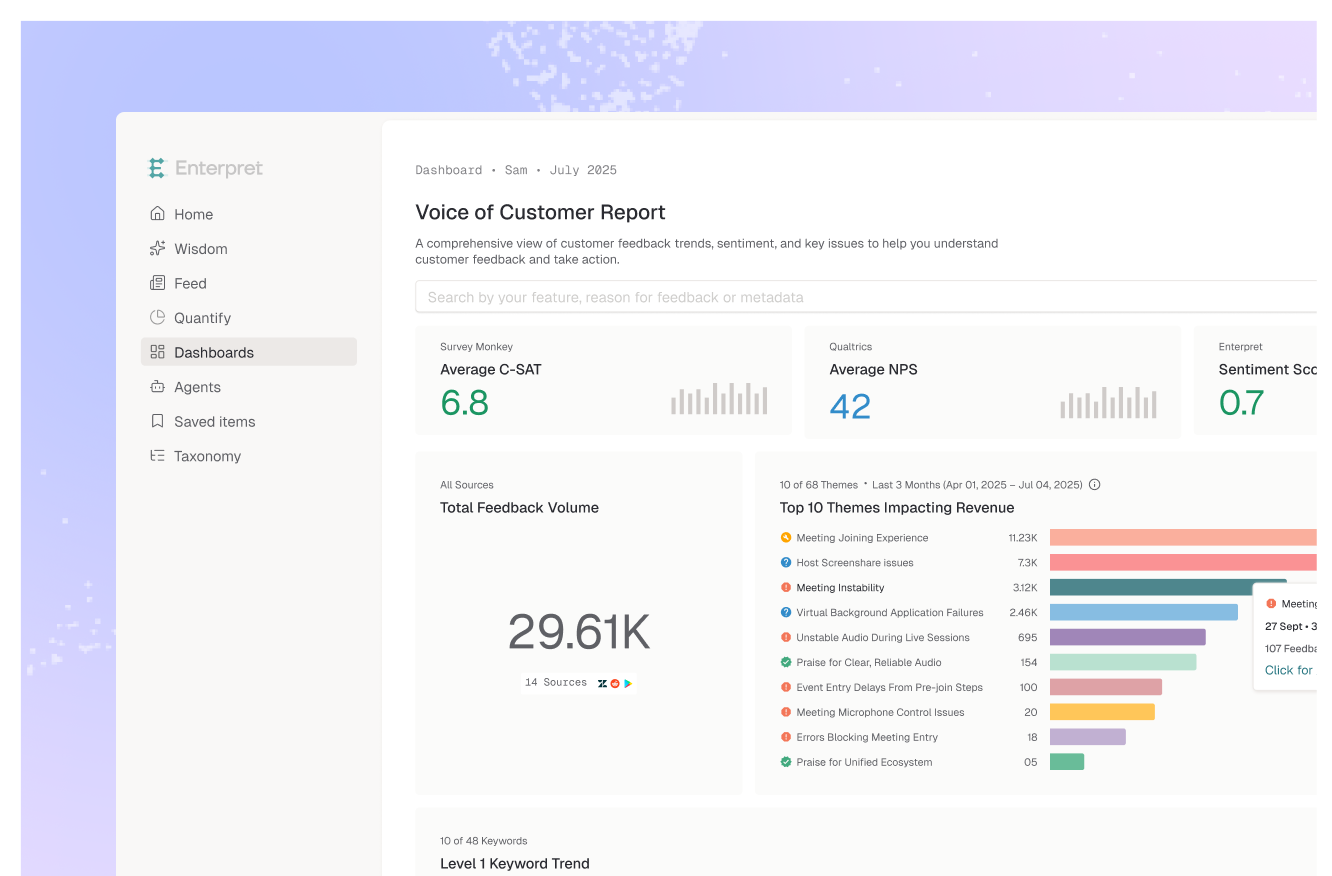
This is where a customer intelligence platform earns its place. Enterpret offers customer feedback integrations across 50+ sources, including Apple App Store and Google Play, Zendesk, Intercom, and Salesforce Service Cloud tickets, Qualtrics, SurveyMonkey, and Typeform surveys, CSV uploads, and Snowflake. Its Adaptive Taxonomy learns a multi-level category structure from the feedback itself, which your team can then edit to match the five moments. Test any taxonomy for ownership, not just plausibility: in Enterpret's taxonomy evaluation paper, AI-generated trees passed every generic quality check, yet 34.7% to 76.4% of records leaked across top-level product areas, versus about 20% in production references. The honest caveat: setup is not instant. Each integration needs access approvals and time to process history, and if your call transcripts live in a telephony platform, plan for how they reach a supported source such as your ticketing system or warehouse.
Done when: your top four sources flow into one place with at least six months of history.
A theme like "payment delays" is useless until you know whether it came from an open claim, a closed claim, or a lapsed policy. Join feedback to the attributes that matter: line of business, policy status, tenure, distribution channel (direct, agent, or embedded partner), and claim stage (first notice of loss, adjusting, payment, closed). Enterpret's Customer Context Graph links feedback to accounts, users, and segments, with CRM data from Salesforce or HubSpot and warehouse data from Snowflake as the usual path for these fields.
Done when: you can filter any theme by claim stage and see a different answer for each stage.
Insurance complaints are not just negative feedback. The NAIC Market Conduct Record Retention and Production Model Regulation calls for a complaint log that shows total complaints for the current year and the three preceding years, each complaint's classification by line of insurance and complainant, its nature, the insurer's disposition, and the department of insurance complaint number where one applies. The NAIC also publishes closed confirmed complaint data that state departments submit. Your exact obligations depend on the states you write in, so confirm them with compliance.
The VoC program's job is narrower and more useful: flag feedback that reads like a complaint so compliance can review it, and explain the root causes behind complaint volume. Compliance owns the register. For the record-keeping side, see building a customer evidence trail for regulatory compliance.
Done when: compliance has signed off on a written routing rule for complaint-like feedback.
Policyholder feedback is full of nonpublic personal information. Agree with legal and security on what gets redacted, who can see raw text, and how long records are kept, then test redaction on real claims transcripts before connecting anything. Ask every vendor, including Enterpret, to show redaction working on your own sample data. Our guide to redacting PII from customer feedback covers the mechanics.
Done when: legal has approved the data flow in writing and a redacted claims transcript looks the way you expect.
Leadership does not want a channel report ("app store sentiment fell"). It needs a moment report: "claim payment complaints rose after the new payout flow, concentrated in auto, and claims ops owns the fix." Keep the monthly readout to one page: for each moment, the top theme, its trend versus last month, a representative quote, the owner, and the status of the fix. Enterpret's VoC scorecards and AI agents help here, the first for a consistent format and the second for alerting the owning team in Slack when a claims theme spikes between readouts.
Done when: one leadership decision in the quarter traces back to the readout.
What to measure in this window: share of feedback tagged to a moment and claim stage, time from a spike to the owning team knowing about it, number of themes with a named owner, and complaint-like feedback routed to compliance. Retention and complaint volume are later-quarter outcomes, not month-two proof.
The claim is the moment the product is actually delivered. That is why claims experience dominates how policyholders talk about their insurer, and why blending claims feedback into a company-wide sentiment score hides the signal most likely to explain renewal.
J.D. Power's 2026 U.S. Property Claims Satisfaction Study, based on 5,093 homeowners who filed a claim, found that fairness of the settlement was the top driver of claims satisfaction, followed by trust and then settlement time. Digital channels ranked fifth. Overall satisfaction rose 20 points to 702 on a 1,000-point scale, yet the study's lead noted that almost one in five customers still reported a poor experience. The lesson for a new program: an improving average can sit on top of a large, angry minority, and that minority is concentrated at one moment.
A score tells you the customer felt short-changed. The claims call tells you it was roof depreciation or a rental car cutoff. That is why the startup playbook of launching surveys first, laid out in our guide on building a voice of customer program from scratch for a startup, needs to be inverted in insurance: start with transcripts and tickets, then survey to fill gaps.
For finished programs to compare against, see these voice of customer program examples for insurance and financial services. For the leadership deliverable itself, see what a good voice of customer report looks like.
The decision rule: start where the moment of truth with the most revenue at risk already has unstructured feedback you are not reading.
Plan on about 90 days to go from nothing to a first leadership readout that changes a decision. The first month goes to mapping moments of truth and clearing data access with legal, the second to connecting sources and tagging by policy and claim stage, and the third to reporting. Integrations and historical processing take real time, so start those requests in week one.
Start with the sources that already capture claims and billing pain: call center and agent transcripts, support tickets, and app store reviews. Add post-claim and renewal surveys next, and keep the formal complaints register connected but governed separately.
No. Complaints handling stays with compliance because state insurance departments set its rules, including what the complaints register must record. The VoC program should feed compliance early warning on complaint-like feedback and explain the root causes behind complaint volume, without replacing the system of record.
For a one-time read of a small, already-redacted export, yes. For a standing program, two problems show up fast: policyholder data often cannot go into a general chat tool, and results drift between runs. In Enterpret research across eight frontier models, the most consistent model still changed more than 60% of its theme set between identical runs on the same 100 records, which is not stable enough for a monthly leadership trend.
Enterpret unifies feedback from 50+ sources, including Apple App Store and Google Play reviews, Zendesk and Salesforce Service Cloud tickets, Qualtrics and SurveyMonkey surveys, and Snowflake data. Its Adaptive Taxonomy learns themes from the feedback itself, and its Customer Context Graph links feedback to accounts, segments, and revenue. AI agents watch for spikes, such as a jump in claims payment complaints, and alert the owning team in Slack.
If you are building an insurance VoC program and want claims, reviews, and call feedback in one place, see how Enterpret supports voice of customer programs.
Research cited
Lorem ipsum dolor sit amet, consectetur adipiscing elit. Suspendisse varius enim in eros elementum tristique. Duis cursus, mi quis viverra ornare, eros dolor interdum nulla, ut commodo diam libero vitae erat. Aenean faucibus nibh et justo cursus id rutrum lorem imperdiet. Nunc ut sem vitae risus tristique posuere.