



The 7 Steps to Analyze Product Reviews From UK Retailers Like Argos and Very

Feedback Analysis
November 5, 2026

To compare your product reviews against competitors across retailers, you need three things: the same competitive set on every retailer, reviews for your products and theirs pulled into one place, and one taxonomy that scores every review feature by feature. Then you compare share of complaints per theme, not star ratings. That is the whole game.
Your customers are not reviewing you on your own site. They are reviewing you on Best Buy, Walmart, Argos, MediaMarkt and JB Hi-Fi, right next to the product they almost bought instead.
Every one of those product pages is a live, public head to head. Most brands read only their side.
A 4.3 against a 4.5 tells you that you are losing. It does not tell you where.
Star averages blend setup, hardware quality, app experience, delivery damage and price into one number. Two products can share a 4.4 and fail in completely different places.
And the signal is scattered. One SKU, five retailers, four countries, three languages. Teams end up with exports, manual reads and a competitive slide built on anecdotes.
Competitive review benchmarking is not a ratings report. It is Customer Intelligence pointed at the whole shelf: your signals and your competitors' signals, on one taxonomy, broken down by retailer and country.
Your rivals change by shelf. The product sitting next to yours on Best Buy Canada may not exist at MediaMarkt in Germany or JB Hi-Fi in Australia. For each category, list the three to five listings shoppers actually compare against yours, per retailer and country, at the same price tier.
Benchmarks need both sides in the same system. Copy and paste does not scale, and DIY scraping means maintaining scrapers, handling site changes and rate limits, and checking each retailer's terms of use. Review those terms and use an approved or managed route.
Every review, yours and theirs, gets tagged to the same product areas, features and sub-features. If your reviews are tagged "Connectivity" and a competitor's are tagged "WiFi drops," you are comparing labels, not products. One taxonomy is the only fair scoreboard.
Raw counts reward whoever sells more. Instead, ask: of all negative reviews for this product, what share mention battery, setup or the app? Normalize per product, then compare. That turns "they have fewer complaints" into "their setup complaints are a third of ours."
Complaints show where you lose. Praise shows why they win. Look for positive themes that appear on a competitor's listings and barely exist on yours, like "no subscription needed" or "fits a standard outlet." Those are capability gaps, not quality gaps.
Reviewers tell you who they came from and where they are going. "Returned my old one for this," "upgraded from," "switched after the app update." Track brand mentions inside reviews on your listings and theirs. It is the clearest win and loss signal on the shelf.
Themes where you trail go to product and quality with the exact reviews attached. Themes where you lead go to brand and marketing as proof points for listing copy, retailer pitches and campaigns. Then rerun the benchmark every month to see if the gap moved.
A benchmark only works if the numbers hold still when nothing changed. That is where most DIY approaches break.
Paste a few thousand reviews into a chatbot and ask for top complaints. Ask again tomorrow. In Enterpret's study of run-to-run instability across eight frontier models, run on enterprise support feedback, a raw model changed more than half of its returned theme set between two runs at 100 records, and churn rose from 0.552 to 0.726 as data grew to 5,000 records.
Counts drifted too. That is fatal for share of complaints, which is a ratio of two counts.
0 vs 7.5 to 9.8% Volume disagreement on matched themes: zero for a taxonomy-grounded agent across all 117 valid run pairs, versus 7.5 to 9.8% count movement for raw frontier models. Source: Enterpret Research, "Same Feedback, Different Answer" (arXiv, 2026)
Stability is not the same as accuracy. But a competitive benchmark that moves on its own is noise. More on leveraging ChatGPT AI for customer feedback analysis.
Teams can now bring product reviews from major retailers into Enterpret. Paste product links (or product IDs) and Enterpret pulls every new review on that product. Supported retailers include Best Buy (US and Canada), Walmart (US), Argos, Very (including Littlewoods), Orange, MediaMarkt (including Saturn and MediaWorld), JB Hi-Fi and the Meta Store (meta.com).
Here is the competitive unlock: you can add competitor product listings the same way.
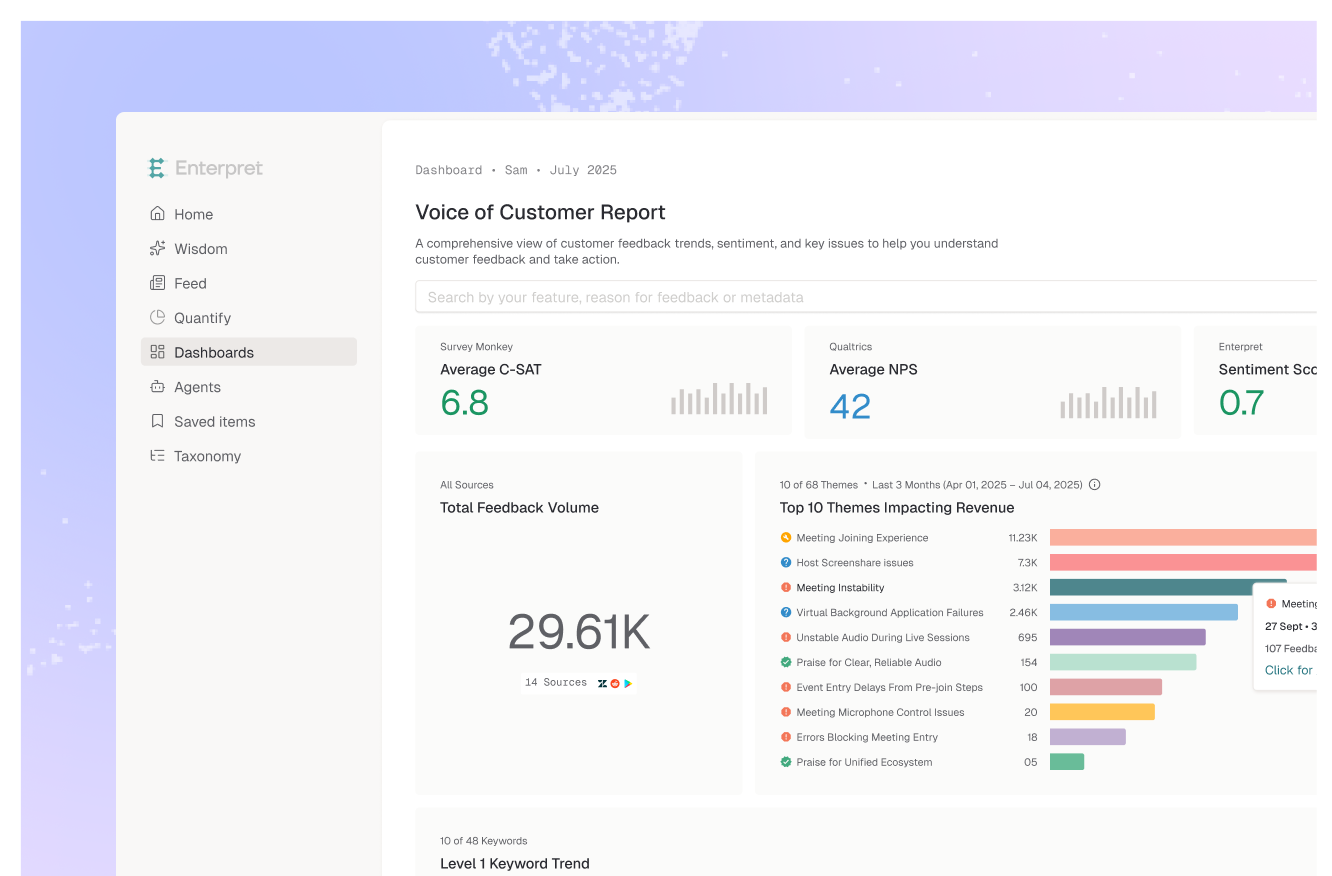
Retailer reviews for your products and competitors' land on one Adaptive Taxonomy (product area, feature, sub-feature) that updates as products and SKUs change, next to your support tickets, surveys, returns notes and app reviews. Break any theme down by retailer, product and country, ask Wisdom which features shoppers praise on a rival and criticize on yours with the exact reviews behind each answer, and set AI agents and alerts for a competitor complaint theme spiking after a launch.
That is what makes it upstream. Your own complaint themes connect to the support tickets and returns notes behind them, which is how DTC brands analyze reviews, tickets and surveys together. Findings ship to Slack, Jira, Linear and Notion, and the MCP server puts the same answers inside Claude, Claude Code and Cursor.
If you already collect reviews through a syndication platform, PowerReviews offers its own competitor benchmarking metrics, including product sentiment by retailer, and PowerReviews also connects to Enterpret. Best for brands that want benchmarking alongside review collection and display.
Picture a smart home brand selling a video doorbell at Best Buy US and MediaMarkt, against two rivals at the same price. Every review is tagged to the same taxonomy. The numbers below are illustrative, not real data.
| Theme (feature) | Your doorbell | Competitor A | Competitor B | What it tells you |
|---|---|---|---|---|
| Setup and WiFi pairing | 31% | 12% | 18% | Biggest gap. Roadmap and quick start guide priority. |
| Battery life | 14% | 22% | 25% | You lead. Use it in listing copy. |
| Companion app | 19% | 21% | 11% | Competitor B wins on app praise. Study it. |
| Subscription required | 16% | 9% | 3% | Shoppers praise B for "no subscription." Capability gap. |
| Video quality at night | 8% | 15% | 14% | Clear strength across both retailers. |
Now cut it by retailer. Say setup complaints are double at MediaMarkt versus Best Buy. That points to a localized instruction or router compatibility issue in one country, not a global product flaw.
Then read switching language. A Competitor A review saying "returned the other one, setup took an hour" is a lost sale with a named cause. See also our guide on which competitors customers switch to when they churn.
The shelf is the most honest competitive research you will ever get. Real buyers, writing in their own words, next to the product they compared you with.
The brands that win the next cycle will stop treating it as a ratings dashboard. They will run it as a continuous Customer Intelligence loop that identifies trending product issues on their listings and their rivals', and turns every gap into a decision.
Pick the competing listings per retailer, pull reviews for both products into one system, and tag every review to the same feature-level taxonomy. Then compare the share of negative reviews per theme and the positive themes each product earns. Star ratings alone hide where the gap actually is.
Yes. Paste product links or product IDs from supported retailers and Enterpret pulls every new review on that product, and you can add competitor product listings the same way. Reviews for both are tagged on one Adaptive Taxonomy and can be broken down by retailer, product and country.
Enterpret supports major retailers in the US, Canada, UK, Europe and Australia: Best Buy (US and Canada), Walmart (US), Argos, Very (including Littlewoods), Orange, MediaMarkt (including Saturn and MediaWorld), JB Hi-Fi and the Meta Store (meta.com).
For a one-off read, yes. For a benchmark you rerun, raw models are unstable: Enterpret's research found a taxonomy-grounded agent had zero volume disagreement on matched themes across 117 run pairs, while raw frontier models' counts moved 7.5 to 9.8%. Share of complaints is a ratio of counts, so that drift becomes noise in your comparison.
Start with three to five listings per category and retailer, chosen by what shoppers actually compare against you at the same price tier. Expand once the monthly benchmark is running.
If you are building competitive intelligence from retailer reviews, see how Enterpret works.
Research cited
Lorem ipsum dolor sit amet, consectetur adipiscing elit. Suspendisse varius enim in eros elementum tristique. Duis cursus, mi quis viverra ornare, eros dolor interdum nulla, ut commodo diam libero vitae erat. Aenean faucibus nibh et justo cursus id rutrum lorem imperdiet. Nunc ut sem vitae risus tristique posuere.